Navigation
- Concept
- Introduction (What Death Looks Like)
- Death as a Body
- Death as a Character
- Death as an Object
- Holbein’s Vision
- Conclusion
concept
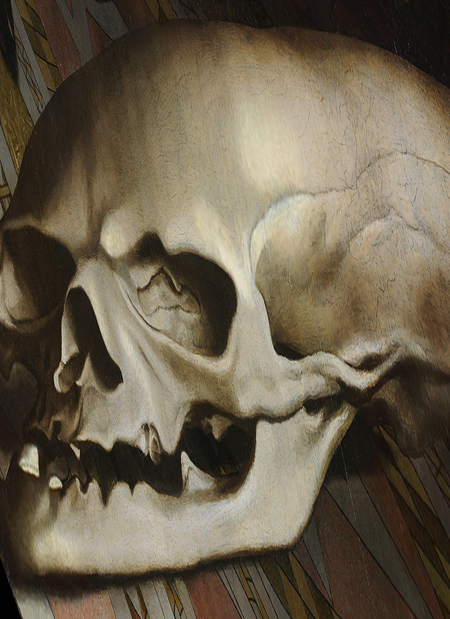
I was captivated by one painting: Holbein’s «The Ambassadors.» When you look at it straight on, it’s just a standard state portrait, but there’s a strange gray patch on the floor, which turns out to be a skull. I became interested in how the artist managed to conceal death right within the image, requiring the viewer to actively search for it. This question led me to a broader topic: how people in the 15th and 16th centuries depicted what could not be seen.
Death has no inherent appearance, so artists had to invent one. In the Northern Renaissance (15th to early 16th century), I see three primary ways: death as a body, death as a character, and death as an object. I want to demonstrate how each approach utilizes poses, gestures, bodily details, and symbolic objects, and how they differ in meaning—ranging from compassion and terror to a quiet memento mori.
hypothesis
My hypothesis is that these three methods don’t just succeed one another; rather, they overlap until they converge in Holbein’s «Ambassadors.» But Holbein takes a further step: he presents death not as an image within the painting, but as a distortion of the gaze itself. To see the skull, the viewer must change their body position, and thus the abstract idea of mortality transforms into a personal experience.
questions
The research addresses several questions. How did artists depict what could not be drawn directly? How do the death-body (Van der Weyden, Grünewald, Holbein), the death-personage (Dance of Death, Baldung, Dürer), and the death-object (skull, hourglass, coat of arms) differ? What role do gestures, poses, bodily details, and symbolic objects play? And why do the «Emissaries» represent a special case?
Structure
I limited the study to the 15th and first half of the 16th century to fit within the scope of the course, selecting works that depict death in various ways: paintings, engravings, and book illustrations. In each chapter, I analyze three to four works that can be compared to one another, and I pair specific examples (such as two works by Baldung) where similarity helps illuminate difference. All images are sourced from museum and open collections, with proper citation and date of access provided. The first chapter establishes the general context—the culture of dying following plague epidemics. Chapters 2–4 examine three themes—the body, the character, and the object—analyzing works individually within each. Chapter Five is entirely dedicated to the «Emissaries» and examines the painting in detail: the skull, the faces, the crucifixion, the objects, and the color. In the conclusion, I synthesize the findings and address the central question.
Introduction (What Death Looks Like)
Death is difficult to depict: it has no face, and no one has ever seen it from the inside. Therefore, in the 15th century, artists had to invent forms for it. The era itself helped shape these ideas: after the plague epidemics in the mid-14th century, the theme of death permeated all of culture, as Hoijeringa noted. Fear was formalized in sermons, books, and frescoes, and these formulas were later adopted by masters of the Northern Renaissance.
I will examine three approaches: death as a body, death as a character, and death as an object. Finally, I will analyze Holbein’s «Ambassadors,» where all three approaches converge in a single painting. We will begin by looking at how artists learned to portray death at all, using three examples that set the tone for the rest of the discussion.
«The Temptation of Pride» (from the treatise The Art of Dying / Ars moriendi), Netherlands (or Germany), unknown master (after E.S.'s prints), circa 1460–1465.
This is a small book of engravings that taught how to die properly. The dying person lies in bed, surrounded by demons tempting them with unbelief, despair, pride, and greed, while angels and saints protect them. Death here is not a frightening skeleton, but an event in a room where gestures and objects matter. The main thing that happens is the choice the person manages to make in the final moment.
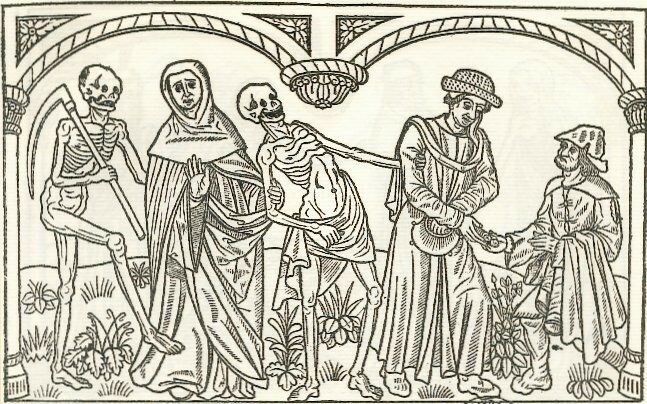
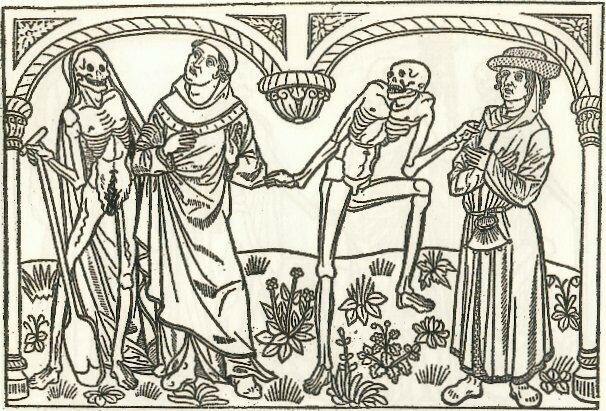
«Dance of Death: Scholar (Astrologer) and Bourgeois» (from the edition Danse Macabre), Paris, France, unknown master (publisher Guy Marchant), 1485–1486.
Death as a body
Death as a Character
Death as a Subject
Holbein’s Vision
Conclusion