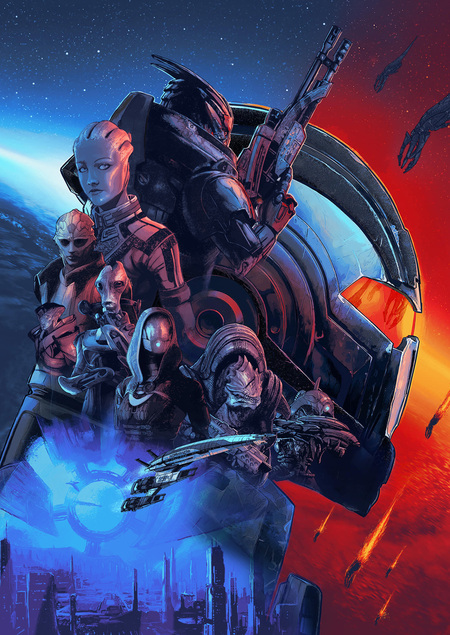
Research Concept
The visual study is dedicated to analyzing the representation of alien species in the Mass Effect trilogy (2007–2012) and how visual language encodes real historical traumas, imperial hierarchies, and colonial relationships. The selection of this topic stems from the fact that science fiction is traditionally perceived as a genre about the future; however, its visual apparatus almost always engages with material from the past and present. By creating the «non-human, ” the author inevitably relies on pre-existing cultural codes—bodily, racial, and colonial. Mass Effect is a relevant subject because it offers the player not a collection of disparate „aliens, ” but a visually organized galactic hierarchy, where a race’s place in the power structure is readable from its appearance before it has even spoken.
The research focus centers on how appearance transforms into a statement about a being’s place in the world. The visual image is examined not as an illustration, but as an autonomous mechanism that guides the player’s perception and renders certain power dynamics as «natural» and invisible.
Research Question: How does the visual language of alien races in Mass Effect transform social relationships into «inherent» physical traits, and what mechanisms render this operation invisible to the player?
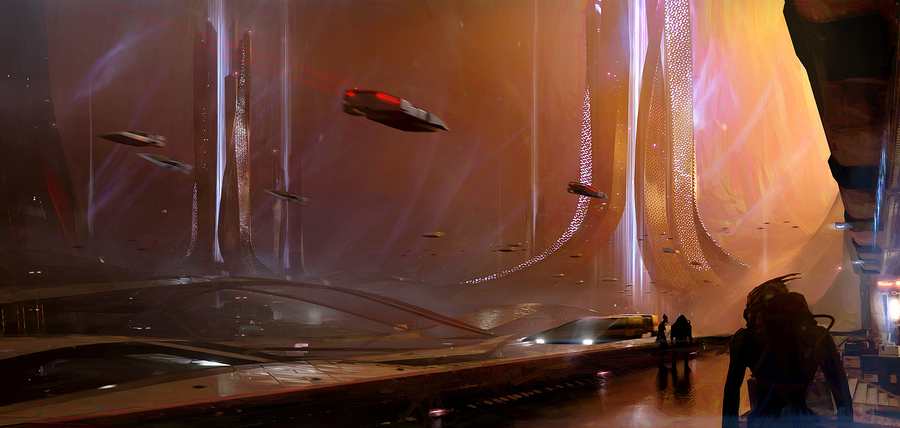
Mass Effect 5 (Unreleased) concept art, 2022
The material selection principle is based on identifying visual elements that function simultaneously as an aesthetic solution and as a carrier of social meaning.The research was conducted using the most iconic visuals from the Mass Effect universe; some references were omitted due to the scope limitations of this work.The primary sources were the series art books—The Art of the Mass Effect Universe (2012) and The Art of the Mass Effect Trilogy: Expanded Edition (2021)—which contain concept art and artist commentary, along with materials from the first game’s bonus disc, featuring the «Creatures of Mass Effect» gallery and transcriptions of comments from art director Matt Rodds. Supplementary materials included interviews with developers and reference resources.
Mass Effect 2 concept art (Illium), 2008
The research is broken down into three semantic blocks: the visual language of the «center» (the race of the Council), the visual language of the «periphery» (the oppressed and exiled races), and the visual strategies of «monstrification.»
I. The «Center’s» Visual Language: Council Races
Mass Effect 3 (Citadel), 2012
Races holding power in the Citadel Council are visually constructed as «readable”—their bodies and faces are organized so that the player can quickly recognize a subject capable of dialogue, emotion, and rational action. Beings with power and influence appear as the „norm“ and seem the most familiar outwardly.
Tourians
Mass Effect 3, Palaven Moon, 2012
Tourians are humanoids with avian features, whose skin is covered by an exoskeleton—an evolutionary response to the radiation of Palaven, their home planet. Their culture was molded after ancient Roman civilization, blending elements of egalitarianism and extreme militarism with a sense of superiority. Tourian facial tattoos denote affiliation with their native colony and clan—a tribute to the era of intraspecies civil wars. [4]
Facial Marker Comparison of Several Turians from Mass Effect 3, 2012
The civil war for unification began with disagreements between the colonies far from Palaven. The colonies were governed by local chieftains, many of whom had seceded from the Hierarchy. Without government influence, isolationism and xenophobia flourished in the colonies, and the colonists began marking their clothing and faces to distinguish themselves from residents of other colonies. After several years of conflict, the Hierarchy reestablished control, but the animosity among the colonists persisted for decades. This is why facial tattoos are a living trace of the civil war—a visual marker of identity and potential conflict. [8]This is similar to the unification of Italy (Risorgimento) in the 19th century or the consolidation of the German lands under Prussian rule. Disparate territories with different dialects and customs are brought into a single state through force or diplomacy. The Tuarian tattoos are a direct analogue to regional patches or dialectal variations, which in the real world could serve as markers of «us versus them» and a cause for conflict. Saren Arterius’s lack of tattoos signals that the hero exists outside the system. In Tuarian culture, the «faceless» are those who cannot be trusted.
Concept art of the Turians from the official art book, 2021
The First Contact War (2157). Humanity attempted to activate an unstudied relay station, which was forbidden by the Citadel laws. A Turian patrol attacked the human fleet without attempting negotiations, blockading the Hanshi colony. A month later, humanity launched a counterattack. The conflict threatened to escalate into a full-scale war, but the Council intervened as a mediator. For the Turians, it was the «Relay 314 Incident”—a police action. For humanity, it was the first trauma of encountering outsiders. [8]
Concept art of the Tuarian from the official art book, 2021
The British Empire and the «diplomacy of cannons.» In the 19th century, Britain considered itself the guarantor of «law and order» in the world’s oceans. If a country, in London’s view, violated «civilized» rules, the British fleet could simply approach its shores and open fire without engaging in lengthy negotiations. The Turians operate in the exact same manner: to them, people are «lawbreakers» with whom one does not need to be polite. Another example is the Falklands War (1982). Argentina landed on islands that Britain considered its own, and London responded with military force.
Early concept art of the Thurians from the official art book, 2021
The visual language of the Turians is the language of an empire that does not consider itself one. The exoskeleton is armor that is always with them, turning them into weapons. Their ships, designed with layered plating, visually echo the «feathered» silhouette of the Turians themselves. The Turians are the «galactic police, ” and their appearance speaks of „order, ” „discipline, ” and „law.“ But this law was established by them. They, along with the Salarians, were the ones who deployed the Genophage against the Krogan, which is an act of biopolitical imperialism. [2]
Early concept art of the Thurians from the official art book, 2021
Salarians
Salarians are slender amphibians with enormous oval eyes, a high metabolism, and a short lifespan (rarely living past forty years). Their society specializes in intelligence gathering and covert operations. The primary Salarian special service, the Special Tasks Group (STG), consists of highly skilled agents who operate in small, independent teams for counter-terrorism, intelligence, infiltration, and elimination missions. [6]
Concept art of Mordina Solus from the official art book, 2021
Visually, the Salarians embody «the speed of thought.» Their bodies are thin, almost ethereal, with enormous eyes and quick movements. They do not appear threatening, yet it is their sharp intellect that created the Genophage, which sterilized an entire people. Their image is that of the «mind» of imperialism: an intelligence that does not get its hands dirty, but instead engineers the tools of destruction.
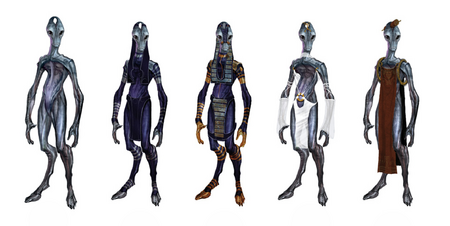
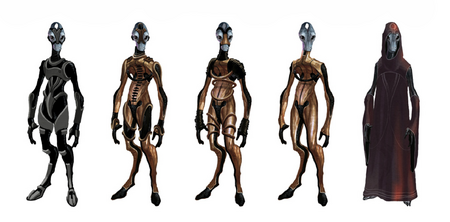
Salarian concept art from the official art book, 2021
Art Director Matt Roads stated that while developing the appearance of the Salarians, he felt they possessed «an almost Japanese or, say, Asian approach to war, ” where there is „beauty“ in the conflict, contemplation, and time for quiet. [2]
This is not a casual remark: it explains why the Salarians are visually and culturally read as «Asian» on a galactic scale. Their slender, almost ascetic bodies, their restrained, precise movements, their cult of efficiency and long-term planning—all of this builds into a stereotypical image that the Western player is accustomed to associating with «Eastern» rationality: intelligent, disciplined, yet potentially dangerous.The same mechanism at work here applies to other races: the visual code replaces the actual nation. The Salarians are not Azati—but their appearance and mannerisms are constructed from details that Western culture has historically ascribed to the «East»: restraint, discipline, collectivism, secrecy, and a readiness for self-sacrifice for a strategic objective. Visually, this manifests in their appearance: large eyes with minimal expression, thin lips, and the absence of superfluous details in their costume and armor. They look like a «race that is always thinking several steps ahead.»