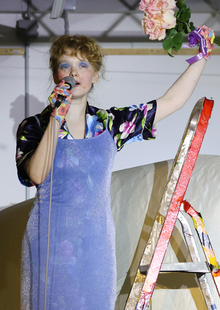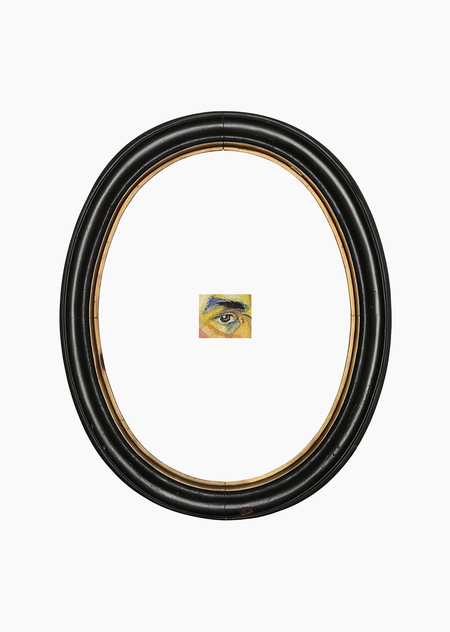

This essay analyzes the interplay between an artwork and curatorial logic. Using the exhibition «Still Life. Portrait. Landscape. Beyond Genre» at GES-2 as an example, I demonstrate how the exhibition context connects the themes of consumption and self-representation, thereby influencing the interpretation of individual pieces. In my view, Andrei Monastyrsky’s key work, «Finger, ” establishes the thematic focal point of the exhibition—the duality of display as a means of asserting one’s existence and as a mechanism of alienation, wherein the individual becomes an object of another’s gaze.
Encountering the excessive ornamentation of Dutch still lifes and Dmitry Tsvetkov’s installation, «Feast,» the exhibition curators immerse us in a context of ostentation and consumption that runs throughout the display. Initially, this context is revealed literally—through food and objects—and then expands to encompass the entire space. The still life and its elements are linked to advertising, politics, and conspicuous possession. The object becomes an embodiment of social and personal facets of life. The landscape section develops this idea by addressing themes of technological advancement, the utilization of natural resources, digitalization, and virtualization—the transformation of space and the creation of its digital simulacra. Through interaction with the external environment (with objects and space), a broad context of humanity’s relationship with the world is revealed.
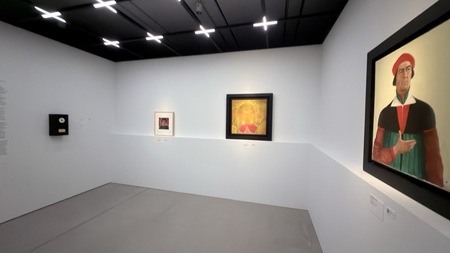
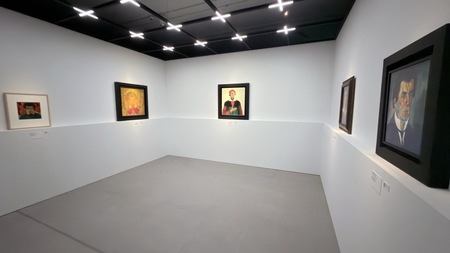
It is logical that in the exhibition’s finale, this research turns to the human being—specifically, to the portrait, or rather, the self-portrait. This genre allows for the contemplation of self-representation and self-assertion. Five of Malevich’s self-portraits demonstrate a transformation of artistic language, reflect his mastery and diverse artistic personae, and manifest a creative spirit.
The setting for the self-portrait area resembles a tight, ascetic altar adorned with icons. The glowing crosses above the heads evoke a starry sky mixed with digital graphics. A sense of duality arises: the icon, in this context, is perceived as a digital avatar. The sacred coexists with the demonstrative.

Kazimir Malevich. Self-Portraits, 1907–1933.
In this sense, the breakthrough of the author’s (and viewer’s) solitude with the self is interesting. Monastyrsky’s «Finger» echoes the idea of self-contemplation, but it divides the person into the object and the subject of observation. What is interesting is that the work took on a prophetic meaning with the advent of social media, as the idea of display shifted from external objects (as in «The Feast» or among the Dutch) to the individual itself. Consumption culminates in the observer. The person constructs their own image, presents it to others, and becomes an object of observation and evaluation. Observation, consumption, and narcissistic narratives converge at a single semantic point.
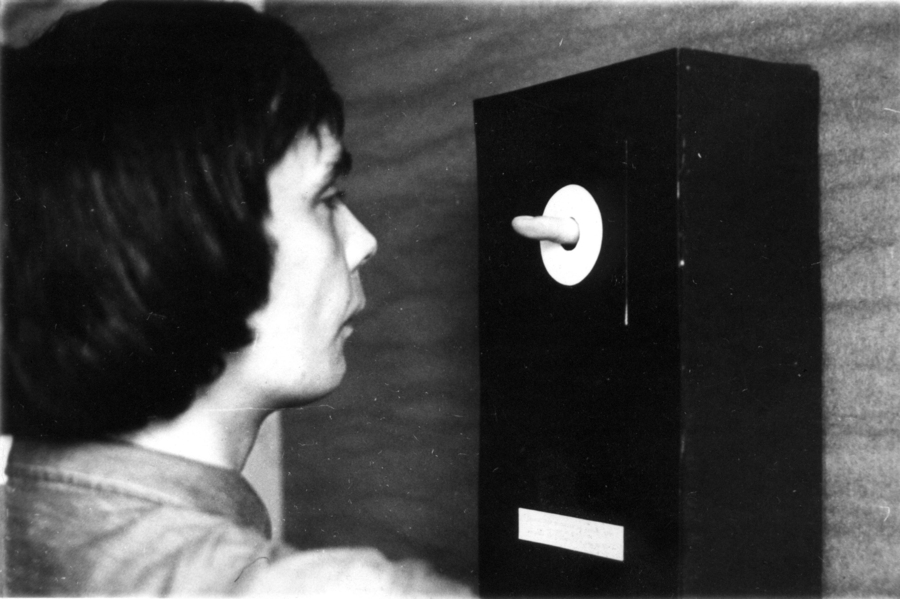
Andrey Monastyrsky with the piece «Finger, ” 1977. Photo: Andrey Abramov.
It is interesting how the quantity and ratio of the works allow for this interpretation (this refers to a personal impression). Malevich’s self-portraits are directed inward, focused on the self, but one «twist» interrupts this path. This inward isolation and the drive for self-assertion turn into self-alienation.
On the other hand, (self)observation can be perceived as the condition for existence (the work «Life Measurer, ” presented at the exhibition, is literally dedicated to this idea): to be seen, one must present oneself, and to confirm one’s own existence—one must take the position of an observer.
In this sense, the title «After the Genre» is perceived as a reinterpretation of the genre’s function as a tool. It is as if all the genres presented in the exhibition become a portrait of a person in the broadest sense, revealing them through objects, space, ways of interacting with the world, and the desire to construct one’s own identity. «The Finger» becomes the climax: just when one might think self-observation has reached its limit and full subjectivity has been attained, the viewer or the author is jolted.