While genre classification in art has receded in importance and is not a fundamental element for assessing and characterizing contemporary works, genre remains relevant as a lens through which to view and organize the ever-increasing flow of visual imagery. The exhibition «Still Life. Landscape. Portrait. Beyond Genre» demonstrates the productivity of this approach.
The history of landscape reflects changes in the relationship between humanity and the surrounding world. Nature served as a backdrop for events, an object of study, and a metaphor for the human soul. Seeking to narrow the gap between reality and its representation, artists honed techniques and explored human perception. It seemed that technological advancements would help depict reality more adequately, but ultimately, the very concept of reality underwent a reevaluation. The aesthetic shift of the Modern era demonstrated that art is not bound to reality: painting gained freedom from the necessity of fixing reality, which manifested in a plethora of formal experiments. Today, some contemporary artists continue this trajectory, but within a different context that imbues their work with added layers of meaning.
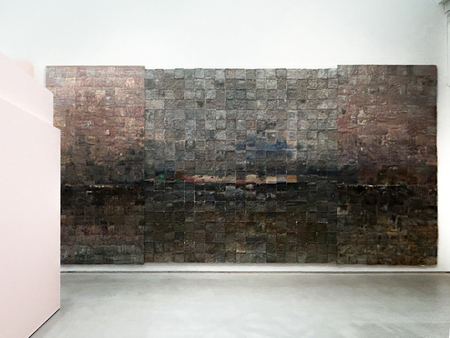
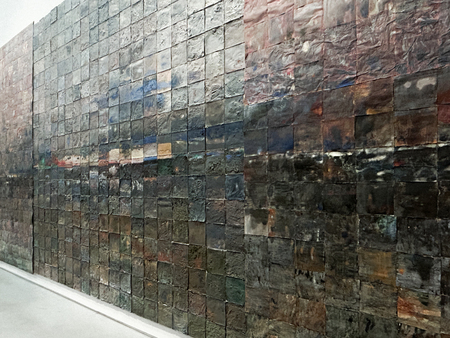
«432 Etudes on Levetan in Repetitive Technique» by Sergey Karaev, in my view, belongs to the category of works that continue Modernist formal experiments. This piece is highly material and methodical, and it claims formal novelty: the artist hand-casts plaster squares and covers them with acrylic layers, allowing the texture of the plaster to remain an active element influencing the perception of the image. The juxtaposition of Karaev’s work with Paul Signac’s «Harbor in Marseille» (1906), executed using the Divisionism method, partly supports this perception. At close inspection, the works of both artists appear as abstractions, but they transform into cohesive images as the viewer steps back. However, while Signac consistently fragments images into points, appealing to scientific theories of how the human eye perceives reality, Karaev addresses the experience of modern life by referencing pixelated imagery.
The emergence of digital art, and subsequently artificial intelligence, has radically intensified skepticism toward visual imagery. Now, creating realistic images is so readily accessible that we cannot trust what is depicted. Thus, in our time, the evolution of the landscape is linked to the disappearance of the opposition between the real world and its representation: the artist often engages not directly with nature, but with its representations of varying degrees of authenticity. Perhaps Karaev’s choice of the traditional painted landscape as a primal image is a reaction precisely to this process: on one hand, the artist does not claim to reflect reality directly, yet at the same time, he appeals to the authentic experience of contemplating nature, which artists of the past were capable of.
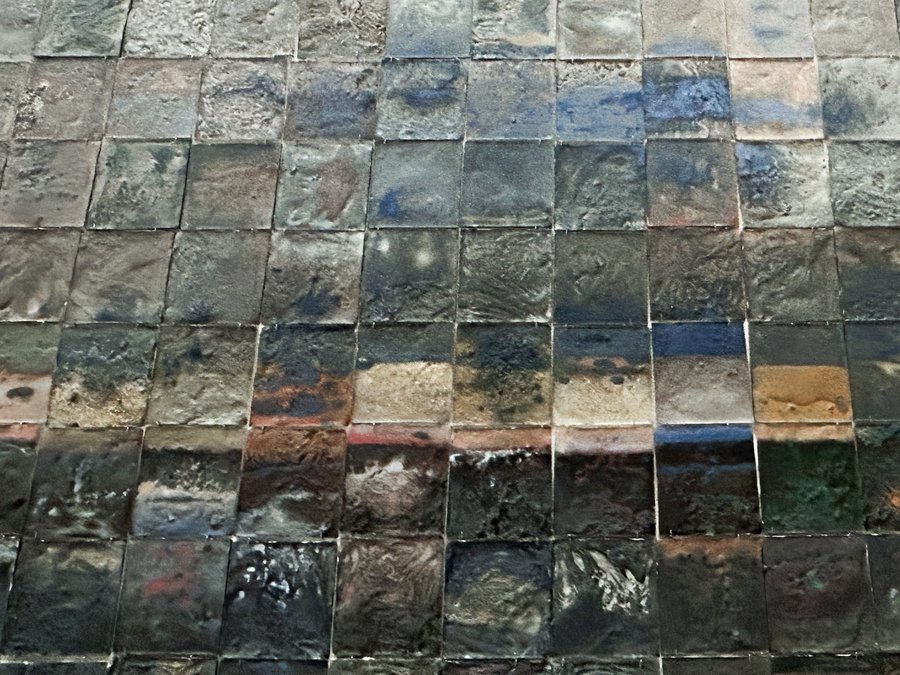
The connection of the studies to reality becomes even more complex within the context of their materiality. By choosing a highly tangible and intricate technological process, the artist places themselves within the framework of a certain craft tradition that demands a high level of engagement. The resulting work carries the traces of this process: texture, monumentality, and nuance. All of this makes the piece more convincing from a craftsmanship-artistic standpoint, allowing its painterly qualities to be comparable to the original works of Levitan.
In my view, the craftsmanship of this work is an integral part of the artistic statement, allowing us to examine a trend in contemporary art that is counter to digitalization—a return to «active» mediums as a way to preserve tangible material relationships with reality. Consequently, the more the material manifests in the work, the more the landscape becomes «real» on one hand, yet simultaneously less «realistic» on the other.