Navigation
ConceptChapter 1 Character DesignChapter 2 Space as an Amplifier of AnxietyChapter 3 Visual DeceptionChapter 4 The Unknown Beyond the FrameConclusionIndex
Concept
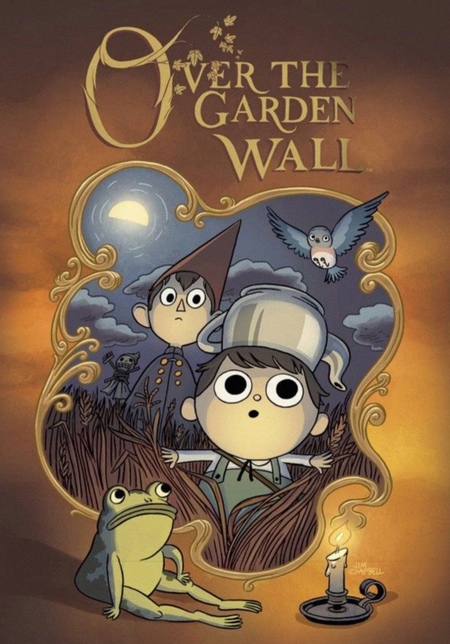
Some fairy tale worlds evoke a simultaneous urge to remain immersed in them and a discomfort that drives the immediate need to escape. Often, comfort and anxiety are perceived as opposite states. Comfort is safety, warmth, and a familiar setting, whereas anxiety arises when a person confronts the unknown and loses their sense of control, feeling only unease. However, in visual art, these states do not necessarily exclude one another. On the contrary, their combination can create particularly powerful and vibrant imagery. Sometimes the most uncomfortable space is not an old house or a graveyard, but simply an autumnal forest that seems too beautiful and tranquil to be trusted completely. This contradiction is at the heart of the artistic world of «Over the Garden Wall.» Patrick McHale first depicted this world in the eponymous animated mini-series. The cartoon aired on Cartoon Network in 2014. It follows two brothers, Wirt and Greg, who become lost in a very strange place called The Unknown and try to find their way home. The Unknown resembles the setting of old American fairy tales and folklore: it features talking animals, skeletal settlements, antiquated homes from various eras, winding forest paths, and strange creatures. Yet, almost every one of these elements contains a certain ambiguity. A welcoming place might turn out to be dangerous; a terrifying character might be positive; and a simple walk through the woods might become a journey with no visible end. The mini-series only has 10 short episodes, and it concludes quite quickly. This is why, in 2015, BOOM! Studios, under the KaBOOM! imprint, released a four-part comic book series that expanded upon the events of the cartoon. Beginning in 2016, ongoing series started to come out, further expanding the world of The Unknown through new stories and adventures. These comics are interesting not only as a continuation of a popular work but also as a standalone form of visual storytelling. Unlike animation, where movement and musical scoring help set the mood, the comic relies on static imagery, color, composition, and panel sequencing. It is through these elements that the reader is invited to feel the atmosphere of the illustrated world.
In this study, we propose to examine an effect that can be termed «anxious coziness.» This concept refers to the combination of indicators of saccharine safety and latent threat within an image. Such a feeling can arise when familiar and appealing elements of a fantasy world are placed in a strange, unpredictable environment. For instance, warm light amidst dark trees simultaneously evokes domestic comfort while emphasizing the surrounding darkness. A charming fantasy creature may inspire affection, yet its unusual behavior keeps the observer wary. Similarly, a colorful forest landscape, lacking obvious landmarks, gradually begins to feel like a space from which escape is difficult. The choice of this topic is motivated by the fact that the anxious atmosphere of «Over the Garden Wall» is not always constructed through the direct portrayal of danger. On the surface, the comics resemble children’s illustrated fairy tales. They employ expressive, simplified forms, characters with large eyes and simple features, soft natural color palettes, and humorous situations. Nevertheless, an underlying sense of uncertainty is constantly felt beneath this appealing shell. The comic is not read as purely childish as it initially appears. Of interest is the mechanism by which this impression is generated: why can the viewer experience anxiety even when the image contains no obviously frightening elements? The main research question is: how does the combination of visual cues suggesting coziness and uncertainty shape this dualistic perception of the fantastical space in the «Over the Garden Wall» comics? The study also posits the hypothesis that the feeling of «anxious coziness» in the comics is created through the interaction of two visual systems. The first forms the perception of a familiar and safe world through a warm color palette, rounded shapes, enchanting natural landscapes, and appealing characters. The second disrupts this impression using dim lighting, limited visibility, disproportionate figures and surroundings, unusual situations, and incomplete visual information. Consequently, anxiety arises not in place of coziness, but within it. The allure of the fantastical world remains even when that world becomes labyrinthine or potentially dangerous.
Accordingly, the aim of this research is to identify the visual elements through which the comic connects these opposing impressions and how their interaction determines the perception of the Unknown. The primary material for this study consists of the comics «Over the Garden Wall, ” published between 2015 and 2020. We examine covers, individual images, and sequences of panels in which the interaction of characters with their surrounding space, lighting contrasts, and unusual visual situations are particularly noticeable. Despite the involvement of various creators, the comics are viewed more as a unified visual world with common images, motifs, and principles of atmosphere creation, rather than as the work of a specific individual and their approach. Images are selected not based on their beauty or recognizability, but on their potential to illustrate specific ways in which anxiety and comfort arise. For analysis, three types of situations are important: images predominantly depicting attractive and safe spaces, images showing clear signs of anxiety, and scenes where these characteristics converge. This comparison allows us to test under what conditions the studied effect occurs, rather than simply declaring all scenes in the comic as anxious in advance. The structure of the visual sequence adheres to a thematic principle. The first chapter discusses the equally important design of the main characters. The second chapter is dedicated to the space of the Unknown: the forest, the roads, the natural landscapes, and light sources. The third chapter examines the characters and plot situations. The fourth section explores the specific capabilities of comic language: panel construction, image scale, and the gaps between consecutive scenes. Thus, the analysis will demonstrate both the appeal of the Unknown and the fact that it is not the opposite of its danger. On the contrary, it is precisely the familiar, warm, and fairytale-like elements that make the resulting uncertainty particularly striking. The comic creates a world that invites the reader in, but does not give them confidence that everything beyond the next bend in the road will remain so harmless.
Protagonist Design
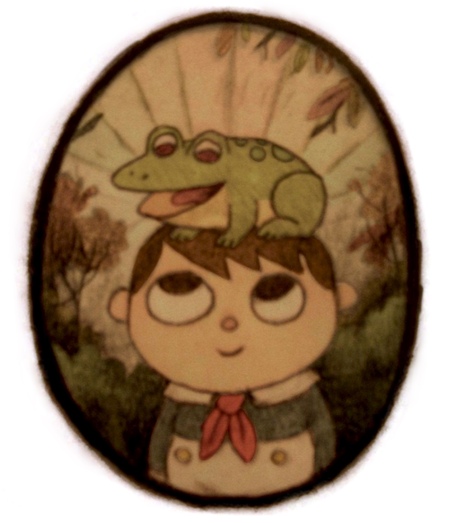
The first thing that catches the eye in the «Over the Garden Wall» comics is the distinct, almost childlike simplicity of the main characters' design. Wirt and Greg are drawn with minimal detail: they have large round eyes, geometric noses, stylized facial features, and easily recognizable silhouettes. However, this simplicity doesn’t render the characters as emotionless figures. On the contrary, thanks to their simple, expressive facial expressions, movements, and costumes, their personalities are read almost instantly. Perhaps this very concept is what will continue to prevail in the comic to convey any anxiety or fear, even through the cutest and most pleasant illustration design. Just as here, we can see the brothers as if they were small figures from a bedtime children’s story, but as we delve deeper into the comic, we calmly perceive their multifaceted personalities—and most importantly, their emotions allow us to feel anxiety or fear alongside them.
Illustrations from the «The Art of Over the Garden Wall» artbook, 2017.
Illustrations from the artbook «The Art of Over the Garden Wall» 2017.
Illustrations from the sketch artbook «The Art of Over the Garden Wall, ” 2017.
This specific stylization is not arbitrary. Patrick McHale, the creator of the characters and original storyline, stated that he consciously aimed for simpler forms that could effectively convey the characters' emotions. This principle remains consistent in the comics: instead of detailed facial renderings, the artists utilize the position of the eyes, eyebrows, head tilt, and expressive poses to communicate any emotion. The personalities of the two brothers also operate on contrast. While Virt is capable of building tension, inducing false anxieties, and escalating the entire atmosphere, Greg offers a contrast to his turmoil with his unshakeable childhood calm or positivity.
Comic excerpt from «Over the Garden Wall, ” Volume 1, 2015.
Excerpt from the comic «Over the Garden Wall,» Volume 2, 2016.
A panel from the comic «Over the Garden Wall,» Volume 2, 2016
Virt is a thinker. In reality, he overthinks everything. He will analyze a problem until it becomes far more complex than it needs to be.
Greg relies heavily on Virt in many ways, but he doesn’t entirely understand why his brother thinks and worries so much. Greg is almost never anxious or afraid.
Comic fragment from «Over the Garden Wall, ” Volume 1, 2015.
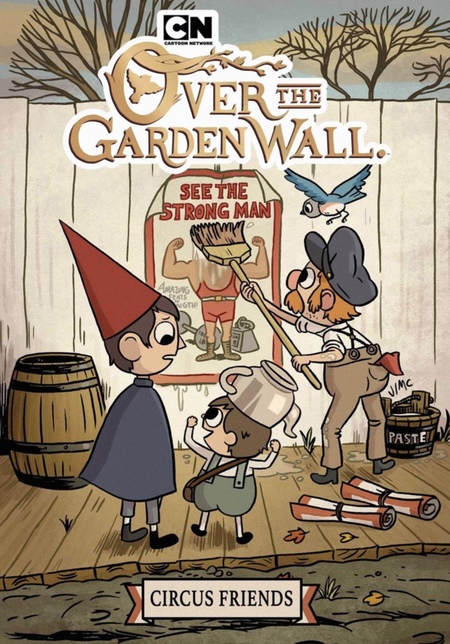
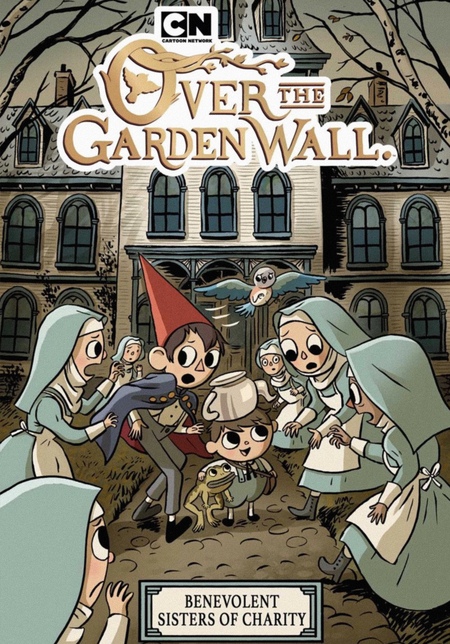
Cover illustration for the comic book «Over the Garden Wall: Circus Friends,» 2019. Cover illustration for the comic book «Over the Garden Wall: The Benevolent Sisters of Charity,» 2020.
A fragment from the comic «Over the Garden Wall, ” Volume 1, 2015.
Thus, the brothers are already building that concept of the anxious comfort of the Unknown. Their characters always resonate with one another, often without sharing a common emotion. Therefore, the duality of this world is evident even before analyzing its landscapes—specifically, through how the characters look and perceive their surroundings. This is precisely why simple design does not limit the emotional expressiveness of the characters; rather, it makes it more accessible to the viewer. Furthermore, the brothers' opposing reactions help create the very effect of «anxious comfort,» so their design and personalities are also closely interwoven with the atmosphere and the overall concept of the comic.
Space as an amplifier of anxiety
The forest in «Over the Garden Wall» is not merely a setting; it is one of the primary tools for creating atmosphere. Its autumn landscapes, muted colors, and soft natural forms evoke familiar illustrations from old children’s fairy tales, seemingly transporting us back to childhood. The unknown feels beautiful, tranquil, and almost familiar, even though the characters still do not know how to escape it and sense that there is no way home. In the narrative, the forest functions as an analog for a liminal space—a transition between life and death. In the comic pages, the forest is often depicted in ochre and golden tones. This palette softens the space, creating a feeling of warmth and even a touch of nostalgia. The trees and fallen leaves appear appealing, and the small figures of the characters in vintage costumes resemble characters from antique books. However, this tranquility proves deceptive: behind the beautiful scenery, an unknown world still lurks.
Excerpt from the «Over the Garden Wall» comic, Volume 1, 2015.
A fragment from the comic «Over the Garden Wall,» Volume 1, 2015.
Comic excerpt from «Over the Garden Wall,» Volume 1, 2015.
Comic book excerpt from «Over the Garden Wall,» Vol. 1, 2015.
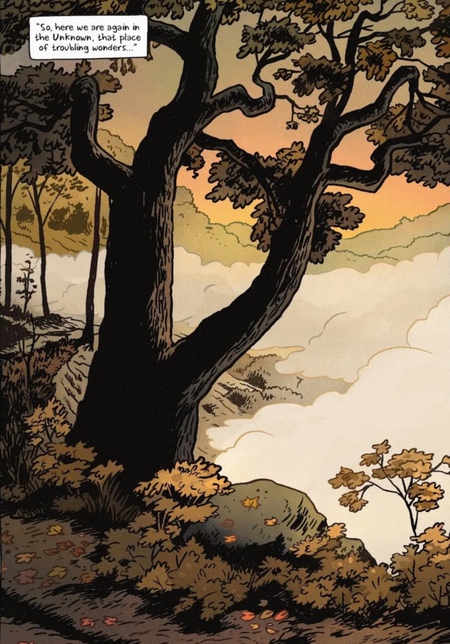
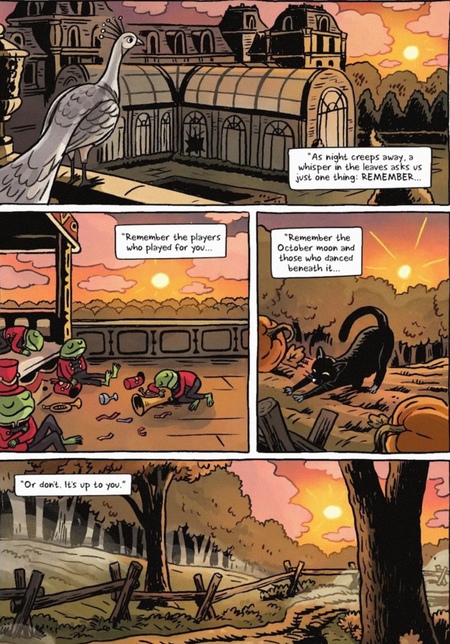
Comic excerpts from «Over the Garden Wall: Distillatoria, ” 2018.
This contradiction is particularly evident in images where the characters are situated among tall trees. Their small figures get lost against the backdrop of the surrounding space. Even if the trees do not appear threatening, the difference in scale emphasizes the characters' vulnerability. The forest ceases to be perceived as a familiar walking spot and transforms into a space whose size and boundaries are impossible to define. Lighting plays an additional role. Warm light can evoke a sense of safety, yet simultaneously underscores the darkness beyond its reach. The smaller the illuminated area, the more noticeable the surrounding unknown becomes. Fog functions in a similar manner: it softens the image and lends it a painterly quality, but it conceals distant objects and deprives the viewer of spatial reference points.
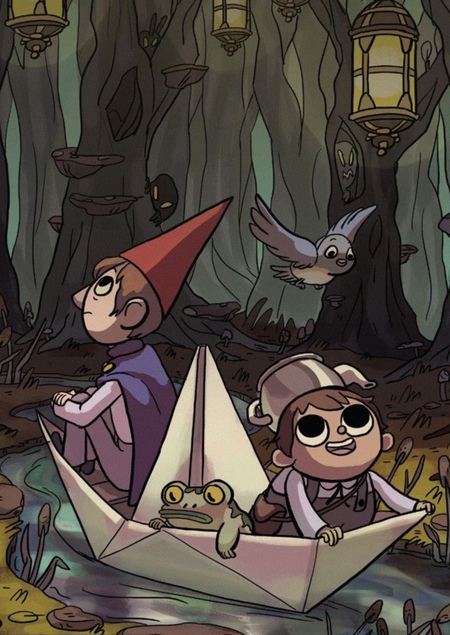
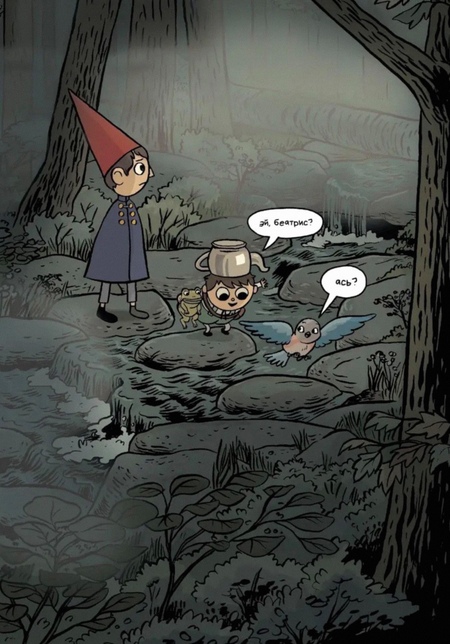
Comic book excerpts from «Over the Garden Wall, ” Volume 1, 2015.
Excerpt from the comic «Over the Garden Wall: Distillatoria, ” 2018.