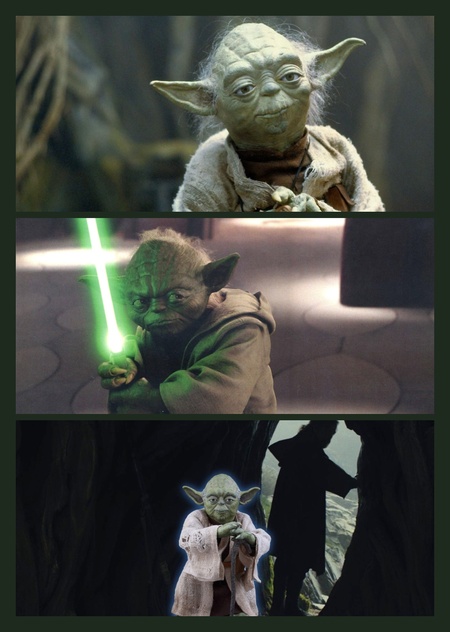
Table of Contents
1. Introduction
2. Doll and Digital Character
3. «The Empire Strikes Back, ” 1980
4. „Return of the Jedi, ” 1983
5. „The Phantom Menace, ” 1999
6. „Attack of the Clones, ” 2002
7. „Revenge of the Sith, ” 2005
8. „The Phantom Menace“: 2011 Re-release
9. „The Last Jedi, ” 2017
10. Comparison
11. Conclusions
12. Bibliography
Introduction
Yoda has appeared in six Star Wars films. Over 37 years, his portrayal has changed in two ways: in 1980, it was a latex puppet operated by a puppeteer; in 2002, it was a digital character; and in 2017, it was once again a puppet cast in the mold of the 1980 design.
I found it fascinating to trace how the technology evolved and how that shift is visible on screen. Yoda is well-suited for this comparison. The hero remains the same—Frank Oz has voiced or portrayed him throughout all these years—and viewers clearly remember his appearance.
Doll and Digital Character
The puppet exists on set. It is filmed alongside the actors, receives the same lighting, and its movements are directed by puppeteers hidden beneath the set dressing. It has one limitation: it can only do what its mechanics allow.
The digital character appears after filming. The actors perform around an empty space or marker, and then Yoda is animated, lit, and integrated into the footage—the plate. Such a Yoda can run and fight, but every movement and every reflection on his skin is defined by the artist.
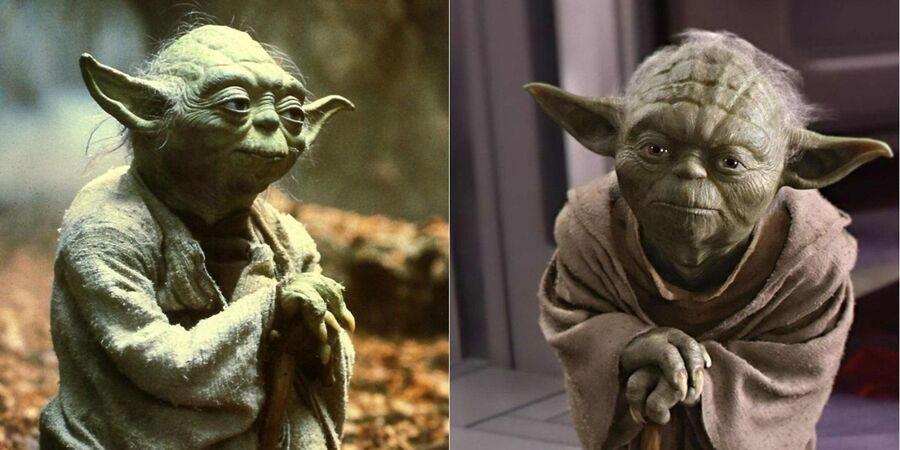
Doll («Empire Strikes Back, ” 1980) and digital character („Clones Attack, ” 2002)
«The Empire Strikes Back, ” 1980
Special Effects Supervisors: Brian Johnson and Richard Edlund. Stuart Freeborn created the puppet, and Frank Oz operated it.
Before the puppet, the group seriously considered using a trained monkey wearing a mask. In the end, Stuart Freeborn sculpted the head, basing it on Ralph McQuarrie’s sketches. He added his own features and the wrinkles around Albert Einstein’s eyes from a photograph hanging in his studio.
The head size was determined by the puppeteer’s hand. Before sculpting, a mold was taken from Frank Oz’s hand, and the skull, made of fiberglass and polyurethane, was designed to fit the gap between the skin and the palm. The puppet has no jaw: Oz moved the mouth and the lower part of the face with his fingers, so the skin under the cheeks hangs freely.
The skin was cast in three pieces from expanded latex, while the ears, hands, and feet were made separately. Nick Mealy prepared the molds and the skin. The layer around the eyes is thinner so that the movement of the eyelids is visible. Wendy Fraud assembled the hollow torso from 2.5 cm thick sheet polyurethane. She also devised the mechanism for moving the ears.
Yoda. A still from the film «The Empire Strikes Back,» 1980
There were several puppets: a hand puppet for Oza, two remote-controlled puppets for general setups, such as a scene where Yoda sits on Luke’s back, and a costume for the actor Deep Roy. The hands and feet were removed—some were affixed to canes, while others were worn like gloves.
Oz controlled the body and speech; other puppeteers managed the eyes and ears. The swamp set was made from real mud, and within a couple of days, it ended up on the puppet’s face. In scenes shot later, the face appears noticeably darker. The timeline was tight, and the eye mechanism turned out simpler than Friborn had intended.
Video: Frank Oz puppeteering Yoda on a film set, original unedited sound. Filming for «The Empire Strikes Back, ” 1979. Source: YouTube, The Star Wars Vintage Collection
There are indications in the frame that the scenes were built around the puppet. Yoda hardly ever walks; he mostly sits or stands, and the camera rarely shows him in full shot. However, he is lit in the same light as Mark Hamill, and during their conversation scenes, there is no sense that the actor is looking into empty space.
Source material: articles by D. Reeny (Bold Entrance, 2020), F. Neers (Inverse, 2022), and Den of Geek, «Yoda: The Empire Strikes Back’s Big Gamble.»
«Return of the Jedi, ” 1983
Visual Effects Supervisors: Richard Edlund, Dennis Muren, and Ken Ralston. The puppet was created by Stuart Freeborn and operated by Frank Oz.
In the third film, Yoda appears in only one scene: in his home on Dagobah, he speaks with Luke and dies. The technology is the same as in 1980: Freeborn’s puppet, operated by Oz. The scene is nearly static—Yoda sits and then lies down—and this is where the puppet excels.
Yoda. Still from the movie «Return of the Jedi, ” 1983
For this same film, Friborn built a large animatronic figure of Jabba the Hutt, which took three months. Yoda remained a small hand puppet and looks almost the same on screen as in The Empire.
Sources: Den of Geek, «Star Wars: The Changing Face of Sy Snootles & the Max Rebo Band»; Wikipedia (English), article «Return of the Jedi.»
«The Hidden Threat, ” 1999
VFX Supervisors: John Knoll, Dennis Muren, and Scott Skwairs. The puppet was built by the Creatures Department under the direction of Nick Daddman, and it was operated by Frank Oz.
The film takes place many years before the Empire, so Yoda was decided to be made younger. Nick Daddman’s team built the new puppet, and instead of foam latex, the skin was cast in silicone. Daddman explained that this made the skin look healthier, but the team strove to preserve the original character traits.
Yoda doll on the Jedi Council. A scene from the movie «The Phantom Menace,» 1999 version.
Computer Yoda is only depicted in two general shots; otherwise, it is a doll. Nick Mayle, who made the skin for the 1980 doll, later called the entire attempt to update Yoda a mistake. According to him, the head was repainted, and the new material turned out to be heavier.
It seems to me that this doll had another problem. In 1980, Yoda stood in a genuine set among real props, but in 1999, digital characters and painted cities surrounded him. Against such a backdrop, the rubber doll stands out more starkly than it did on Dagobah’s swamp.
Source sections: Star Wars Aficionado blog (quote by Nick Dadman from Empire magazine, 1999), CinemaBlend (words by Nick Mayle), «Yoda» article on Wikipedia (English).
«Attack of the Clones, ” 2002
ILM VFX Supervisors: John Knoll, Pablo Helman, Dennis Muren, and Ben Snow. Animation Director Rob Coleman, Modeling Supervisor Jeff Campbell.
At first, Lucas wanted to keep the puppet and only digitize the fight scene with Dooku. Rob Coleman persuaded him to make Yoda fully digital: adapting a computer copy to a puppet in a single film would have been more complicated. The puppet barely moved, but here Yoda needed to walk, jump, and fight.
Digital Yoda. Frame from the movie «Attack of the Clones, ” 2002
To get Lucas, Coleman, and Campbell’s approval, they remade six frames from «Empire» featuring a digital Yoda: three with dialogue and three silent. Frank Oz reviewed the initial tests and felt the face was too expressive—the puppet mostly just opened and closed its mouth. They subsequently toned down the facial movements.
The model was built using scans of the head model in the ILM I-Sculpt program. For Campbell’s face, he sculpted hundreds of forms tied to anatomy and musculature, and the animators blended them in the Caricature program. The mouth was worked on separately, down to the thickness of the tongue and cheek walls.
Model wireframe, model without textures, and a final shot of the duel scene. Digital Yoda ILM for the film «Attack of the Clones,» 2002
The animators intentionally translated the doll’s flaws into digital form. When the doll turned its head, its ears trembled—a consequence of the weight and fatigue from Oza’s raised arm. Without this tremor, the digital Yoda looked younger, which is why they included it.