[0] Concept
One of the most important tasks of historical cinema is creating visual imagery based on past events. Architecture holds significant importance in this process. It is what allows for the transmission of the scale and structure of former civilizations, as well as shaping the viewer’s perception of life within a historical setting.
This research investigates how early American silent film, from the 1910s to the 1920s, depicted bygone eras using architecture and screen space. Historical and biblical films of this period frequently featured large-scale sets of ancient cities and architectural ensembles. However, the depiction of the past was not an accurate reproduction of historical reality; rather, it was constructed from established perceptions of the era and the director’s vision. The study examines how architecture contributed to the creation of a coherent image of historical epochs and events.
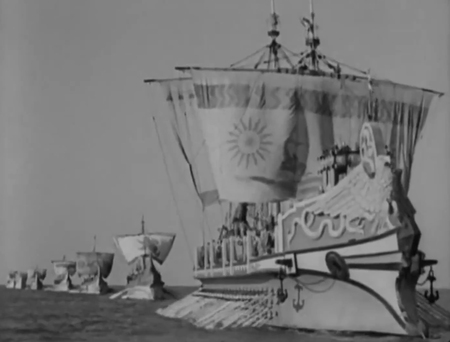
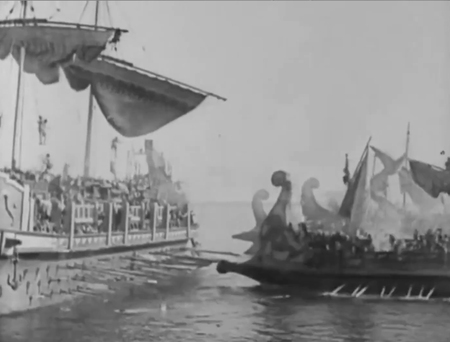
«Ben-Hur» (directed by Fred Niblo, 1925)
The central research question: what visual elements were employed to construct historical spaces in American silent film?
The research hypothesis posits that the persuasiveness of architectural reconstructions is determined less by the historical accuracy of individual structures and more by the principles of spatial organization: the scale of the architecture, details, symmetry, frame composition, and the relationship between the human figure and monumental structures form an independent visual model of the past. Architecture conveys representations of power, religion, social order, and the historical transformations of bygone eras.
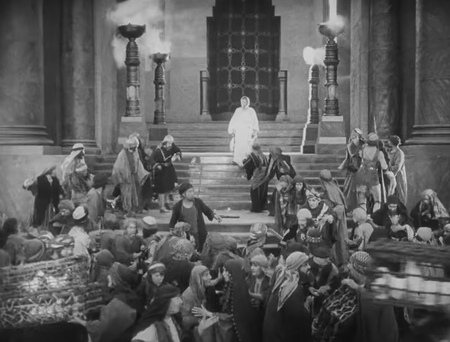
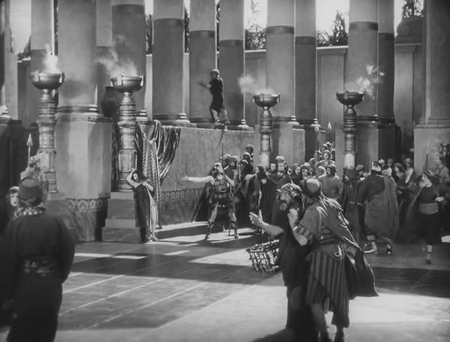
«King of Kings» (Dir. Cecil B. DeMille, 1927)
The study examines five films: David Wark Griffith’s The Birth of a Nation (1915) [Note: Original text listed 1916 for Griffith, but the film is from 1915; maintaining original year structure], Jane Eyre (1916), Cecil B. DeMille’s The Ten Commandments (1923) and King of Kings (1927), and Fred Niblo’s Ben-Hur (1925). These films are used to compare the ways different historical spaces are depicted: Babylon, medieval France, ancient Egypt, the Roman Empire, and Judea. Despite variations in plot and the eras portrayed, all the films utilize architecture to create a recognizable spatial environment and convey the notions of the respective civilizations.
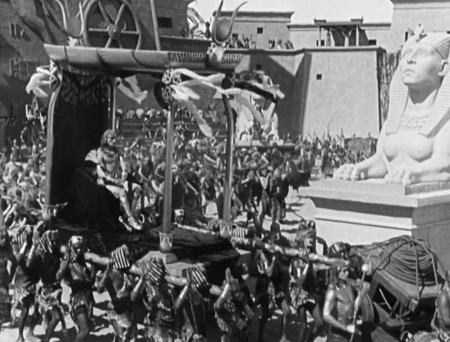
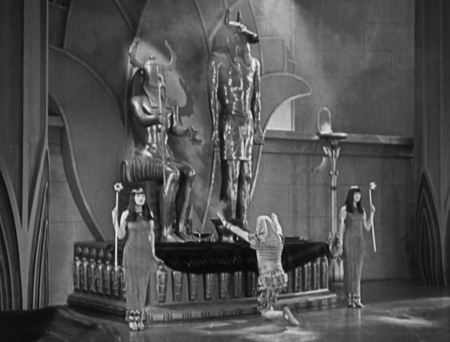
«The Ten Commandments» (dir. Cecil B. DeMille, 1923)
The analysis encompasses several aspects. The urban environment is examined—methods of representing streets and squares, and the principles for unifying individual structures into a cohesive composition. Furthermore, architecture is explored as an expression of power and religious organization: palaces, temples, fortresses, and other monumental buildings. Finally, attention is paid to perspective, scale (the relationship between human figures and architecture, the use of perspective, and the placement of objects within the frame), and the interaction between space and the characters in films. A separate focus of the analysis relates to the change and destruction of space. The demise of cities and the collapse of structures allow us to examine how cinematography visualizes historical shifts and the disappearance of entire civilizations.
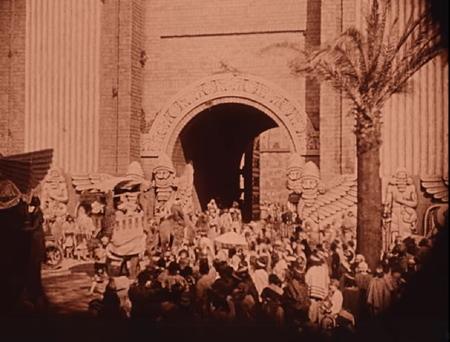
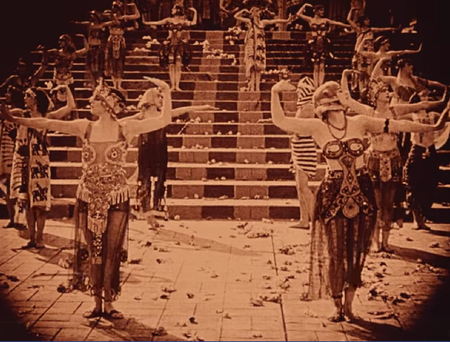
«Intolerance» (directed by David Warock Griffith, 1916)
This research will trace how architecture was utilized to create the image of the past in American silent cinema. Comparing five films will help reveal the role of composition and spatial organization in depicting different eras.
TOPICS [0] Concept [1] The City as an Image of Civilization [2] Architecture of Power and Oppression [3] Nature as a Symbol of Freedom [4] Interiors as a Reflection of Luxury and Status [5] Cities in the Moment of Ruin [6] Conclusion
[1] The City as an Image of Civilization
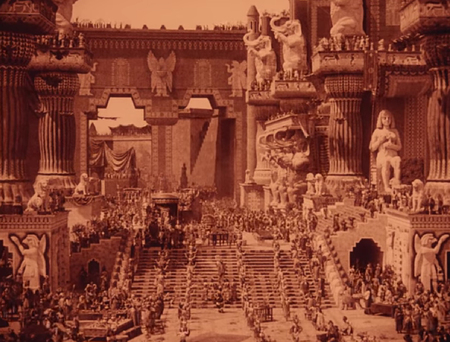
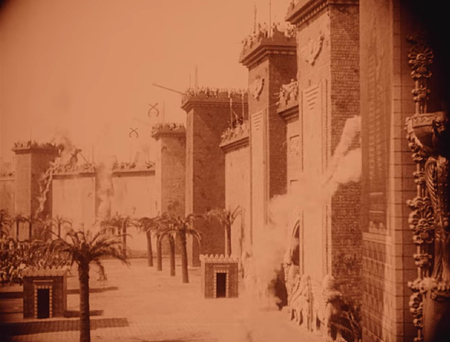
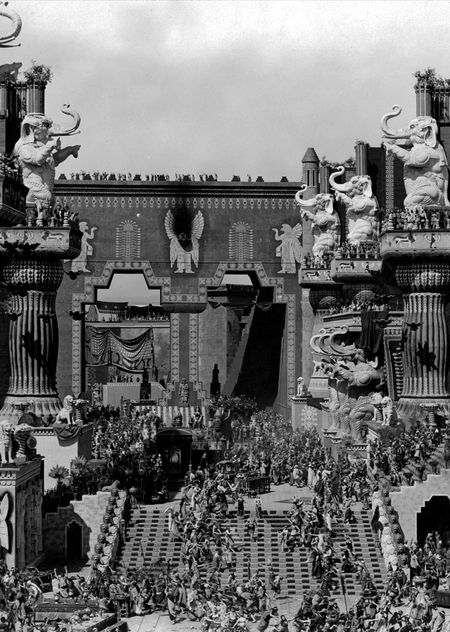
«Intolerance» (dir. David Wark Griffith, 1916). Reconstructions of the city and the gates of Babylon
In «The Tower of Babel,» Babylon is presented as a massive urban organism, composed of streets, palace structures, colonnades, and multi-tiered platforms. In the first frame, the expanse of the street and the repeating tower structures create a sense of immense city, while the numerous, dynamic figures of people engaged in vastly different activities emphasize the scale of the buildings. In the second frame, the focus is on monumental gates, against which the palm trees appear utterly minuscule. The symmetrical composition and the abundance of decorative details convey the grandeur of the city and its architecture, even during the siege of Babylon.Maria de Fátima Rosa notes that Griffith’s portrayal of Babylon was shaped by various historical conceptions and visual sources. Therefore, the film’s set design reflects less the actual appearance of the ancient city and more the perceptions of it that existed in the early 20th century [6].
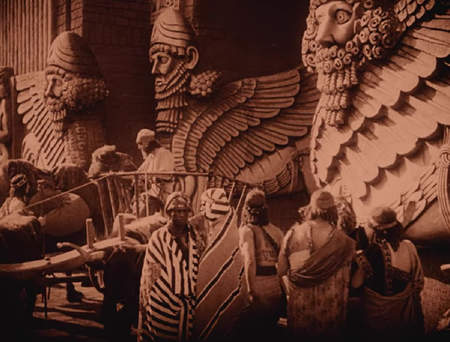
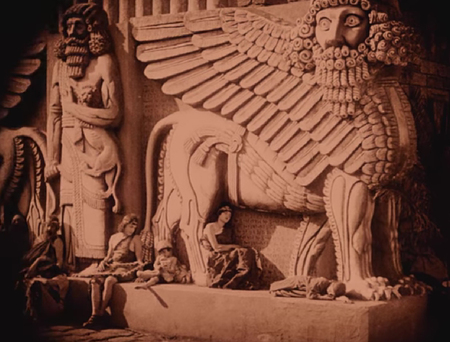
«Intolerance» (dir. David Warck Griffith, 1916). Babylon
The repetition of architectural elements, including sculptures, plays a significant role. Both frames display massive figures of winged creatures with human heads. Figures like these resemble Assyrian lamassu, which were traditionally placed at palace entrances to serve as guardians. Their scale and placement emphasize the grandeur of the architecture, and the combination of human and animal features lends a mythological character to the space.In the Arzamas article, «8 Questions about Babylon, ” the image of Babylon is described as „a city of enormous size, very majestic, populous, vibrant (one need only recall the lapis lazuli gates of Ishtar), and, of course, amazing to travelers“ [8]. It is also mentioned that the city „unintentionally associates itself with multilingualism and multiethnicity.“ This is precisely why Griffith highlights the richness of the city through massive decorations and an abundance of ethnic sculptures.
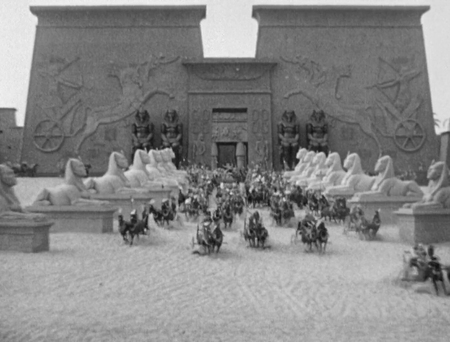
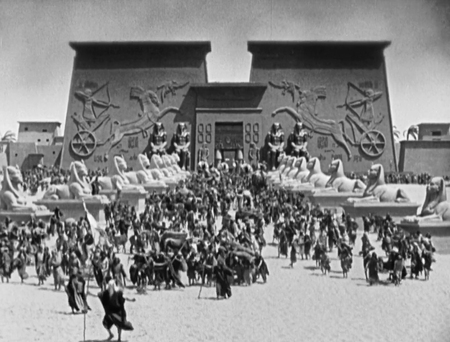
«The Ten Commandments» (dir. Cecil B. DeMille, 1923). Entry into Ramses' city
In «Ten Commandments» (1923), the image of Ancient Egypt is also constructed through monumental architectural ensembles. Sumiko Higashi describes the entrance to Ramses' city as a symmetrical composition featuring massive walls, colossal statues, and reliefs [2]. In both frames, the central focus is a long wall with gates in the middle and rows of sculptures receding into the distance. Small human figures at the bottom emphasize its scale. The symmetry, repetition of sculptural elements, and accentuated height of the structures create the image of a monumental city where architecture demonstrates the ruler’s power.
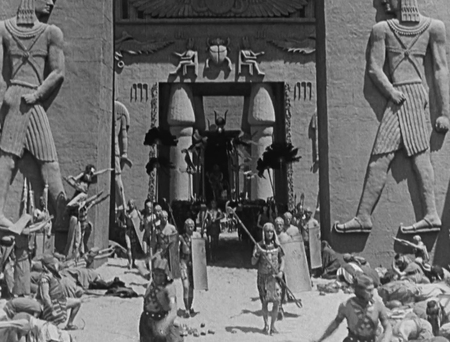
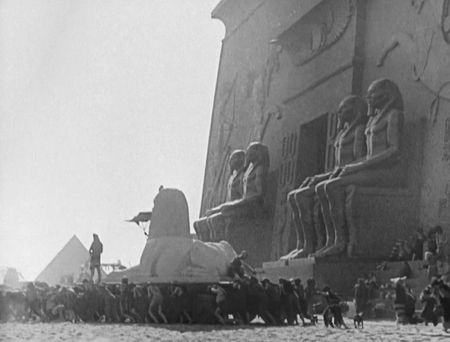
«The Ten Commandments» (directed by Cecil B. DeMille, 1923). Monumental elements of the Egyptian architectural ensemble
Ancient Egyptian architecture in this film is built from massive walls, ancient Egyptian reliefs, and sculptures. Even the titanically sized gates seem designed to overwhelm. The geometric, almost constructivist forms of the pyramidal structures contrast with the detailed imagery on the facades. The gigantic statues, which resemble divine beings in their scale, make a particularly strong impression. Against their backdrop, a person appears almost like an ant, emphasizing the grandeur of the Egyptian constructions.
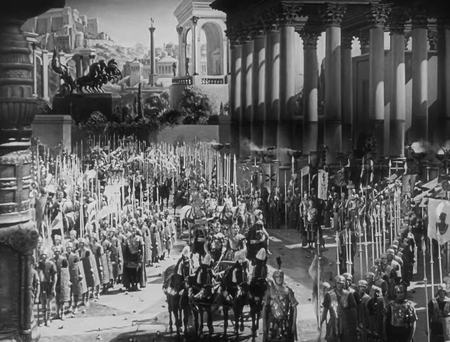
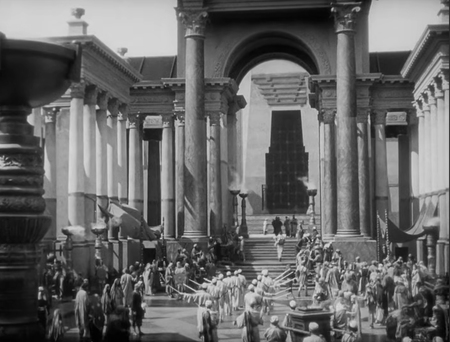
«King of Kings» (dir. Cecil B. DeMille, 1927). The Urban Environment of Judea
In «King of Kings,» the urban environment is constructed through a combination of open plazas, long avenues, and monumental structures. Colonnades and repetitive architectural elements organize the space, creating a sense of order and scale. Furthermore, the architecture possesses a distinct grandeur: the abundance of ornamentation, rich finishes, and the height of the buildings evoke an impression of exceptional luxury and opulence. The city appears deliberately majestic, as if its architecture is intended to impress the viewer with wealth and scope.
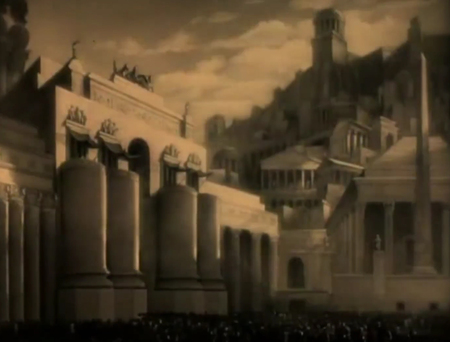
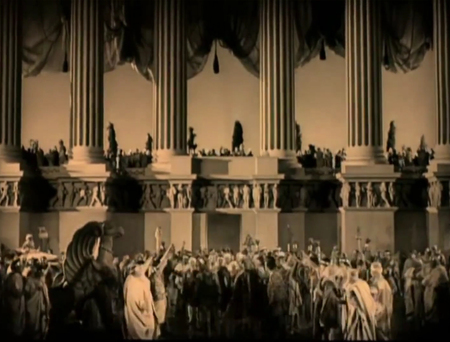
«Ben-Gurion» (dir. Fred Niblo, 1925)
In «Ben-Gurion» (1925), the scale of the structures is conveyed through repeating, symmetrical compositions (massive columns and elongated walls). The architecture appears severe and monumental. Particularly interesting is the first image of the city: the rows of gigantic columns resemble industrial structures and factory workshops, which may evoke associations in the viewer with the era of industrialization in the United States. The city acquires the characteristics of a mechanized space, where everything is subordinate to order and scale—a striking contrast to the natural landscapes in the film.
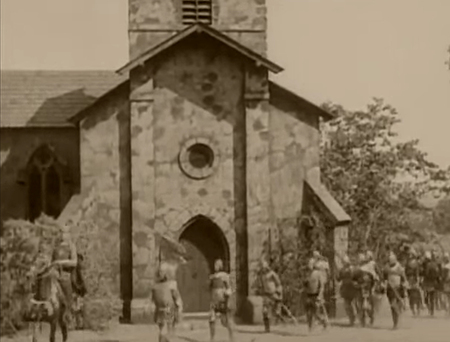
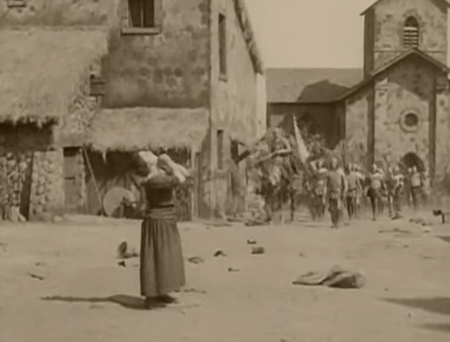
«Jane Cantabile» (directed by Cecil B. DeMille, 1916). A medieval rural setting
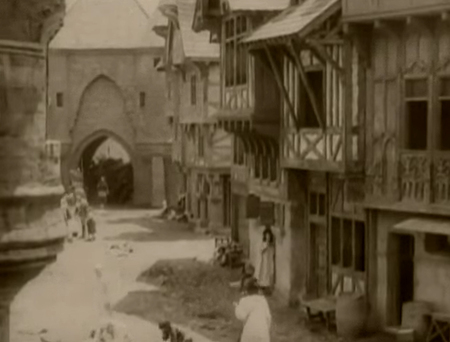
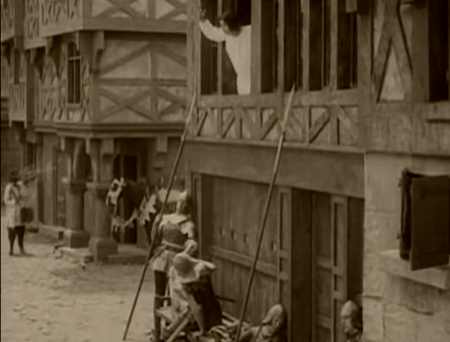
«Jane Eyre» (dir. Cecil B. DeMille, 1916). Medieval urban environment
In «The Lady of Jeanne,» one can observe differences in the organization of rural and urban spaces. The village consists of small stone houses with thatched roofs. The architecture appears humble and simple, and the space itself feels sparsely populated and quiet; even during the British attack, there is hardly any sense of hustle and bustle. The city, in contrast, is built much more densely: residential buildings stand close to one another, and the streets and paved alleys form a more complex system of movement. Because of this, the urban space is perceived as slightly more vibrant.The architecture here helps to form an idea of daily urban life for medieval French people. Unlike in Babylon and Egypt, where large public structures predominate, the streets are composed of numerous small buildings situated close to each other.
[2] Architecture of Power and Oppression