Cinematic art in its intrinsic nature has always been transgressive. Back when Dziga Vertov first introduced the world to the kino-eye, cinema was already pushing the boundaries of perception and representation, or even, what it even is to perceive and to play a part. What Vertov did was not just film, he was rethinking vision itself, reshaping the process by which we witness the world, and in doing so, became the precursor to something even bigger — the notion that art can be an act of intervention.
Filming, capturing videos became a tool for resistance, a way to challenge the status quo by altering the very systems through which the world is shown to the audience. To subvert the norm.
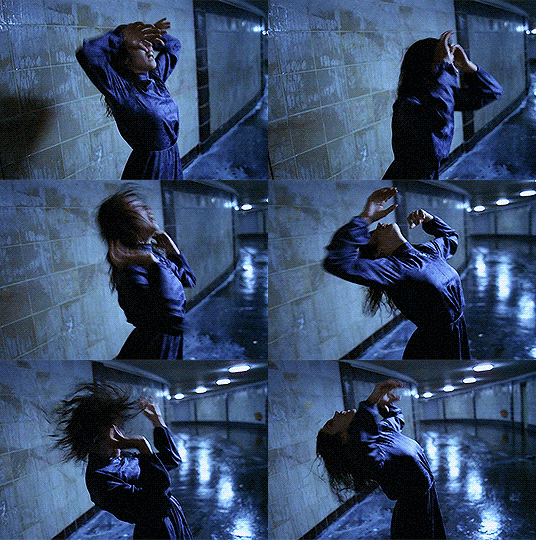
'Possession', Andrzej Żuławski, 1981. Protest against the female status-quo, motherhood and the instituions of marriage.
When one talks about 'protest' in motion art, even though it still remains an act rooted in politics, but rather than social politics or economic crises we often hear about on various social media, one should turn their gaze to an identity. Protest in video art is a deeply personal confession, a conflict of personal interests and consequences of what we most often cannot control.
Protest in video art is a radical redefinition of how we see, record, distribute, communicate and cope — a rejection of those norms enforced on both the creators and the audience by figures in power and the status-quo.
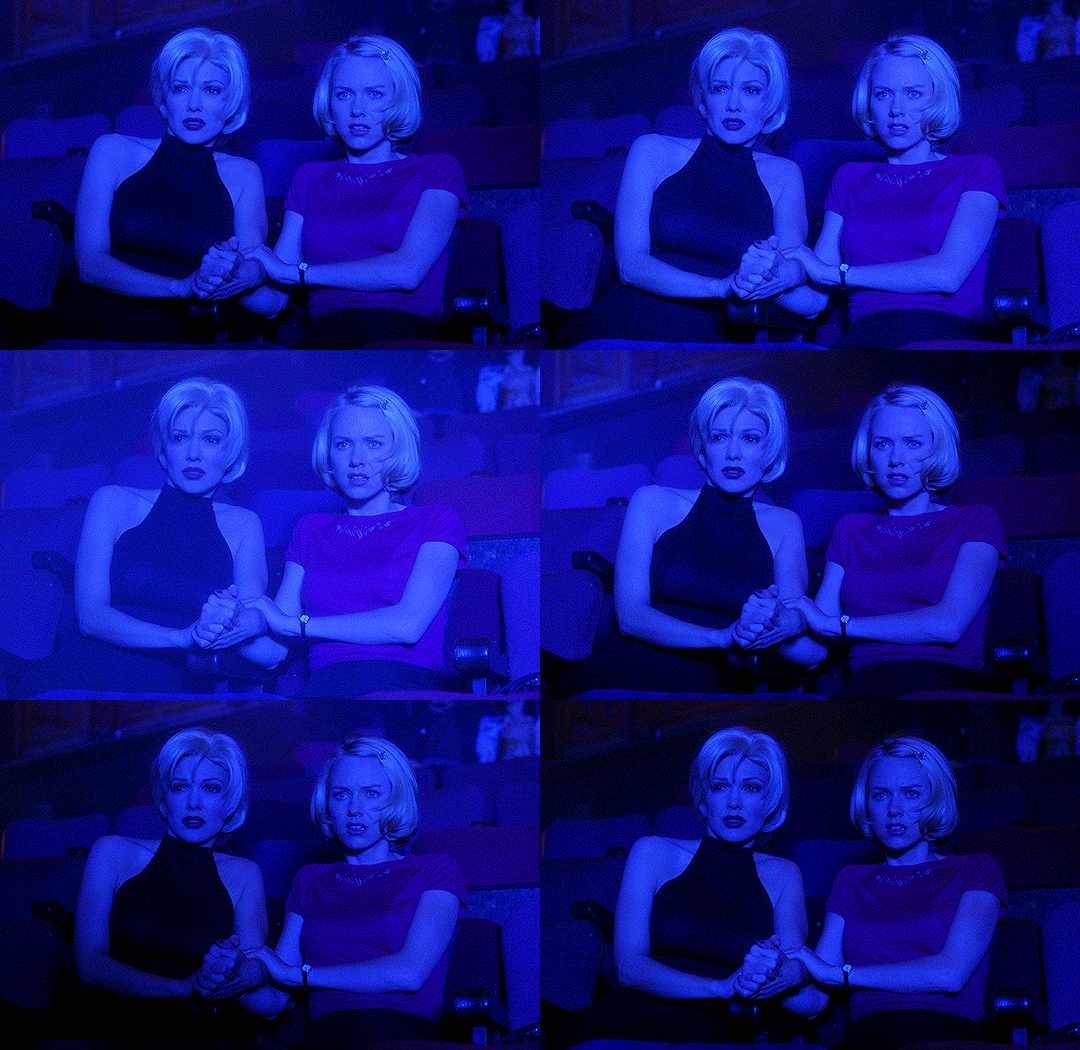
'Mulholland Drive', David Lynch, 2001. A protest againts the American film industry, Hollywood, and explotation of art for money.
By disrupting the typical logic of representation — the clean lines of narrative, the comforting certainty of the frame, the ease of social and cultural codes — video artists expose the cracks in the foundation of how we understand the world.
Susan Sontag in her work 'Regarding The Pain Of Others' poignantly points out that images are never neutral. Every act of seeing is inherently political, and something is always shown to us for a reason: blockbuster movies, box office action slop with A-list celebreties, Oscar-baits, giving illusion of a message that in reality doesn’t stand the test of dissecting. To witness is to interpret, to question, to potentially resist; and to record, to act, to publish, to put one’s art out there is always to spread a message. In this visual research, we will be looking in just what ways videoart dares to protest, not to conform.
To film is to protest. To watch is to resist.
Contents
- Concept
- Subverting The Format and Interpretation
- Media, Censorship, Commerce
- On Social Commentary and Oneself
- Conclusion
Subverting The Format. The viewer’s Interpretation and the creator’s perspective
Back when the term 'videoart' wasn’t as widely used, the medium was emerging as a mere subversive experiment. This was the era when Fluxus, an international network of artists, introduced a new approach to art. Fluxus was a movement that sought to blur the lines between art and life, emphasizing interactivity, playfulness, and democratization of art. The group encouraged artists to experiment with new media and techniques, incorporating elements from sound, performance, and even everyday objects into their works, always with the intention of subverting the viewer’s expectations and redefining what art could be.
Nam June Paik, Zen For Film, 1964.
In the case of Paik, video became a powerful medium for disrupting not just artistic conventions, but the very way in which viewers engaged with moving images. Create interaction where it once sought to be impossible to appear. His 'Zen For Film', a 7-minute long white video with film grain, is, perhaps, an ultimate dare to what videoart can be. Everything the viewer wants it to become, but almost nothing without its audience.
Nam June Paik, Zen For Film, 1964. Framed as it was shown at exhbitions.
Yoko Ono’s work, a fellow member of the Fluxus Foundation, followed in Nam Joon Paik’s footsteps in experimenting with the medium and the technologies. Singular angles, slow-motion and rapid shots, often times playing with themes of body, nudity and life.


Eyeblink, Yoko Ono, 1966 and No.4 (Bottoms), Yoko Ono, 1967.

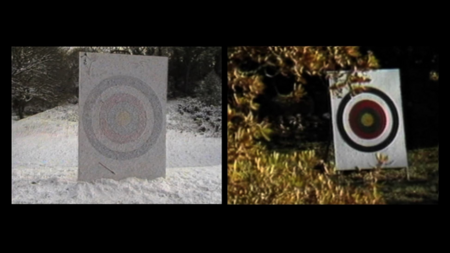
One Stroke of Painting (still), Kim Soun-Gui, 1975-1985.
One Stroke of Painting (still), Kim Soun-Gui, 1975-1985.
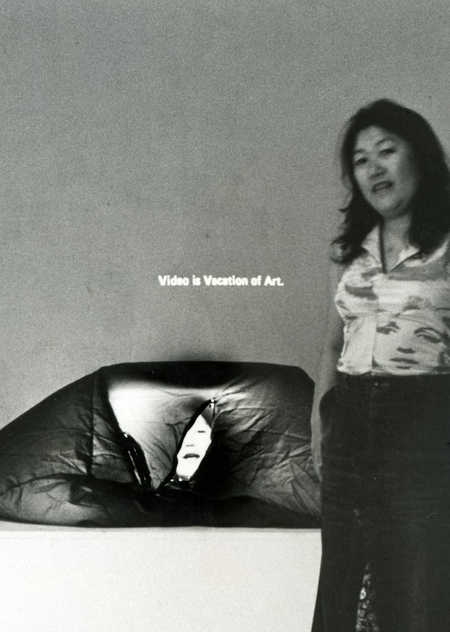
Among other pioners are Kim Soun-Gui, who found videoart a 'primal' and raw tool for executing visual metaphors; as well as Shigeko Kubota, who used video to create diaries of her work, infuse them with voice over and editing tools. Videoart opened a portal for art to become multidisciplinary — interactive, cinematic, poetic.


Video Poem, Shigeko Kubota, 1970-1975.
'Video Is Vacation of Art' — Shigeko Kubota.
Video Poem, Shigeko Kubota, 1970-1975.
Censorship, Commerce, Surveillance
As a medium devoid of ways to commercialize itself, it only makes sense for videoart to stand agains the industry. While mainstream cinema and mass media often operate within commercial frameworks, designed for profit, mass consumption, and mass appeal, video art has historically been a space for critique and nuance.
Technology/Transformation: Wonder Woman, Dara Birnbaum, (1978-1979).
'Dara Birnbaum’s Technology/Transformation: Wonder Woman' (1978-1979) stands as a powerful critique of both media representation and the gendered politics of the popular in mass media superhero genre. Using footage from the television show 'Wonder Woman', Birnbaum dismantles the traditional portrayal of the female superhero and exposes the underlying patriarchal commercial structures that disguise themsevles as female empowerement.

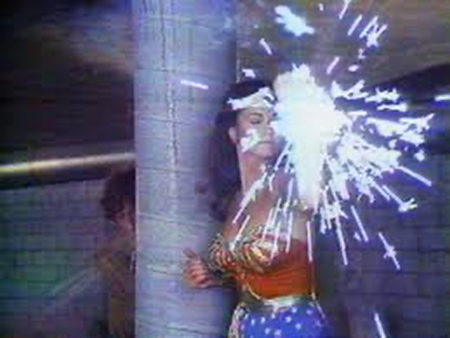
Technology/Transformation: Wonder Woman, Dara Birnbaum, (1978-1979).
Videoart allows for reframing and reimagining. It can take something pre-existing and turn it against itself, make it the example in the discourse without adding anything extra or new, except for one thing — context.
Videoart fights what it stand againts by showing, not telling. Videoart rarely explains — it expects the viewer to derive meaning from observing footage through lenses of cultural and ideological context. Videoart needs the viewer to agree with it, or at least understand its point of view.