Navigation
- Concept2. Antiquity 2.1. The Legend of Callimachus: How the Acanthus Became Part of the Corinthian Order 2.2. Geometry, Symmetry, and the Rhythm of Leaves in the Capitals of Ancient Greece and Rome. 2.3. The Acanthus Motif in the Decoration of Roman Altars and Columns3. Medieval and Renaissance Periods 3.1. Simplification of Form and the Use of the Motif in the Temple Decoration of Romanesque and Gothic Cathedrals 3.2. A Return to Antique Roots and New Interpretations in Furniture and Frescoes. 3.3. Comparative Analysis of the Medieval and Renaissance Interpretations of the Acanthus Leaf Motif4. Baroque and Classicism 4.1. Dynamism, Opulence, and the Acanthus Scroll in Baroque Interiors 4.2. The Return to Geometry and Rigor in the Neoclassical Style5. Art Nouveau 5.1. The Floral Language of Art Nouveau: Works by Gaudí, Guimard, and Van de Velde 5.2. The Acanthus in Graphic and Applied Arts 5.3. The Acanthus Leaf in Stylization and Abstraction6. The Acanthus Leaf in Contemporary Design7. Conclusion
Concept
Vegetal ornamentation is often dismissed as a relic of the past, yet modern graphics, fashion, and interior design actively utilize it. The acanthus leaf is one of the most enduring motifs. It has evolved from the ancient capital to modern logos and apparel prints. The issue is that this motif is rarely examined as an independent visual phenomenon. It is mentioned in passing, but not deeply analyzed regarding how its plasticity has changed or why designers continue to return to it. Studying the evolution of the acanthus motif helps us understand how nature transforms into a decorative language in the hands of the creator.
I hypothesize that the acanthus leaf was not merely copied from one era to the next, but rather reinterpreted each time. In Antiquity, it was a formal element; in Baroque, it could be theatrical and opulent; and in modernity, it has become fluid and orientalist. It is this plasticity and adaptability to any style that have made the acanthus a universal tool for designers across different centuries.
In this study, I aim to trace how the visual form of the leaf has transformed within European applied arts and design, and to identify the artistic techniques masters employed to adapt it across various historical periods.
My research methodology involved studying visual material featuring this motif, as well as drawing from online articles on the history of ornament, curated visual collections from museums, and designer essays about the contemporary use of botanical motifs. This approach enabled me to compile a rich visual field and observe the living connection between historical decoration and what is seen in digital design or on the streets today.
I structured my work chronologically. Starting from the origins of the motif in Ancient Greece and Rome, through its transformation in the Middle Ages and the Renaissance, leading to the opulent Baroque, and finally to the strict Classicism and the free forms of Art Nouveau.
Antiquity
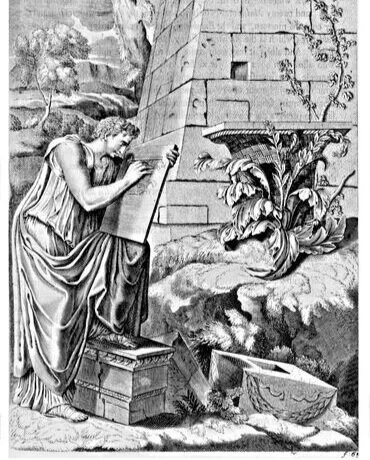
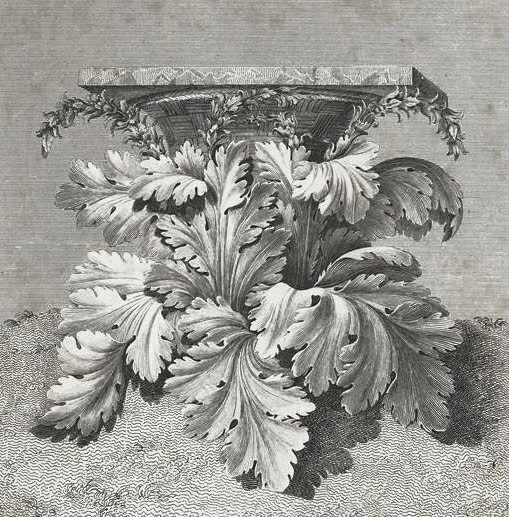
The invention of the Corinthian capital by sculptor Callimachus. Engraving from Rolan Fréar de Chambray’s treatise «Parallel of Ancient and Modern Architecture,» 1650 / Origin of the Corinthian Capital. Engraving by J. Mercoli after a design by J. Albertolli, 1787.
The origin story of the Corinthian capital is known to the world through the Roman architect Vitruvius. However, this is most likely just a beautiful legend. Vitruvius was not only an architect and engineer but also a writer, meaning he could easily embellish reality. After all, the simple assertion that the Corinthian order originated in the Greek city of Corinth sounds far less captivating. According to the legend, Callimachus once strolled through a cemetery in Corinth and saw an unusual scene. On a girl’s grave sat a basket, a kind of funerary offering. Such occurrences were rare, as in ancient civilizations where child mortality was very high, such gifts were usually intended for adults. Even stranger was that the basket remained there for a very long time: acanthus leaves, which were also an offering to the deceased, managed to sprout through its weaving. Inside the basket, according to tradition, lay the girl’s toys. Someone was very caring about the child and even placed a tile on top to protect the contents from the rain. The heavy tile pressed down on the growing leaves, and as they tried to break through to the light, they naturally curled into tight spirals. This reminded Callimachus of an architectural structure where the entablature rests on the capital.
The Corinthian order, known as the third order, imitates the delicacy of maidenhood; because of their youth, female forms exhibit a particular refinement, and a more graceful effect can be achieved in their adornments.
Thus was born the canon of the Corinthian order. In the first illustration, Callimachus sketches a basket sprouting with acanthus, standing by a wall. This is an idealized scene from a myth that conveys the very idea of transitioning from random natural form to art. The second engraving shows how the acanthus leaves, yielding to the weight of the tiles, curl into volutes that would become the main decoration of the Corinthian capital.The legend explains the order’s meaning. Its grace and elegance are initially likened to the fragility of a young woman—it is a feminine order.
Corinthian columns in the interior of the Roman Pantheon. Artist J. P. Pannini, 18th century
The Roman acanthus, unlike the Greek, is flatter and more graphic; the volute scrolls and the leaves themselves are strictly symmetrical. Because of this, the capitals of the Pantheon retain their expressive quality even at the immense height and in the semi-darkness of the dome.
Furthermore, Panini depicts the columns surrounded by people from different social classes, which allows the scale to be shown. The acanthus on the capital is, in fact, a powerful tectonic element that supports the vault and completes the massive column.
In the overall view of the reconstruction of the Altar of Peace (Ara Pacis Augustae), you can see an alternative use of this motif under the Greek meander. The lower panel features a continuous vegetative frieze, whose surface is covered with a dense and lush pattern. Here, the acanthus symbolizes abundance and perpetual bloom, as well as the state propaganda that glorified the era of Emperor Augustus.
Unlike the columns of the Pantheon, where the acanthus is subservient to strict verticality and geometry, on the Altar of Peace, it forms a horizontal carpet. The leaves are more realistic and less elongated.
Ara Pacis Augustae. 13–9 BCE. Museum of the Altar of Peace, Rome
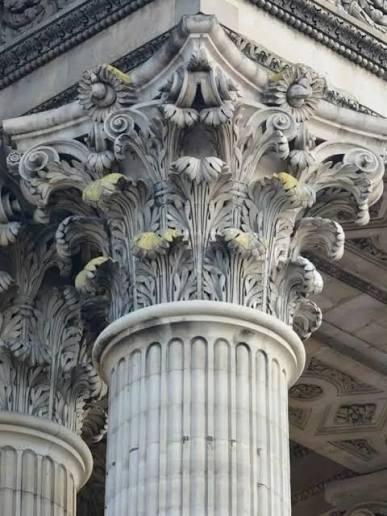
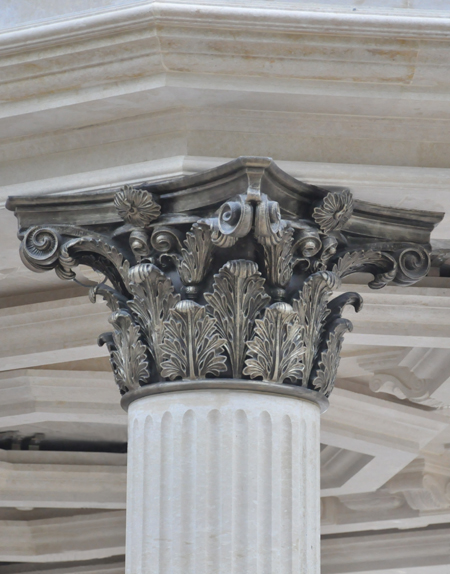
Corinthian capital of the Pantheon portico in Paris. Architect J.-J. Soufflot, 1758–1789/Cast metal capital of the Corinthian order featuring two tiers of acanthus leaves, volutes, and palmettes.
The capital examples illustrate how the ancient acanthus motif persists in later architecture. Both demonstrate different approaches to interpreting the leaf.
The first capital shows very dense, overloaded carving. The acanthus leaves here are deeply cut, featuring strong incisions that create a stark contrast between light and shadow. However, unlike the ancient model from the Pantheon, there is a sense of superfluous detail—the scrolls and leaves seem to compete with one another. The artisan likely aimed not for harmony, but for decorative exuberance.
The second capital is executed in an almost graphic manner; the acanthus leaves are flat, their veins delineated with sharp lines, and the scrolls are small and symmetrical. This capital is closer to the Neoclassical ideal: it possesses a dryness that distinguishes it from the vibrant, organic plasticity of Roman masters.
The motif changes depending on the era and the architect’s intentions—sometimes it is very lush, and at other times it is geometric. This speaks to the plasticity of the acanthus and its ability to adapt to any style.
The acanthus motif has never been static; the legend of Callimachus explains its symbolic birth, but the real history demonstrates its constant transformation. Depending on the era, the objectives, and the tastes of the architect, the same leaf can be either overblown and theatrical or dry and strictly symmetrical. It is precisely this plasticity and ability to adapt to any style that made this plant’s leaf a universal tool.
The Middle Ages and the Renaissance
Capital with acanthus leaves and rosettes. Limestone, c. 1150. Languedoc-Roussillon, France. Victoria and Albert Museum, London.
The presented Romanesque capital from Southeastern France, likely dating to the 12th century, was one of the primary decorative elements in Romanesque church sculpture. The acanthus leaf, vividly rendered on this capital, was a motif borrowed from ancient Roman art, although here it is executed in a stricter, linear style.Looking at the form, one can notice an interesting paradox, as the capital appears very classical. It features tightly curled volutes neatly tucked beneath a flat abacus, strongly reminiscent of the ancient Ionic order. However, the column shaft here is not covered in simple fluting, as in Antiquity. This is a quite vivid example of medieval sculptural architecture.
The column body is not covered with simple ribs, but with intensive, deeply carved, stylized acanthus leaves that curl outward from the top and press against the lower sides of the volute scrolls, creating the impression of an overgrown Greek or Roman ruin.The artisan who crafted this capital was clearly influenced by Roman examples, yet they did not simply copy them. They reworked the form, making the acanthus leaf more rigid than those found in Rome or Greece. Its leaves resemble a pattern more than a living plant. Medieval sculptors were acutely aware of the mastery of ancient architects, but they did not replicate it blindly; instead, they refined it, eventually achieving their own heights.
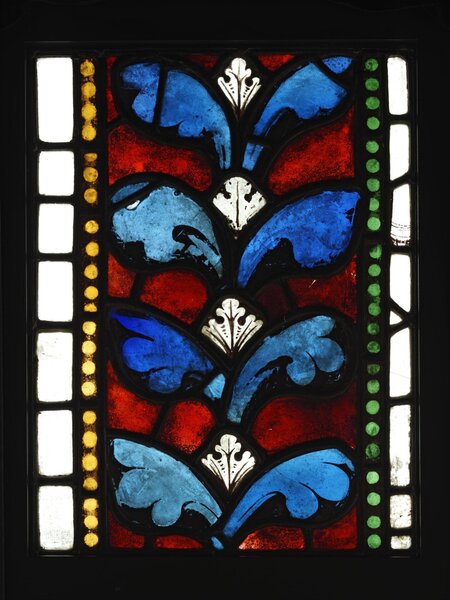
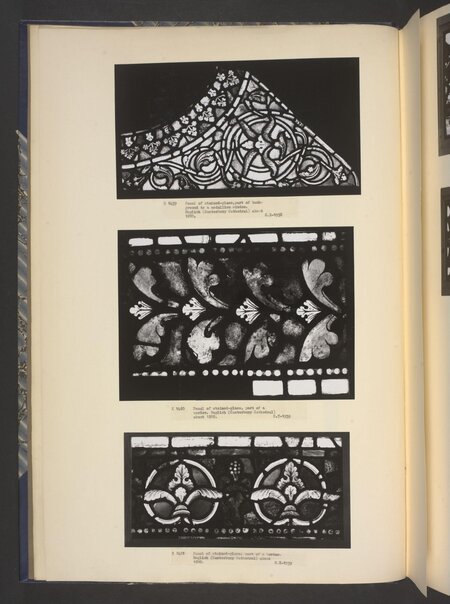
Fragment of a stained glass border featuring acanthus leaves and palmettes. Canterbury Cathedral, England, c. 1200–1220. Victoria and Albert Museum, London. Leaf from the museum catalog with phototypes of fragments of stained glass from Canterbury Cathedral, c. 1200. Victoria and Albert Museum, London.
The first panel is part of the framing for a window from Canterbury Cathedral in Kent. The acanthus leaf was a common decorative motif at the time and illustrates the wide range of classical motifs available to medieval artisans in decorative arts. It extends entirely beyond architecture and its elements.
The panel shows a series of repeating acanthus leaves, but here their form is extremely simplified. Due to the nature of stained glass artistry, it transforms into an abstract ornament. It repeats rhythmically, creating a decorative border for the window.
In the mid-19th century, some medieval stained glass was removed from a cathedral and replaced with copies. The original panels were stored in various glaziers' workshops and eventually sold to private collectors, making it very difficult to determine their original location.
Medieval artisans did more than simply copy the acanthus leaf motif—they adapted it for the new material, integrating it into the church’s interior design.
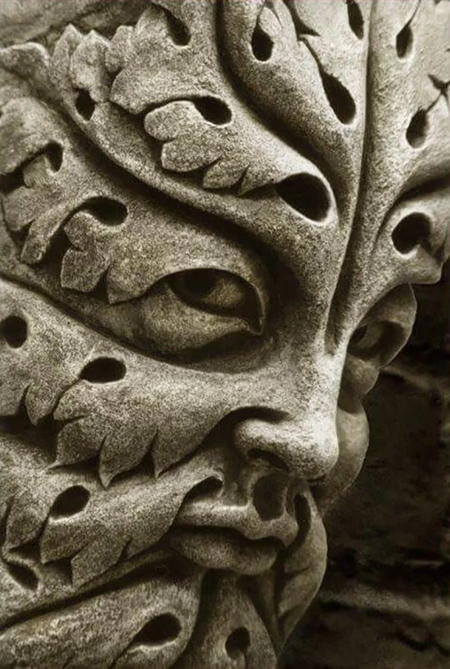
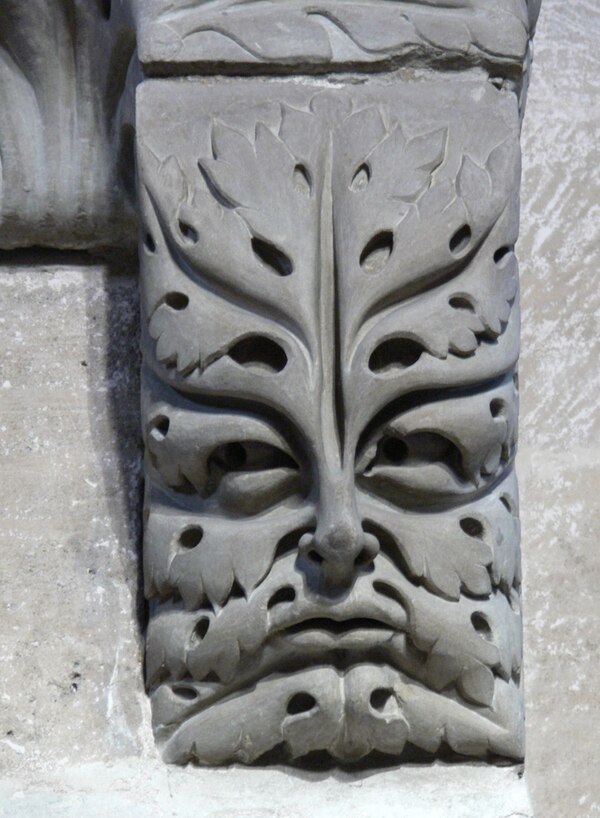
Leaf Mask of the «Green Man» (console beneath the Bamberg Rider statue). Limestone, c. 1235–1239. Bamberg Cathedral, Germany/Leaf Mask of the «Green Man» on the console of the Bamberg Rider (frontal view). Limestone, c. 1235–1239. Bamberg Cathedral, Germany
The Green Man, or the motif of the leafy visage, is a vivid example of how an ancient motif has transformed into something new and unique. The Green Man is a face composed entirely of foliage or surrounded by it. Typically, the shoots and leaves of acanthus grow directly from the character’s mouth, nose, or eyes, becoming an organic part of the human form.
The Green Man from Bamberg Cathedral is entirely composed of leaves; their curls resemble hair, and the deep incisions create a sharp interplay of light and shadow.
In the second Green Man, the central vein of a leaf forms the axis of the face from which all other leaves radiate.
Interestingly, this image was long interpreted as a pagan deity of vegetation. However, research shows that this idea, proposed by Lady Raglan in 1939, lacks evidentiary support. In reality, the Green Man in ecclesiastical architecture often served to illustrate sermons on the mystical origin of the cross. In England, these visages appeared in the early 12th century, arriving from France, and became particularly popular during the Gothic periods of the 13th–15th centuries.
Wedding cassone chest with the Castelli family crest. Walnut, carving, partial gilding. Italy, 16th century.
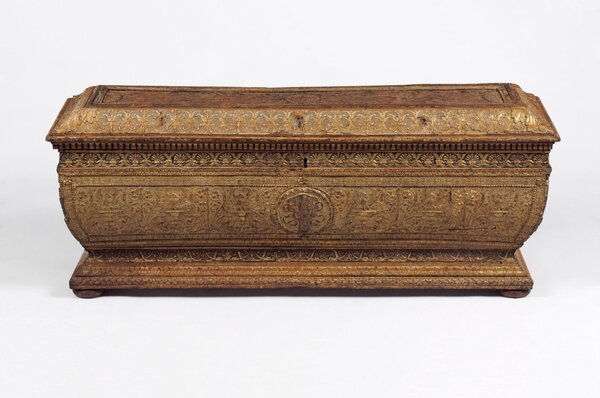
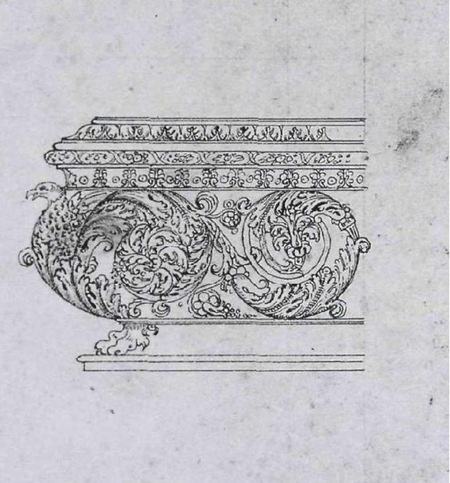
Wedding chest-cassone with the coat of arms of the Della Rovere house. Wood, gesso, gilding, painting. Mantua, Italy, c. 1509. Victoria and Albert Museum, London/Italian Renaissance sketch of a carved cassone with large acanthus scrolls and an eagle corner figure, 16th century.
Two Italian Renaissance cassoni demonstrate how the acanthus motif returned to secular art, becoming integrated into the daily life of the nobility.
The first cassone is crafted from carved walnut with partial gilding. The acanthus is presented in a classic Renaissance interpretation—it is volumetric, plastic, and features deep carving. The artisan creates a true masterpiece from intertwining leaves that serve as a background for a central cartouche bearing a coat of arms. Despite its high decorative nature, the composition is strictly symmetrical, signaling a return to classical principles. The second cassone, created around 1509, features a coat of arms that indicates it was commissioned for Francesco Maria I Della Rovere, Duke of Urbino, for his wedding to Leonora Gonzaga. The chest is covered in gilded stucco with painted decoration, where the acanthus leaves are transformed into a rhythmic ornament that repeats around the entire perimeter.
A line engraving depicting a section of a similar cassone reveals that Renaissance masters functioned as industrial designers. The surface is mathematically gridded, and the acanthus serves as the organizing element. Here, the acanthus is firmly established within secular applied arts, reclaiming its ancient plasticity and becoming a symbol of the patron’s wealth and good taste.
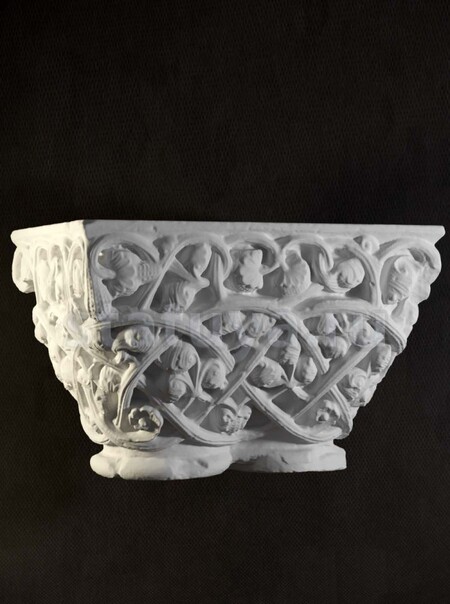
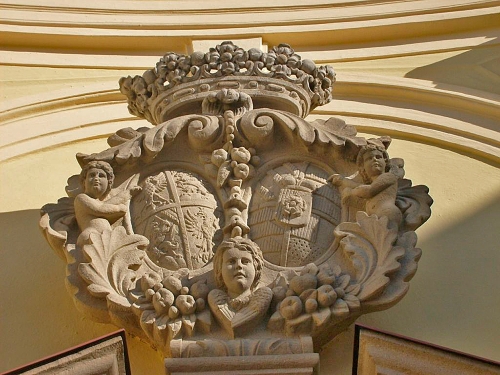
Double Gothic capital with entwined stems and acanthus leaves. Plaster cast, original—13th century / Baroque heraldic cartouche with acanthus scrolls and putti figures. Buchlovice Castle, Czech Republic, late 17th–18th centuries
The visual language and how medieval and Renaissance masters interpreted the acanthus leaf motif differ significantly. The capital featuring acanthus leaves interwoven with heavy vines has entirely lost its antique tectonic quality. It is no longer a constructive element supporting an arch; its leaves transform into a flat, almost lacelike pattern. The master employs a complex interlacing of stems and leaves, creating a chaotic yet rhythmic network where the acanthus is stylized, and its natural botanical form is subservient to religious symbolism and decorative fantasy. In the second image, the acanthus borders a heraldic composition, regaining its volume and plasticity. Large leaves form a symmetrical frame around the coat of arms, curling into tight volutes. The Renaissance master does not hide the acanthus within the pattern; rather, he elevates it to the forefront as a symbol of triumph, nobility, and antique harmony.