Concept
«I am the cinematic eye. I am the mechanical eye.» (Vertov, 1923)
Dziga Vertov, in his text «Kino-Eye. Revolution, ” proclaims the necessity of abandoning an anthropocentric perspective in cinema. He develops the idea of the „kino-eye”—a more advanced, mechanical gaze. Dziga Vertov attributes manifestations of this idea, firstly, to the camera’s properties as an optical apparatus—its ability to capture reality in motion, to distance itself from objects, and to approach them; secondly, to the camera as a physical object that can move and capture a wide variety of angles not always accessible to a person—“…I move beside the muzzle of a running horse, I crash at full speed into a crowd, I run in front of running soldiers, I fall onto my back, I rise along with the airplanes»; and thirdly, to the capabilities of montage, which allow for the creation of a new reality through the juxtaposition of fragmented shots. (Vertov, 1923)
Furthermore, it imbues the cinematic eye with subjectivity, viewing the camera not as a tool wielded by the filmmaker, but as a full participant in the creation of the film to which the director must trust.
Building on these ideas, many researchers following Vertov will expand the concept, contemplating where else this unique cinematic sensibility manifests—what sets it apart from human sensibility—and how it exhibits agency independent of the director’s will. In my work, I will rely on a broader understanding of the cinematic eye—one that incorporates everything that shatters the illusion of cinema as a «window» to the world—and I will reference not only Dziga Vertov’s texts but also ideas from Johannes Binotto’s video essay, «Facing Film.»
Viewing the cinematic gaze as any manifestation of mediated sight, one can find it almost everywhere by shifting the focus of perception, as Binotto does—it was this very idea, raised during a course on film theory, that prompted the research.
I felt the need to find more examples of such manifestations in contemporary Russian cinema. The goal of this research, beyond the search itself, is to examine how and why these techniques are employed and how they affect audience perception. I also hypothesize that new examples of technical mediation can be found in modern cinema—examples that are no longer directly tied to the camera and its properties.
The criterion for selecting visual material was its adherence to the principles described in the text «Kino-ki. The Turnaround,» or the presence of clear traces of technical mediation within the film. As supplementary textual sources, I utilized interviews in which directors and cinematographers describe the technical processes of their work. Each section of this research categorization represents one of the factors that differentiate the cinematic eye from the human gaze, most of which were outlined in Dziga Vertov’s text.
Camera Location
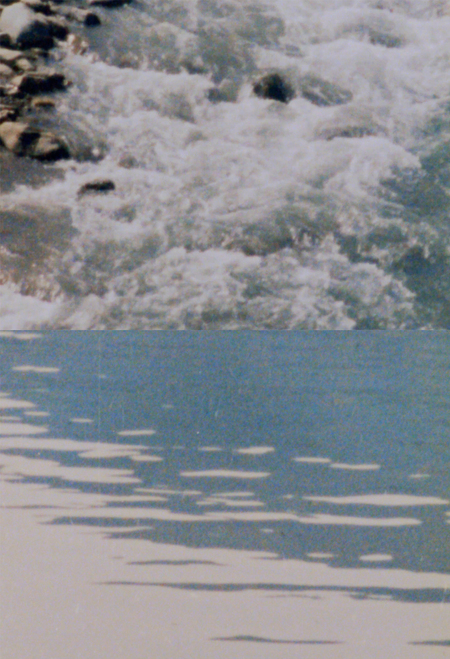
When discussing the camera’s ability to capture what is inaccessible to the human eye, one must first turn to extreme angles—those physically difficult for us to achieve. Modern cinematography equipment—cameras designed for shooting in diverse conditions, and drones—allow us to film practically anywhere. A particularly interesting example seems to be Victor Kosakovsky’s film, «Watercolor,» which explores water as an element.
1. «Watercolor» (2018, directed by Victor Kosakovskiy)
The cinematographer is not limited by the objects around them—“I crawl under them, I climb onto them.» (Vertov, 1923) Kosakovskiy uses shots filmed underwater: the camera circles through layers of ice, observing a drowning horse, plunging into an environment usually inaccessible to humans.
«The cinematic eye lives and moves in time and space; it perceives and records impressions not like a human, but differently. The position of our body during observation, or the number of moments of a specific visual phenomenon we perceive per second, is not necessary for the film apparatus» (Vertov, 1923)
2. «Watercolor» (2018, directed by Victor Kosakovsky)
In narrative cinema, the viewer’s gaze usually aligns with the camera’s gaze, creating a sense of naturalism. Rejecting human perspective—a frontal, eye-level view—breaks this familiar illusion. It is at this point that mediation arises, prompting the viewer to remember that the image they are watching was captured by a camera.
3. «Topi» (2021, dir. Vladimir Mirzoyev)
In «Aquarelles,» which largely rejects human-centered perspectives, the technique is simply a stark, impartial gaze. In «The Swamps» and «Crime and Punishment,» the approach is utilized differently: most scenes are shot from conventional angles, but similar shots appear to evoke a sensation of semi-sleep or hallucination, stemming from a sudden shift in perspective.
4. «Crime and Punishment» (2024, dir. Vladimir Mirzoev)
5. «Dust» (2005, dir. Sergey Loban)
Scale
Another variation on the inhuman perspective, and another principle articulated by Vertov, is maximal proximity to the subject followed by fragmentation.
6. «Vacation in October» (2023, directed by Roman Mikhailov)
The human gaze is limited in its ability to approach an object. Too short a distance prevents the eye from focusing. The camera’s view can «close in» on a subject or person, capturing the finest details, inevitably isolating individual images that may no longer be connected to the surrounding space.
7. «Topi» (2021, directed by Vladimir Mirzoev)
8. «Crime and Punishment» (2024, dir. Vladimir Mirzoev)
In the films of Roman Mikhailov and Vladimir Mirzoyev, such fragmentary images become almost tactile. The image feels ephemeral—the cinematic eye immerses the viewer in another reality, one created by the film, reminiscent of a dream.
«The cinematograph carries the eyes of the cinema viewer from hands to feet, from feet to eyes, and otherwise, in the most advantageous order, organizing particulars into a methodical montage sketch.» (Vertov, 1923)
Movement and Stillness
«I free myself from the stillness of humanity starting today; I am in continuous motion» (Vertov, 1923)
9. «Crime and Punishment» (2024, dir. Vladimir Mirzoev)
Dziga Vertov, in the film «Man with a Movie Camera,» demonstrates shooting from a moving object, where the cameraman stands on a vehicle. In contemporary cinema, camera movement is not surprising, but less often does the movement take on the character of a specific object (a bicycle, a car, a boat); more often, it is a smooth tracking shot using specialized equipment, imitating the movement of the human gaze. This reason makes such explicitly mechanical movement stand out from typical perception and reminds us that there is an intermediary step between the viewer and what is happening on screen.
10. «Watercolor» (2018, directed by Victor Kosakovsky)