The «From Point to Pixel» section of the exhibition «Still Life. Portrait. Landscape. Post-Genre» describes the transition from observing nature to images that are created and distributed through technology.
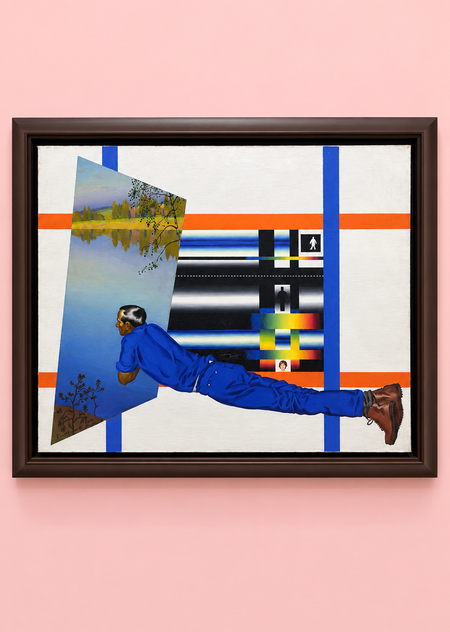
«Artist in the Open Air» (1968) by Erika Bulatov seems like an almost perfect illustration of this transition. However, in my view, the painting speaks less about the shift in technology and more about an earlier and more fundamental conflict—between painting, which promises to open up space, and the impossibility of transcending the picture itself.The canvas depicts the artist Oleg Vasilyev, a friend and collaborator of Bulatov. He appears to be floating before an inclined plane featuring a lake and trees, his gaze directed into the painted landscape. Nature does not surround him; it is before him as an image. Intersecting bands, color gradients, and conventional signs resembling the language of technical diagrams are positioned around his figure. Yet, the entire work is executed in oil on canvas. Bulatov juxtaposes several ways of organizing space: perspectival illusion, figurative painting, and geometric plane. The title sounds ironic; plein air suggests working outdoors among nature, but the protagonist is situated before its representation.
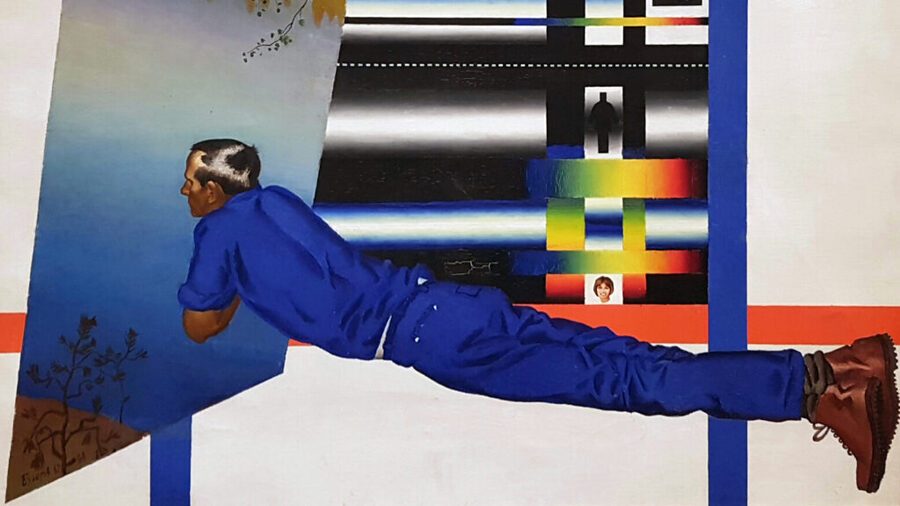
In the late 1960s, against the backdrop of the official Soviet cultural emphasis on representational clarity, Bulatov explored the inner mechanics of the painting. Even before the works where words overshadow the landscape, he investigated how perspective pulls the eye into depth, and how the flat plane halts that movement. «Artist in the Open Air» merges realism and abstraction. Furthermore, the painting suggests that the depiction of nature never corresponds with nature itself.The juxtaposition with Nikolai Vechtomov’s «Road» (1983), placed directly above Bulatov’s work, is particularly striking. Vechtomov’s piece features rows of massive columns converging toward the setting sun, creating an almost infinite pathway. In contrast, Bulatov’s character has already approached the landscape but confronts its flatness. In one work, perspective draws the viewer inward; in the other, its illusion becomes apparent.The curatorial decisions allow us to read Bulatov’s geometric bands and conventional signs as elements of a screen image. This is an interesting perspective, but it is unlikely that the 1968 work should be attributed to a critique of digital technology. I believe Bulatov’s question is deeper—it predates the computer and all other technologies. Why does the image compel us to believe in a space that is not physically present before us? In this sense, the curatorial reading does not negate the original meaning; rather, it brings it into contemporary relevance.
The screen, much like a painter’s canvas, invites entry into the depicted world while remaining an impenetrable surface.