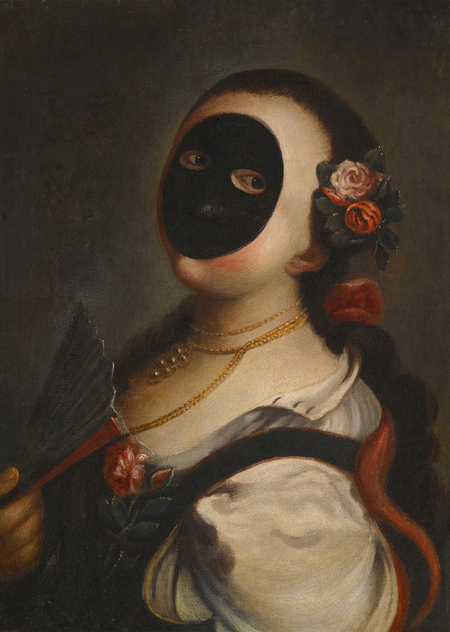
Concept
Since ancient times, humans have strived to inhabit the forms of others—donning masks, participating in theatrical performances, and playing various roles. In our modern era, this opportunity has found new expression in video games. This often allows us to step outside our own identity and, for a time, become someone else. A player can choose a character with a distinct personality and appearance or create their own avatar and even live an alternate life through them. This kind of interactive space in games, where the individual independently conceives their character, presents an opportunity to experiment with one’s own «self.»
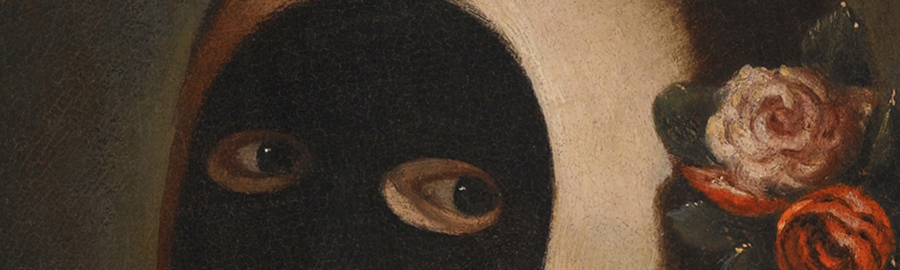
Felice Boscaratti // Moretta // Fragment
The hypothesis of this research is that role-playing is not merely a way to escape reality, but also an opportunity to explore one’s own identity by adopting another role. Masks, character personas, and player-created characters help individuals try on different roles and experiment with behavior.
The visual research will be built around the theme of interest in role-playing as a means of self-expression and the exploration of alternative identities.
Why do players spend hours customizing their appearance? Why does one person strive to create an avatar that looks as much like themselves as possible, while others choose a completely contrasting persona? How does the chosen role influence the player’s own behavior?
To answer these questions, the visual research will analyze video games where embodiment is a significant part of the gameplay space. Examples include: «The Sims» and «Baldur’s Gate».
We will also analyze masks, theatrical representations, and role-playing practices—historical and cultural examples of embodiment—to allow for a comparison between in-game avatars and earlier forms of assuming another’s role.
Screenshot from The Sims 4
With the evolution of video games, the possibilities for in-game role-playing have expanded significantly. Today, an individual can create their own characters and determine their subsequent fate. In light of this, the question of what role in-game role-playing plays in a person’s perception of their own identity has become particularly relevant.
The theoretical foundation of this research is built upon two primary views of role-playing: Kai Hua Roger’s concept, which views play as an opportunity to inhabit another person’s identity, and Lev Vygotsky’s theory, which explains how an imagined situation and an adopted role influence human behavior.
A key concept in Kai Hua Roger’s theory is mimicry—one of the four categories he identified in play. It relates to imitation, disguise, and the temporary adoption of another identity. Another crucial element of the research is Lev Vygotsky’s theory, which is based on the concepts of imagined situations and roles in play. He views play as an activity where the participant acts according to the rules of an imagined situation. This theory helps explore how adopting a role influences a player’s behavior and why actions taken on behalf of a character often differ from their usual behavior in reality.
Franz Josef Jannek // «Masquerade Ball in Venice»
The research is divided into two main parts, which sequentially examine early and contemporary forms of immersive role-playing, as well as changes in character creation methods and the experience of inhabiting game roles.
The first part covers the origins of immersive role-playing. This section will explore the evolution of adopting another’s role—from traditional masks, theater, and role-playing games to the creation of early video and board games that offered character selection and customization.
The second part will examine modern methods of immersion through character customization, the creation of virtual identities, and detailed appearance tailoring. It also addresses the possibility of living alternative lives and influencing the plot surrounding a character through one’s own decisions.
Categories
Here will be a section breakdown
The Origins of Immersive Play
Long before the advent of video games, people were captivated by role-playing and used various masks for this purpose. Masks became a part of rituals, celebrations, and theatrical performances, allowing an individual to temporarily embody another creature or character.Roger Caillois, in his book «Games and People,» examines the mask as an essential element of role-playing. He notes that the concept of mimicry «covers all forms of entertainment that require wearing a mask or dressing up, and which are based precisely on the fact that the player is masked or in disguise.» Thus, the mask does more than just change a person’s appearance—it allows them to temporarily adopt a different role.
Édouard Manet // «Bal Masqué at the Opera»
«Mimicry—any game involves the temporary adoption of some closed, conventional, and in some respects fictional world.» Kai Hua Roger
The words of Kaihua suggest that role-playing is not limited to external changes in appearance. By adopting a new fictional role, a person temporarily becomes a part of an imaginative and «fictional» world.
The concept of mimicry describes several forms of role-playing. Examples include children’s games in other people’s roles—for instance, «a girl plays mommy or a cook» or «a boy pretends to be a soldier, musketeer, or Martian"—principles that often «transition from childhood into adult life.» This same principle of adopting another’s role is also found in theatrical performances and masquerades.
Pieter Bruegel the Elder // «Children’s Games» // The painting depicts children engaged in trade, a wedding, and a christening.
These events took on a special form, during which participants wore costumes and concealed their faces. People held carnivals to temporarily forget society’s strict rules, feel freedom, and try on a new role. According to Kaiua, «the mask conceals the social role and frees the authentic self.»
The mask also held immense significance in theater; it helped actors embody specific characters. In theatrical productions, the mask presents a person as a distinct, recognizable character, stripping the actor of their own identity and the freedom to interpret the character’s nature.In this scenario, the mask became merely the boundary between the performer and the character, yet the audience perceived the artist as the hero of the story they were playing, without assigning them individual character traits.
Mosaic // Masks of Tragedy and Comedy // Artist Unknown
Thanks to the convergence of theater and masks, «the play fully manifests its cultural productivity.»
There are also «ritual masks» that were used to connect with the supernatural world and facilitate personal transformation. Such a mask is primarily a ritual attribute that aids in the transition between worlds: «Rituals are designed to separate the realm of profane (worldly, everyday) life from life in the sacred world.» According to Roger Caillois, by donning the mask as a ritual prop, a person temporarily ceased to be themselves and transformed into a god, spirit, ancestral animal, or «all manner of supernatural forces.»However, this use of masks differs from theatrical plays or carnivals because the person in a ritual mask experiences «the intrusion of forces that they fear» and over which they have «no control.» Because of this, driven mad, the person begins to genuinely believe they are the god they were merely pretending to be.
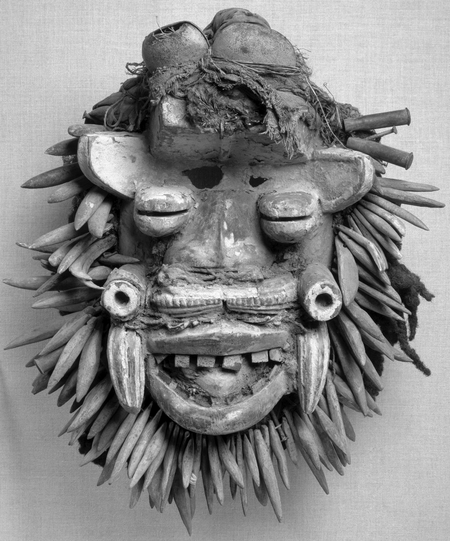
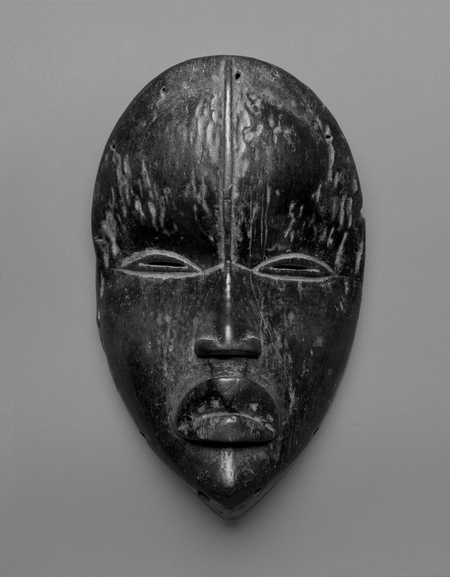
Ritual masks of the Dan people
«As it is said in Kabbalah, by playing the ghost, one can become one.» Roger Kiuah, «Mask and Transformation»
Throughout history, the mask has served various functions: in rituals, it could signify a connection to the supernatural; in theater, it aided in embodying a character; at masquerades, it allowed for a temporary shift in conventional social roles; and for kids, it was simply a fun game.