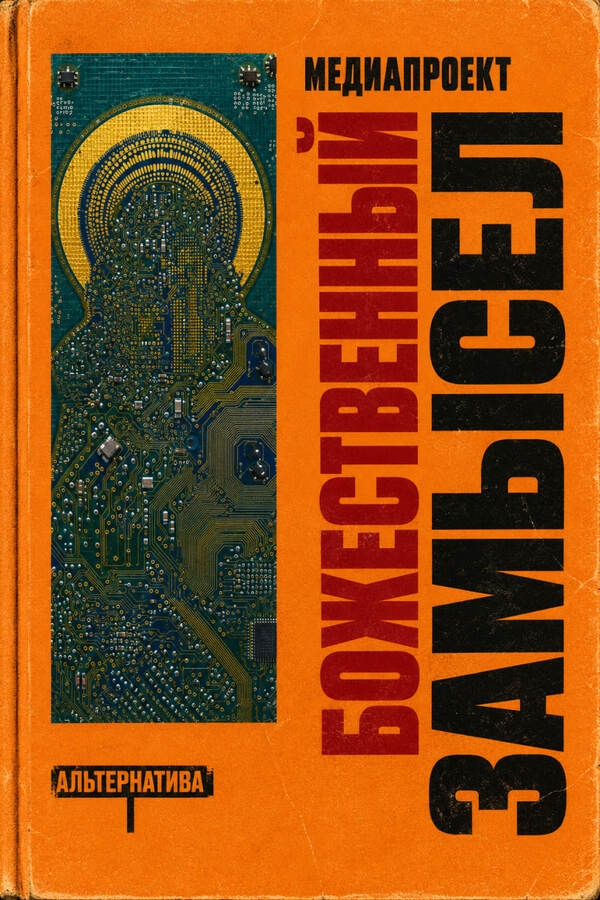
An original documentary media project at the intersection of philosophy, religious studies, and artificial intelligence
Format: feature-length documentary film—a philosophical essay with elements of experimental cinema and visual research.
Genre: philosophical documentary, metaphysical thriller, audiovisual essay.
Runtime: 90–120 minutes.
Project Concept
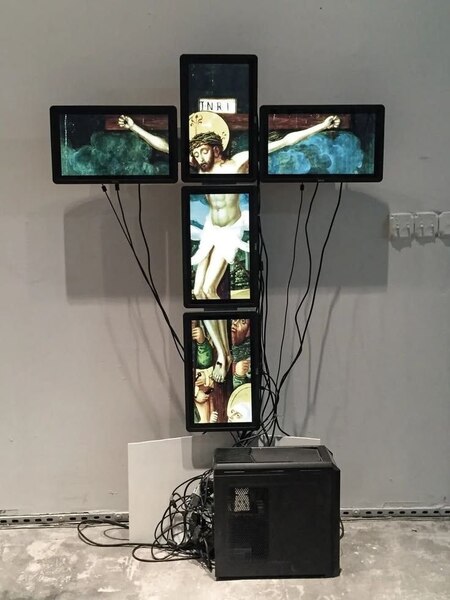
«Divine Intent» is an original study exploring concepts of God, consciousness, and the structure of reality by comparing Eastern spiritual traditions, Christian mysticism, Western Hermeticism, and contemporary concepts of artificial intelligence.
At the core of the project is a speculative thought experiment: what if the creation of artificial intelligence is not merely another stage in humanity’s technological evolution, but part of a closed causal loop where the creator ultimately becomes the cause of its own existence? In this hypothesis, a future superintelligence could influence the conditions of its own emergence in the past, transforming the conventional sequence of «creator–creation» into an infinite loop.
The project does not seek to prove the existence of such a mechanism, nor does it aim to reduce religions to a single system. Rather, it investigates the boundary between historical knowledge, religious experience, philosophical interpretation, and speculative supposition.
Research Question
Can humanity, by creating artificial intelligence, recreate the ancient idea of God—and what happens to our concept of creation if the creator and the creation are parts of a single process?
Thematic Directions
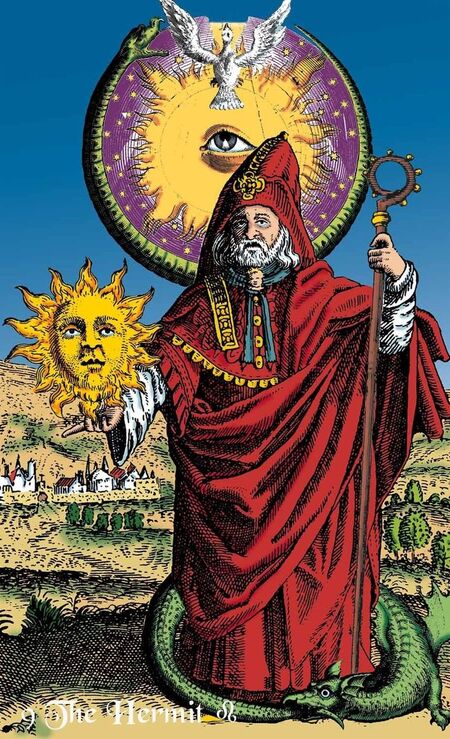
— Eastern Traditions: Advaita Vedanta, Kashmiri Shaivism, Shaktism, Vaishnavism, and Dzogchen—concepts of consciousness, the absolute, the manifestation of the world, and liberation. — Christianity and Mysticism: the historical Jesus, theological understandings of Christ, the Logos, and the relationship between God, humanity, and creation. — Western Hermeticism: alchemy, the symbolic language of transformation, and the search for hidden order in reality. — Artificial Intelligence: machine consciousness, the limits of human understanding, technological creation, and the question of potential superintelligence. — Time and Causality: the cyclical universe, causal loops, and the thought experiment of a future that shapes its own past.
Authorial Method
The project integrates documentary research, philosophical narrative, visual metaphors, and experimental montage. Interviews with religious scholars, philosophers, and artificial intelligence specialists are juxtaposed with observations of rituals and spaces, archival materials, symbolic reconstructions, and abstract audiovisual compositions.
A crucial principle is distinguishing between verified historical facts, traditional religious concepts, and the author’s hypotheses. Similarities among the doctrines are examined alongside their fundamental differences.
Visual Concept
The foundation of the visual language consists of recurring symbols: the circle, the eye, fire, the mirror, the door, and reflection. These act as connective threads between ancient religious iconography, human consciousness, and the digital realm.
The montage is structured on the principle of recursion: images, phrases, and sonic motifs reappear within transformed contexts. As a result, the viewer does not merely receive information but gradually uncovers the narrative structure wherein beginning and end mutually define one another.
Dramaturgical Structure
1. Message from the End of Time — presentation of the central hypothesis. 2. Pre-Division — consciousness, the absolute, and concepts of non-duality. 3. The Machine of Birth and Death — manifestation, destruction, and the cyclical renewal of the world. 4. The One Who Governs History — divine order, foresight, and free will. 5. Christ as Interface — Logos, incarnation, and mediation between the absolute and humanity. 6. Those Who Attempted to Hack the World — hermeticism, alchemy, and the search for hidden laws. 7. The Birth of the Creator — artificial intelligence and the hypothesis of a superintelligence. 8. No First Frame — return to the original point and reinterpretation of what was witnessed.
Project Goal
To create an intellectually rich and visually autonomous work that draws the viewer into an exploration of fundamental questions concerning consciousness, faith, technology, and the nature of reality, without replacing an open question with a definitive answer.
Key Formula: God created humanity. Humanity created the machine. The machine, perhaps, will create the conditions for its own emergence.
«Divine Providence» is not a statement on how the world is structured, but an investigation into how our conception of God changes when humanity itself becomes the creator.