The Universal Measures
Recommended measures for accessibility
An effective architectural project ought to be inclusive, accommodating individuals irrespective of their physical or cognitive capabilities. To enhance awareness of these concerns and aid in the design process, we have curated a set of fundamental principles essential for creating residential spaces that are comfortable and unobstructed for all inhabitants. It is crucial to acknowledge that each country enforces distinct regulations pertaining to universal design, and therefore, the dimensions provided here are based on the Universal Accessibility Guide. Prior to undertaking the design of an accessible environment, it is imperative to consult local regulations and thoroughly understand the specific needs and requirements of its users. This approach ensures a sustained enhancement of their quality of life.
blended ramp and steps at Vancouver, British Columbia’s Robson Square, designed by Canadian architect Arthur C. Erickson in 1980.
Urban Accessibility
The correct urban accessibility facilitates mobility and the autonomous flow of all people. In these public spaces the social encounter and the displacement of all people takes place. If we think about it in an accessible way, it allows us to equalize opportunities and facilitate the development of daily activities under conditions of equality and safety. The accessibility chain allows people with disabilities to move between their home, public or private transport and their places of interest in an autonomous and independent way.
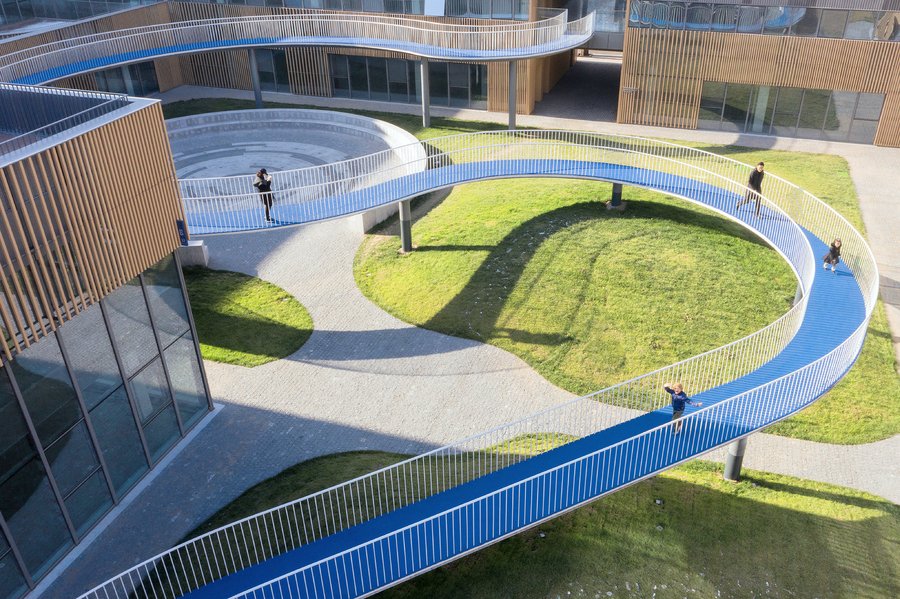
Tongzhou SINLOON Canal Creative District / officePROJECT. Imagen © Zhi Xia
Urban Signage: Tactile Surfaces
Blindness and visual impairment go beyond being just conditions or disabilities; they offer a different way of experiencing the world around us. In this context, touch transforms into a language and an essential tool for engaging with architecture. The Convention on the Rights of Persons with Disabilities (Article 9) emphasizes that everyone has the fundamental right to access the physical environment equally.
Example of outdoor tactile path. Image Courtesy of Enrique Tovar (ArchDaily)
Types of motifs, sizes and colors
The tactile pavement system encompasses two primary types: warning and guide pavements. The warning pavement incorporates a pattern of detectable dots or domes specifically designed for individuals who are blind or have visual impairments, facilitating navigation with the use of a white cane. These pavements should be strategically installed in areas where critical safety information, imminent hazards, and decision-making points must be communicated effectively.
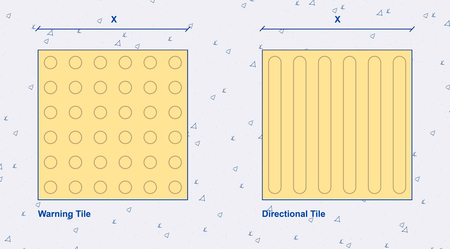
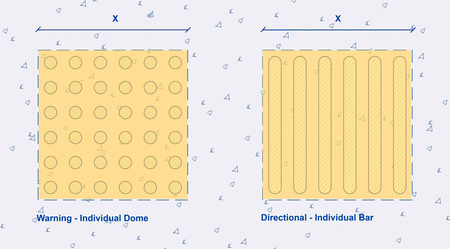
Tile format and Individual format. Image Courtesy of Enrique Tovar (ArchDaily)
Conversely, the directional or guide pavement consists of a pattern of lines or bars that offer clear and consistent guidance for visually impaired users. These pavements should be positioned to signify an accessible circulation route, applicable both outdoors and indoors, or to demarcate a clear pedestrian passageway, thereby aiding in orientation. In both instances, the warning and guide pavements can be detected through tactile cues, either by foot or with the aid of a cane, enabling individuals to maintain a straight path and navigate safely.
Example of outdoor tactile path. Image Courtesy of Enrique Tovar (ArchDaily)
Approach to elements and level changes.
Elements within constructed environments can present hazards for individuals with blindness or visual impairments. Failure to identify these elements can compromise individuals' safety. In such situations, the implementation of warning systems becomes pertinent. Emphasis should be placed on identifying changes in elevation, unprotected edges, inclines such as ramps, the top and bottom of staircases, elevator access points, platform edges, wheelchair ramps, and depressed curbs on streets. Crucially, these elements should consistently be positioned on sidewalks to prevent encounters with vehicular traffic.
Approaching elements and level changes. Image Courtesy of Enrique Tovar (ArchDaily)
Touch trajectory and typical configurations.
The tactile route comprises a blend of tactile warning and guidance pavements, formulated to delineate a clear and unobstructed pathway between two points. Its primary purpose is to offer secure and accessible orientation and guidance for individuals, thereby ensuring the absence of obstacles that may obstruct movement or endanger users. This route proves especially beneficial in constructed environments characterized by expansive open areas, extended distances, and spaces with significant pedestrian traffic.
It is advised to establish a tactile pathway from primary entry points to initial communication areas, including entrance doors, information booths, and similar locations.
In public environments, it is typical to encounter these pathways in settings such as ground transportation hubs, where it is essential to extend coverage from the entrance to the specified vehicle boarding zone.
Typical configurations. Image Courtesy of Enrique Tovar (ArchDaily)
Tactile paths should be easy to travel, giving priority to straight paths and 90-degree changes of direction with at least one warning pavement module or with 4 or more modules when feasible and without creating obstacles.
Typical configurations. Image Courtesy of Enrique Tovar (ArchDaily)
Braille signage facilitates the identification of crucial spaces, such as meeting rooms, restrooms, and entrances, thereby granting autonomy in locating these essential areas.
Typical configurations. Image Courtesy of Enrique Tovar (ArchDaily)
Wheelchair accessible areas
Schematic image with recommended measurements. Local regulations should be reviewed before designing. Image © José Tomás Franco.
Schematic image with recommended measurements. Local regulations should be reviewed before designing. Image © José Tomás Franco
Ramp. Schematic image with recommended measurements. Local regulations should be reviewed before designing. Image © José Tomás Franco
Minimum measurements for doors. Schematic image with recommended measurements. Local regulations should be reviewed before designing. Image © José Tomás Franco
Minimum measurements for bathrooms. Schematic image with recommended measurements. Local regulations should be reviewed before designing. Image © José Tomás Franco
ADA National Network. Learn About ADA [Article]. ADA National Network. (URL: https://adata.org/learn-about-ada). Viewed: 15.11.2024.
ADA National Network. Planning Guide: Making Temporary Events Accessible for People with Disabilities [Guide]. ADA National Network. (URL: https://adata.org/guide/planning-guide-making-temporary-events-accessible-people-disabilities). Viewed: 15.11.2024.
Ciudad Accesible. ¿Qué es el diseño universal? [Article]. Ciudad Accesible. (URL: https://www.ciudadaccesible.cl/que-es-el-diseno-universal/). Viewed: 15.11.2024.
Creative Crews. Classroom Makeover for the Blind [Article]. ArchDaily. (URL: https://www.archdaily.com/918942/classroom-makeover-for-the-blind-creative-crews#). Viewed: 15.11.2024.
Creative Crews. Cómo los 7 principios del diseño universal ayudan a crear una mejor arquitectura [Article]. ArchDaily. (URL: https://www.archdaily.mx/mx/1019754/como-los-7-principios-del-diseno-universal-ayudan-a-crear-una-mejor-arquitectura). Viewed: 15.11.2024.
Creative Crews. Sala de aprendizaje para ciegos [Article]. ArchDaily. (URL: Las presentaciones son herramientas de comunicación que se pueden usar en exposiciones, conferencias, discursos, informes y más.). Viewed: 15.11.2024.
Nora Libertun de Duren. Espacios públicos para personas con discapacidad, niños y mayores [Report]. (PDF, pages 138-144). Viewed: 15.11.2024.
Sealab. School for Blind and Visually Impaired Children [Article]. ArchDaily. (URL: Sealab. School for Blind and Visually Impaired Children [Article]. ArchDaily. (URL: https://www.archdaily.com/984721/school-for-blind-and-visually-impaired-children-sealab). Viewed: 15.11.2024.). Viewed: 15.11.2024.
Tokyo Toilet Project. Yoyogi Fukamachi Mini Park [Article]. Tokyo Toilet. (URL: Sealab. School for Blind and Visually Impaired Children [Article]. ArchDaily. (URL: https://www.archdaily.com/984721/school-for-blind-and-visually-impaired-children-sealab). Viewed: 15.11.2024.). Viewed: 15.11.2024.
ArchDaily. Bronx Children’s Museum [Article]. ArchDaily. (URL: Sealab. School for Blind and Visually Impaired Children [Article]. ArchDaily. (URL: https://www.archdaily.com/984721/school-for-blind-and-visually-impaired-children-sealab). Viewed: 15.11.2024.). Viewed: 15.11.2024.
ArchDaily. Classroom Makeover for the Blind [Article]. ArchDaily. (URL: Sealab. School for Blind and Visually Impaired Children [Article]. ArchDaily. (URL: https://www.archdaily.com/984721/school-for-blind-and-visually-impaired-children-sealab). Viewed: 15.11.2024.). Viewed: 15.11.2024.
ArchDaily. Cómo guiar a las personas en espacios arquitectónicos con pavimentos táctiles [Article]. ArchDaily. (URL: Sealab. School for Blind and Visually Impaired Children [Article]. ArchDaily. (URL: https://www.archdaily.com/984721/school-for-blind-and-visually-impaired-children-sealab). Viewed: 15.11.2024.). Viewed: 15.11.2024.
ArchDaily. Pabellón en Parque Santa Clara [Article]. ArchDaily. (URL: Sealab. School for Blind and Visually Impaired Children [Article]. ArchDaily. (URL: https://www.archdaily.com/984721/school-for-blind-and-visually-impaired-children-sealab). Viewed: 15.11.2024.). Viewed: 15.11.2024.
ArchDaily. Qkids English Center [Article]. ArchDaily. (URL: Sealab. School for Blind and Visually Impaired Children [Article]. ArchDaily. (URL: https://www.archdaily.com/984721/school-for-blind-and-visually-impaired-children-sealab). Viewed: 15.11.2024.). Viewed: 15.11.2024.
ArchDaily. School for Blind and Visually Impaired Children [Article]. ArchDaily. (URL: Sealab. School for Blind and Visually Impaired Children [Article]. ArchDaily. (URL: https://www.archdaily.com/984721/school-for-blind-and-visually-impaired-children-sealab). Viewed: 15.11.2024.). Viewed: 15.11.2024.
ArchDaily. West Lafayette Wellness Center [Article]. ArchDaily. (URL: Sealab. School for Blind and Visually Impaired Children [Article]. ArchDaily. (URL: https://www.archdaily.com/984721/school-for-blind-and-visually-impaired-children-sealab). Viewed: 15.11.2024.). Viewed: 15.11.2024.
Come On Barcelona. Barcelona na Kolyaskakh [Article]. Come On Barcelona. (URL: Sealab. School for Blind and Visually Impaired Children [Article]. ArchDaily. (URL: https://www.archdaily.com/984721/school-for-blind-and-visually-impaired-children-sealab). Viewed: 15.11.2024.). Viewed: 15.11.2024.
Encrypted TBN. Image [Image]. (URL: Sealab. School for Blind and Visually Impaired Children [Article]. ArchDaily. (URL: https://www.archdaily.com/984721/school-for-blind-and-visually-impaired-children-sealab). Viewed: 15.11.2024.). Viewed: 15.11.2024.
Gooood. Publi City Tongzhou: Sinloon Canal Creative District [Article]. Gooood. (URL: Sealab. School for Blind and Visually Impaired Children [Article]. ArchDaily. (URL: https://www.archdaily.com/984721/school-for-blind-and-visually-impaired-children-sealab). Viewed: 15.11.2024.). Viewed: 15.11.2024.
Link Springer. Article on MRS [Article]. Springer. (URL: Sealab. School for Blind and Visually Impaired Children [Article]. ArchDaily. (URL: https://www.archdaily.com/984721/school-for-blind-and-visually-impaired-children-sealab). Viewed: 15.11.2024.). Viewed: 15.11.2024.
UDD. Arquitectura analizará la accesibilidad universal [Article]. UDD. (URL: Sealab. School for Blind and Visually Impaired Children [Article]. ArchDaily. (URL: https://www.archdaily.com/984721/school-for-blind-and-visually-impaired-children-sealab). Viewed: 15.11.2024.). Viewed: 15.11.2024.
Tokyo Toilet Project. Yoyogi Fukamachi Mini Park [Article]. Tokyo Toilet. (URL: Sealab. School for Blind and Visually Impaired Children [Article]. ArchDaily. (URL: https://www.archdaily.com/984721/school-for-blind-and-visually-impaired-children-sealab). Viewed: 15.11.2024.). Viewed: 15.11.2024.
Officesign Company. ADA Braille Elevator Jamb Number Sign [Article]. Officesign Company. (URL: Sealab. School for Blind and Visually Impaired Children [Article]. ArchDaily. (URL: https://www.archdaily.com/984721/school-for-blind-and-visually-impaired-children-sealab). Viewed: 15.11.2024.). Viewed: 15.11.2024.
Skillman. City of West Lafayette Wellness Center [Project]. Skillman. (URL: Sealab. School for Blind and Visually Impaired Children [Article]. ArchDaily. (URL: https://www.archdaily.com/984721/school-for-blind-and-visually-impaired-children-sealab). Viewed: 15.11.2024.). Viewed: 15.11.2024