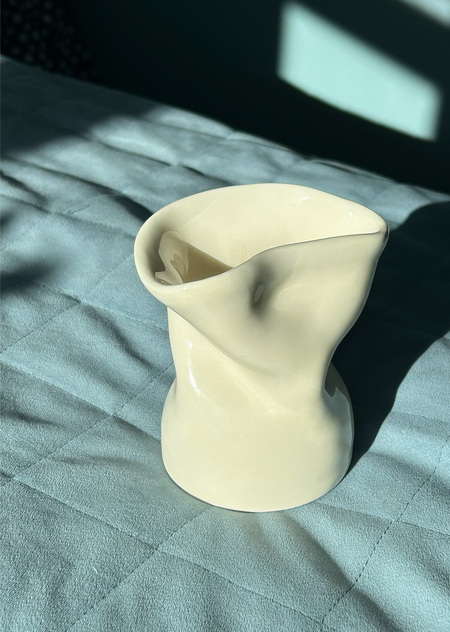
Ceramic Vase for GLOW ME Store
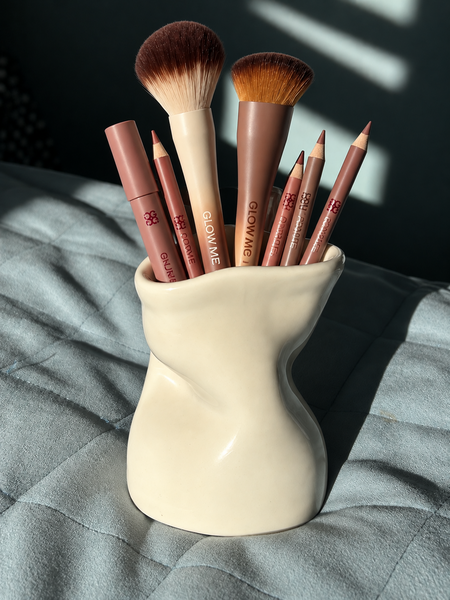
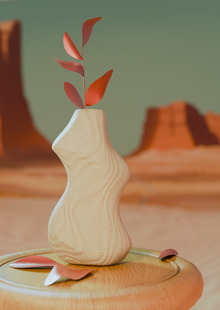
A ceramic vase for storing brushes and pencils, created for the GLOW ME brand, is a functional object that also serves as a standalone decorative element for a workspace. The project is based on the concept of controlled randomness: the form of the piece does not adhere to strict symmetry but emerges through interaction with the material. The object merges practical utility with sculptural expression, transforming an everyday item into a small work of ceramic art.
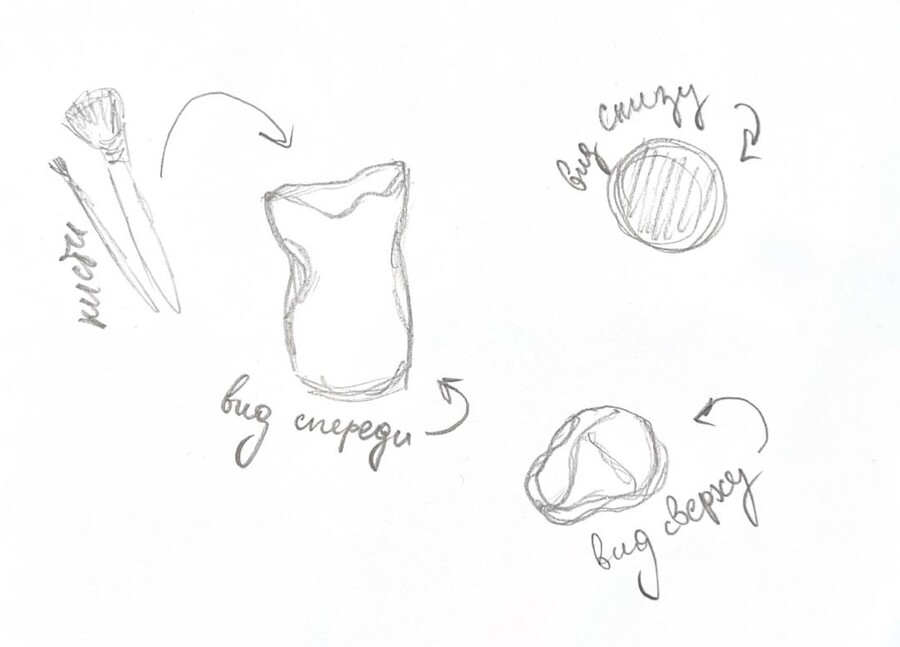
Sketch
Smooth curves, an uneven edge, and flowing lines create a sense of fluidity and movement. The unusual plasticity makes the vase interesting to view from various angles. A light, glossy surface will accentuate the softness of the silhouette, drawing attention to its volume.
Object Description
Purpose: Storage for brushes, pencils, and other creative tools.Material: Ceramic clayManufacturing Technique: Shaping on a potter’s wheel followed by manual deformation of the form.Glaze: Milky white glossy glazeDimensions: Height — 11 cm, Length — 8 cm, Width — 8 cm.Place of Manufacture: Chalet Studio.
Form Generation and Construction
The vase was formed using the pottery wheel throwing method. During the process, the ceramic mass was centered, and subsequently, a hollow volume with an open top was shaped from it. The distinctive feature of this technique is that asymmetry was introduced directly while the wheel was spinning: the position of the walls was intentionally altered during the pulling out process, resulting in smooth curves and flowing lines.The form was not built from a predetermined symmetrical contour but was rather developed intuitively through hand movement and interaction with the plastic material. The rotation of the potter’s wheel became an integral part of the shaping process.This approach can be characterized as dynamic geometry manipulation during wheel throwing. The resulting piece retains the hallmarks of a wheel-thrown object but deviates from traditional axial symmetry. The effect of fluidity serves as the primary artistic device, and the form’s individuality is determined by the creative process itself.The vase constitutes a single hollow volume without any additional connecting elements. Its dimensions are 11 cm in height and 8 × 8 cm at the base in length and width.
Processing
The vase’s exterior is coated with a light, glossy glaze. The cream-milky hue complements the organic softness of the form, while the sheen enhances the play of light across the curves and recesses. The absence of additional graphic or ornamental decoration allows the focus to remain entirely on the silhouette and surface texture.
Firing Technology
After being shaped, the vase underwent natural drying until all moisture was removed from the ceramic mass. The piece was then subjected to a first, bisque firing at an approximate temperature of 900–1000 °C. This stage provided the necessary strength to the body and prepared the surface for glazing.
Following cooling, the surface of the piece was coated with a glaze in a light cream hue with a glossy effect. Next, a second, glaze firing was performed, during which the glaze melted and formed a smooth, lustrous surface. The temperature of the second firing depends on the composition of the ceramic mass and the glaze, and for different techniques, it can range from approximately 1000–1280 °C.
Thus, the basic technological scheme considered is a two-stage firing process: bisque and glaze. The specific temperature regimes are determined by the characteristics of the materials used and the studio’s technology.
To replicate this work, you must retain the core principles of form generation: a compact volume, a stable base, an open neck with an asymmetrical rim, and smooth transitions between the wall curves. The contrast between the expressive organic form and the laconic, light, glossy surface plays a crucial role.
Since the silhouette is achieved through the manual deformation of the blank, exact duplication of each piece is not required. Variations in the direction of the curves, the shape of the rim, the depth of indentations, and the nature of the transitions are acceptable. However, the overall proportions, the stability of the object, and its functionality must be maintained.
For reproduction, you need to use ceramic mass and glaze compatible with the firing temperature, and you must replicate the agreed-upon technological process. If photographs of the production stages, sketches, or digital images of the piece are available, they can be used as visual references. Please check with the workshop regarding the availability of physical molds, templates, or digital files; the organic form was created individually and does not necessarily require the use of a pre-made mold.