About the Project
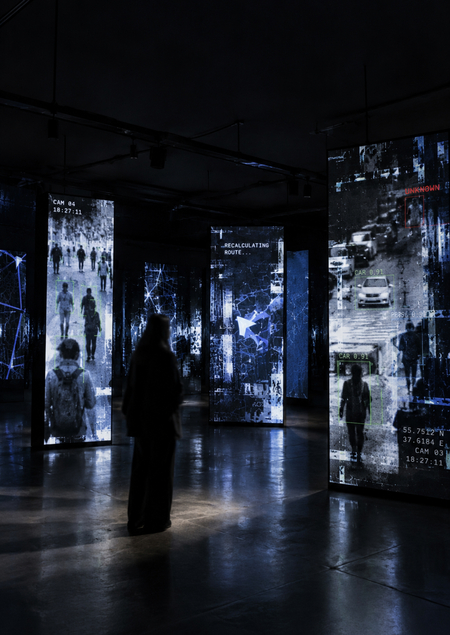
The installation speaks to the idea that there is no single reality anymore. We perceive the world differently ever since technology became available to us. Surveillance cameras, neural networks, phones, webcams—these are filters that distort space.
Target Audience
Youth aged 18–35—Generation Z and younger Millennials.
Those who grew up with a phone in hand. They recognize themselves in the problem: headphones on the way, using a GPS instead of looking around.
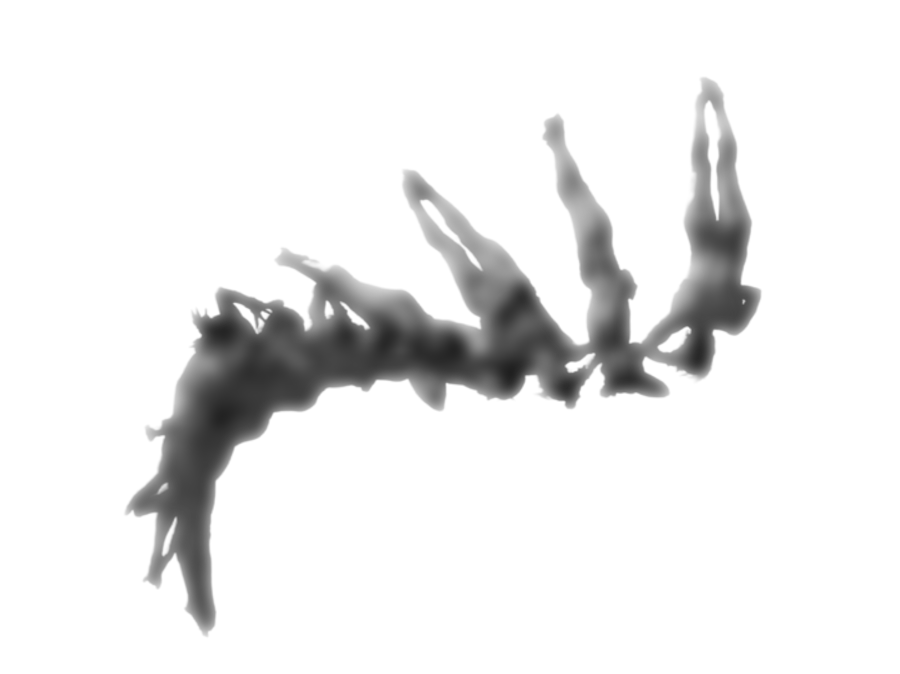
The exhibition is a journey through four states. First, the viewer sees themselves as ordinary. Then, they see how technology changes their perception. Next, they feel lost in reflections. Finally, they are left with a question. Each room is not merely space, but a stage. Together, they illustrate how we have stopped seeing the city and ourselves directly.
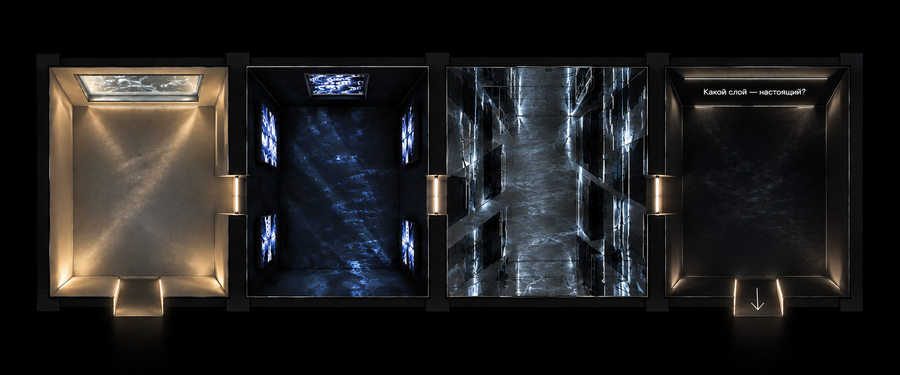
Room 1. «I See Myself» A standard room with a mirror. A starting point. The viewer puts on headphones, and a polite robotic voice says, «Route established: home—university. Follow me.»
Room 2. «I See Differently» Screens display the route through the eyes of different technologies (cameras, neural networks, navigators). The voice in the headphones begins to glitch and lead off course. This is the first break with reality.
Room 3. «I am losing myself.» Multiple mirrors are used for projecting a navigator. Blue arrows get tangled in infinite reflections. The audio guide spirals into madness, glitches, and mocks the visitor: «Where are you? Turn right… no, left.» The viewer physically becomes lost, unable to distinguish between reality and reflection. Climax.
Room 4. «I’m left with a question.» A bare, white room. The sound in your headphones abruptly cuts out. No hints. The only thing on the wall is one question: «Which layer is real?»
Merchandise
Phone Case
Keychain