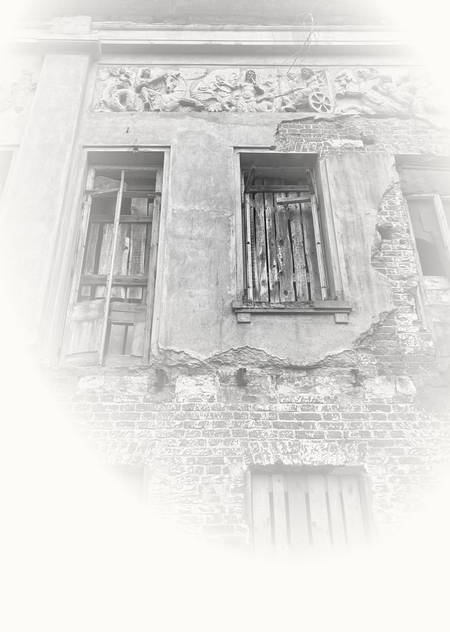
The «Unfinished Memory» project grew out of research on the Pushchino-on-the-Oka manor—an architectural landmark from the late 18th century that is currently in a dilapidated state and closed to the public. Despite its rich history, the manor has nearly vanished from the cultural landscape. Furthermore, one of its owners was a Moscow tea merchant—Sergey Vasilyevich Perlov. Today, Perlov’s tea house on Myasnitskaya remains standing and continues to be part of Moscow’s urban space, while the Pushchino manor slowly deteriorates and disappears.
This contrast became the starting point of my research. Why does the memory of a person endure, while the memory of the place where they lived gradually fades? Why do some objects become part of collective memory, while others remain only in the recollections of local residents? Where is the boundary between what society preserves and what it gradually forgets?
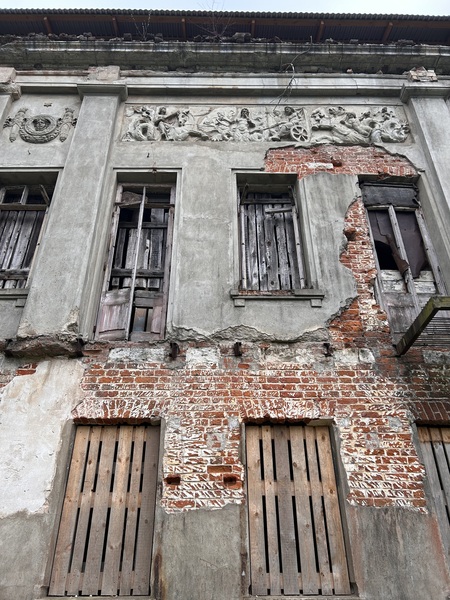
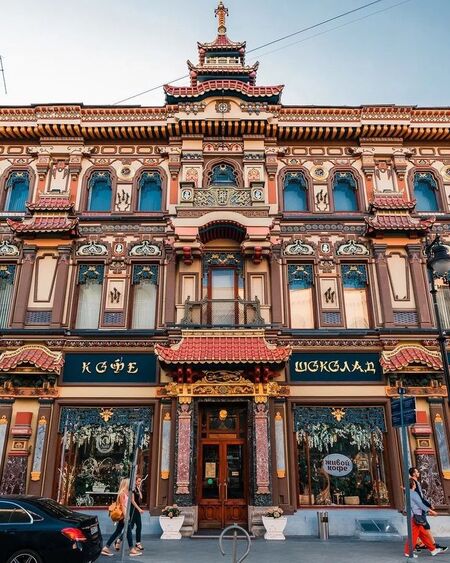
Left: Pushchino-on-the-Oka Estate (current state) Right: Tea House on Myasnitskaya Street (current state)
The study of the estate’s history revealed that the memory of the place is not formed solely from archival facts. It is composed of numerous layers: historical events, personal memories, literary archetypes, artistic works, and urban legends. Each new owner reconfigured the estate to suit their vision, rather than striving to preserve the memories of their predecessors. In this way, the very history of the estate became a process of constant memory rewriting.
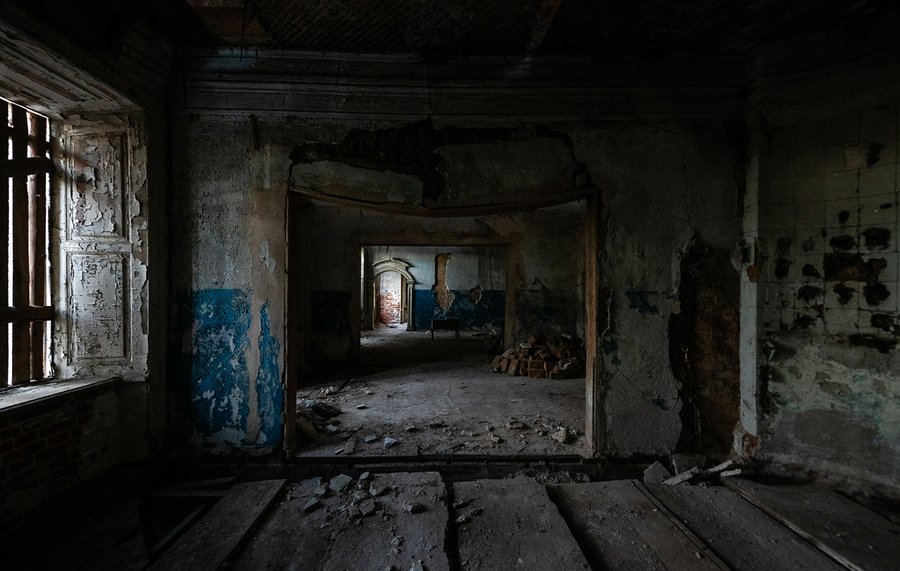
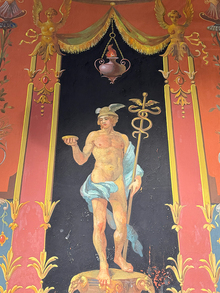
The Interior State of the Pushchino-on-the-Oka Estate. 2025 Source: Vadim Razumov
This is precisely why the project does not attempt to reconstruct historical events. I am interested in history not as a sequence of facts, but as a living process in which the past is constantly being reinterpreted. The chosen artistic form is a performative audio installation. Sound exists in time just as memory does: it emerges, disappears, returns, and can never be completely fixed. The listener becomes not an observer, but an immediate participant in the process of recollection. They independently assemble the narrative from individual voices, noises, and text fragments.
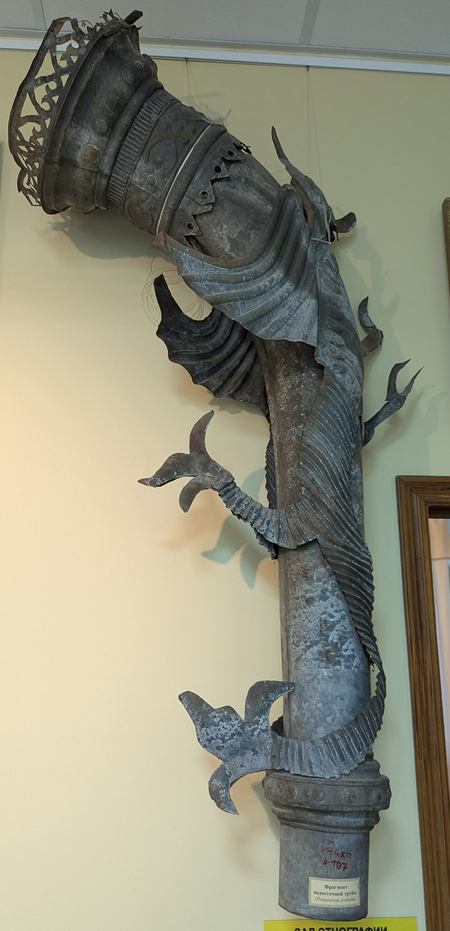
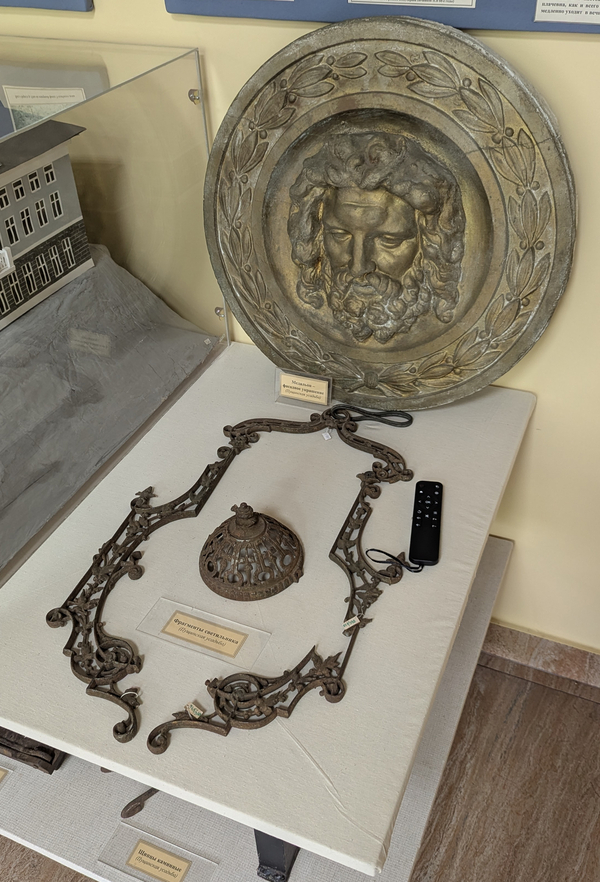
Fragments of the Pushchino Estate on the Oka Source: Pushchino Museum of Ecology and Local History
The project was originally intended to be realized directly on the estate grounds. However, it has since become property of the RF House, and plans are underway to put it up for auction. The lack of access to the architectural monument necessitated seeking an alternative form of existence for the work. As a result, the piece transformed into a distributed object of memory: a small booklet featuring a curatorial text, historical background information, and a QR code for listening to the play. It is passed from hand to hand, finding its way into libraries, museums, and city cafes.
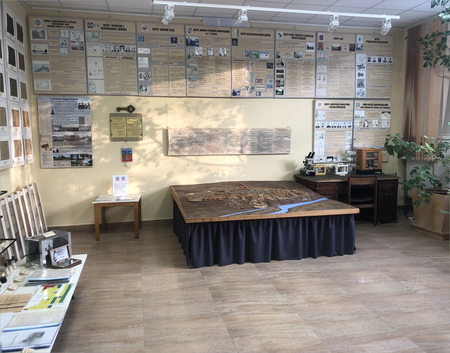
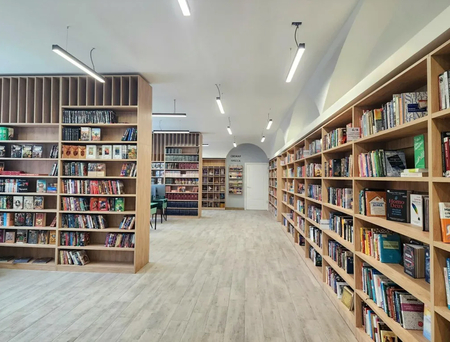
Left: Pushchino Museum of Ecology and Local Lore Right: Library in the Serpukhov Urban District, Pushchino
This format transforms the encounter with a piece into a personal experience. Each person remains alone with the voices, listening at their own pace and in their own personal space. The brochure also becomes a metaphor for memory. It is passed from hand to hand, it can be left behind, forgotten, found by chance, or kept. Like a memory, it exists not as a permanent exhibit, but as a trace that continues to live through the person.
The play is based on several sources. The first includes archival documents, residents' memoirs, historical research on the estate, and museum materials. The second is Anton Chekhov’s play «Without a Father» and Nikita Mikhalkov’s film «An Unfinished Play for a Mechanical Piano,» shot on the estate itself. The literary text becomes part of this place’s historical memory, and the artistic fiction gradually begins to be perceived as one of its layers.
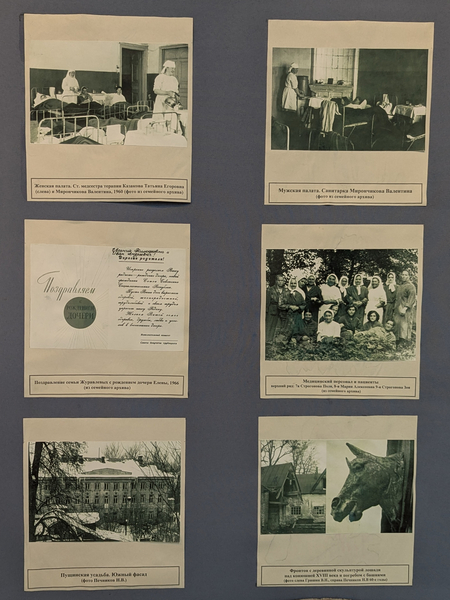
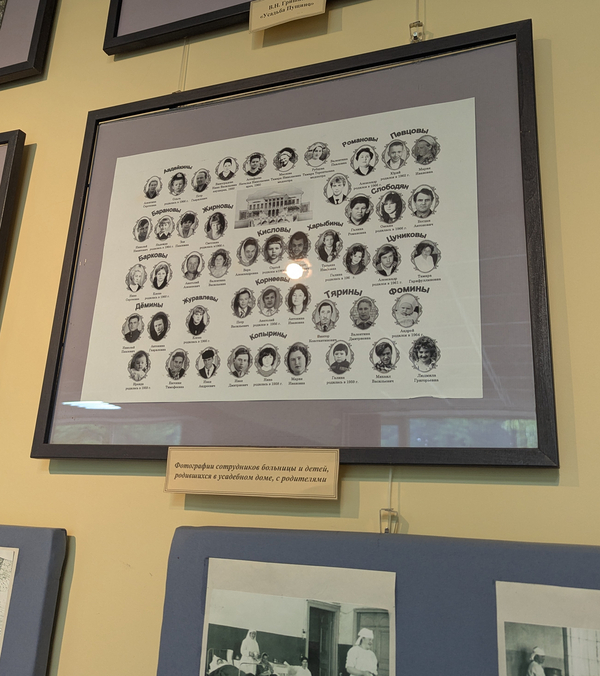
Photos of hospital staff and children born in the manor house Source: Pushchino Museum of Ecology and Local Lore
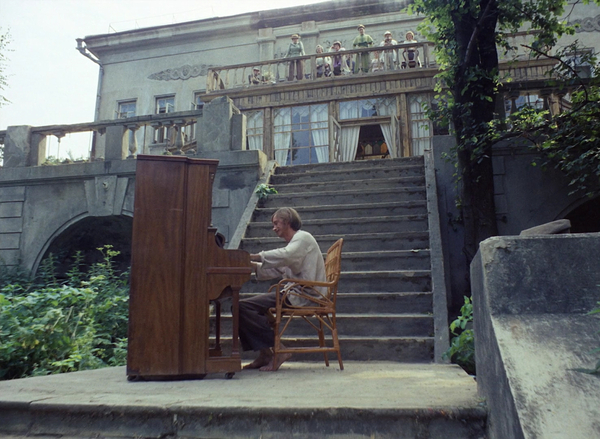
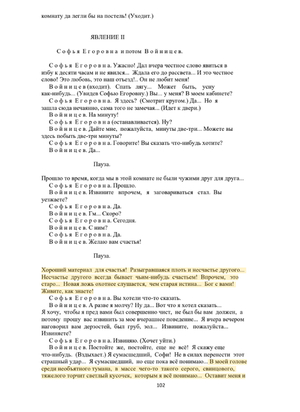
Left: Fragments from the film «An Unfinished Play for a Mechanical Piano.» Nikita Mikhalkov. 1977 Right: Fragments from the play «The Fatherless.» Anton Pavlovich Chekhov. Presumably 1878–1881
Sound plays a vital role in the project. In addition to the actors' voices, the composition includes the rustling of leaves, the flow of the river, children’s voices, the chiming of clocks, military sounds, wind, bells, and other acoustic elements. Each element is linked to a specific period in the estate’s history. For instance, a child’s cry alludes to the period when the manor housed a maternity ward, while military intonations evoke the memory of numerous military owners. Eduard Artemyev’s music serves as a distinct reference point—it does not illustrate the action but instead conjures a feeling of reminiscence and nostalgia.
The play’s text is constructed as a sequence of memory fragments. Historical figures intersect with literary characters and the author’s reflections. Each character embodies a specific memory mechanism.
Perlov is a man of anticipation. He continues to wait for guests who will never arrive.
Afrosimova preserves the memory of the past and constantly corrects others. She remembers a great deal and does not allow events to completely disappear.
Artsybashev is trying to escape his own past. He is unsatisfied with his life and is looking for a chance to start over.
Sasha represents everyday memory. Through mundane conversations, she reminds us that history is shaped not only by major events but also by ordinary life.
Bolotov becomes the voice of the present. Unlike the other characters, he does not try to cling to the past; instead, he constantly brings the conversation back to the current moment.
Owners of the Pushchino-on-Oka Estate
Each action gradually reveals one of the characters, along with a distinct way of being in memory. Furthermore, the characters rarely hear each other. Their dialogues slowly evolve into parallel monologues, much like how the memories of different people never perfectly align.
The final sixth act belongs to no single character. Memory itself becomes the main protagonist. All voices blend together, lines lose their original meaning, and the audience is left to assemble them into a cohesive narrative.
Thus, the project becomes not a reconstruction of the past, but an investigation into memory as an artistic process. It invites the audience not to learn the history of the estate, but to experience the process of memory gradually emerging—a memory that each listener assembles for themselves.