Table of Contents / Longform Article Content
- Research Concept (topic justification, material selection, main hypothesis, categorization, work with textual sources).
- Part I. Assembly Point: The Diagonal, Plane, and Tectonics of the Avant-garde (Screens 1–12).
- Part II. From Slogan to Sign: Graphics, Typography, and Poster Language (Screens 13–24).
- Part III. Architectural Utopia and Spatial Constructs (Screens 25–36).
- Part IV. Post-Soviet and Global Remix: The Diagonal in Digital Media, Street Art, and Fashion (Screens 37–48).
- Part V. The Shift in Meaning: From Collective Project to Individual Statement (Screens 49–54).
- Conclusion / Research Findings.
- List of Textual Sources according to GOST 7.0.5-2008.
- List of Image Sources
Textual Concept Description
The visual language of the Soviet avant-garde of the 1910s–1920s remains one of the most recognizable and simultaneously most ambiguously interpreted codes in world culture. In contemporary design, graphic arts, fashion, street art, and media art, its techniques—sharp diagonals, high-contrast pairings of red, black, and white, carved geometry, modular grids, photo-montage, and Constructivist tectonics—are used ubiquitously. However, outside of its historical context, these forms often devolve into a decorative «style,» losing their original utopian and life-building energy.
The focus on the theme, «From Revolution to Reinterpretation: The Visual Language of the Soviet Avant-Garde in Contemporary Art, ” is driven by the need to trace how a radical language of societal restructuring transforms in the era of postmodernism, metamodernism, and digital culture. For a design student, it is crucial to understand not only the external morphology of the form but also the internal logic of the transition from a collective revolutionary project to individual reflection, irony, critique, or commercial aestheticization.
Material Selection Principle
The visual sequence is structured around the principle of paired and thematic juxtaposition: historical primary sources (Suprematism, Constructivism, Product Art, Photomontage, Poster Art, Architectural Projects, and Textiles) are paired with the works of contemporary artists, graphic designers, street artists, and brands. We selected objects where the connection to the avant-garde is not coincidental, but structural or referential—through composition, color, texture, montage principles, or the reinterpretation of the gesture of deconstructing old forms.Visual units utilized reproductions of artworks, archival photographs, exhibition documentation, street art pieces, and thematic collages assembled according to long-read templates (each collage counts as one screen). The total volume of the visual sequence comprises 54 screens, which adheres to the guidelines (50–90 screens) and allows for the construction of a dense yet uncluttered evidential thread.
The central hypothesis of the research
In contemporary art and design, the visual language of the Soviet avant-garde ceases to be a tool for constructing a singular, utopian reality; instead, it functions as an open «archive of forms.» Within this archive, revolutionary energy is re-coded—shifting from the pathos of collective world restructuring to a language of irony, critical deconstruction, nostalgia, or purely formal design. In other words, the form itself retains its visual «charge» (dynamism, sharpness, constructive clarity), but its ideological and semantic vector shifts. Where the avant-garde strove to erase the boundary between art and life for the sake of the future, contemporary art often employs that same language to explore memory, trauma, hyperreality, or market consumption.
Principle of Material Structuring
The material is divided into five thematic blocks, guiding the reader from the basic formal devices of the avant-garde to their contemporary mutations:
- Point of Convergence: Diagonal, Plane, and Avant-Garde Tectonics — identifying basic plastic formulas (plane, color, constructive node, texture).
- From Slogan to Sign: Graphics, Typography, and Poster Language — working with the word, typeface, montage, and visual impact.
- Architectural Utopia and Spatial Constructs — transitioning from «paper» and utopian architecture to spatial installations and environmental objects.
- Post-Soviet and Global Remix: The Diagonal in Digital, Street Art, and Fashion — adapting the avant-garde language in new media and mass practices.
- Shift in Meanings: From Collective Project to Individual Statement — generalizing how the author’s position and the function of the image change.
Principle of Selecting and Analyzing Textual Sources
To build the theoretical framework, we have selected works by art and design historians, cultural theorists, and avant-garde theorists. These selections allow us to connect the historical program of the avant-garde with the logic of contemporary artistic practices. The textual sources are used to verify terminology (Suprematism, Constructivism, texture, photomontage, life-building) and to understand the mechanisms of citation and reinterpretation within culture. Direct quotes in the concept description and commentary are limited and always accompanied by authorial analysis.
Section I. The Assembly Point: Diagonal, Plane, and the Tectonics of the Avant-Garde
Kazimir Malevich. «Black Square.» 1915
The zero point from which the discussion about a radical visual language overhaul begins. Malevich frees form from narrative constraint, transforming the geometric plane into an autonomous field of meaning. In contemporary art, this gesture has become a universal archetype of radical reductionism and the «blank slate.»
Kazimir Malevich. «Suprematist Composition.» 1916.
The dynamics of colored planes in zero gravity illustrate how geometry can convey motion and tension without relying on a mundane object. Contemporary graphic design inherits this freedom of composition, where the plane functions as a rhythmic accent.
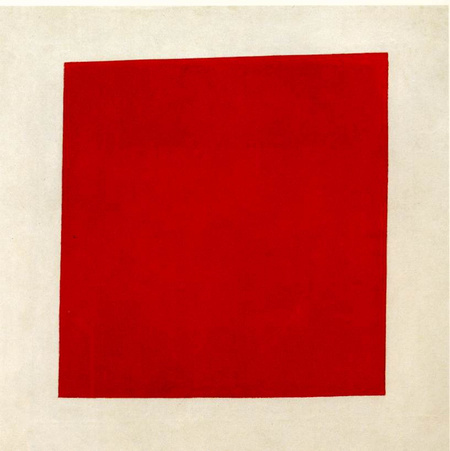
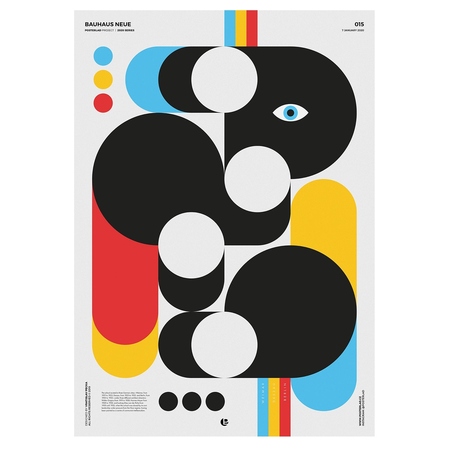
Kazimir Malevich. «Red Square (Pictorial Realism of a Peasant Woman in Two Dimensions).» 1915 Vratislav Pecka (PosterLad), «Bauhaus Neue», 2020
The comparison reveals a shift: for Malevich, the colored plane carries cosmogonic and philosophical meaning, whereas in contemporary poster design, similar geometry serves as a tool for visual navigation and emphasis.
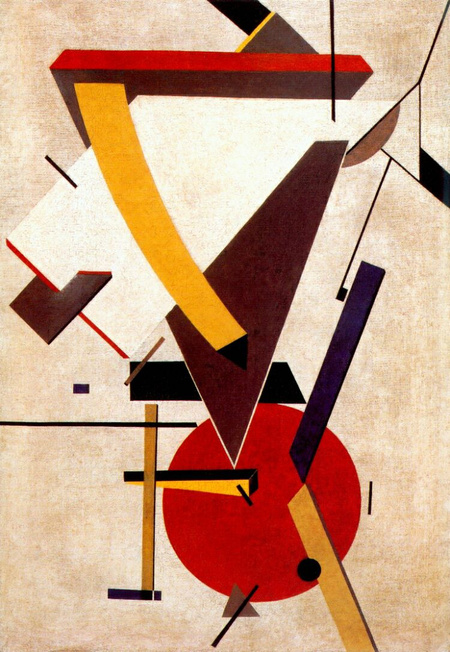
Lyubov Popova. «Pictorial Architectonics.» 1917.
Popova’s intersection of volumes and planes anticipates constructivist thinking, where form is built as an engineering system. This principle is recognizable in modern identity and branding through multi-layered, modular compositions.
Olga Rozanova. «Color Painting.» 1917
Expressive work with color and rhythm demonstrates that the avant-garde was not restricted to mere line drawings. Contemporary abstract artists often turn to this kind of color intensity to imbue form with emotional density.
Alexander Rodchenko. «Line-Constructivist Composition.» 1920.
The line ceases to be merely the outline of an object and becomes an independent constructive element. In modern interface and web design, thin guiding lines and grids perform a related, organizing function.
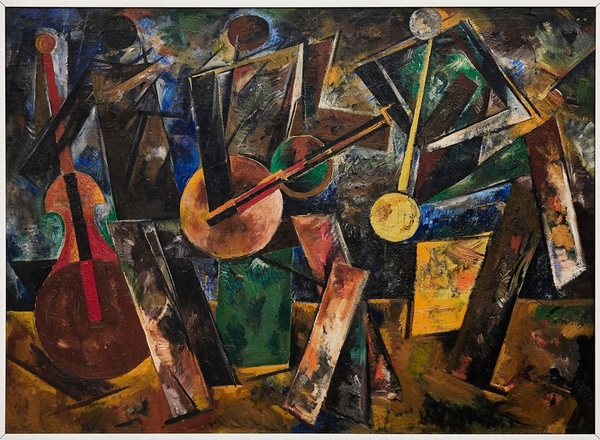
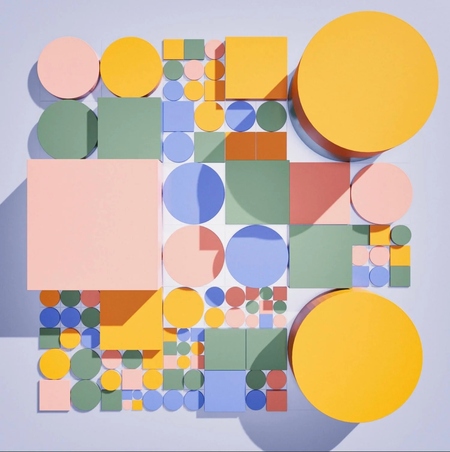
Attach Card Varvara Stepanova. Three Figures. Musicians. 1920 Generative Art by Manolo Gamboa Naon.
Algorithmic precision in contemporary generative art enters into a dialogue with manual constructivist graphics. The difference is that the code, not the artistic will of the builder of a new world, dictates the calculation.
Ilya Chasnik. «Suprematist Relief.» 1926
Working at the boundary of plane and volume demonstrates how geometric form begins to claim real space. This transition remains one of the key themes in contemporary sculpture and relief.
Section II. From Slogan to Sign: Graphics, Typography, and the Language of Posters