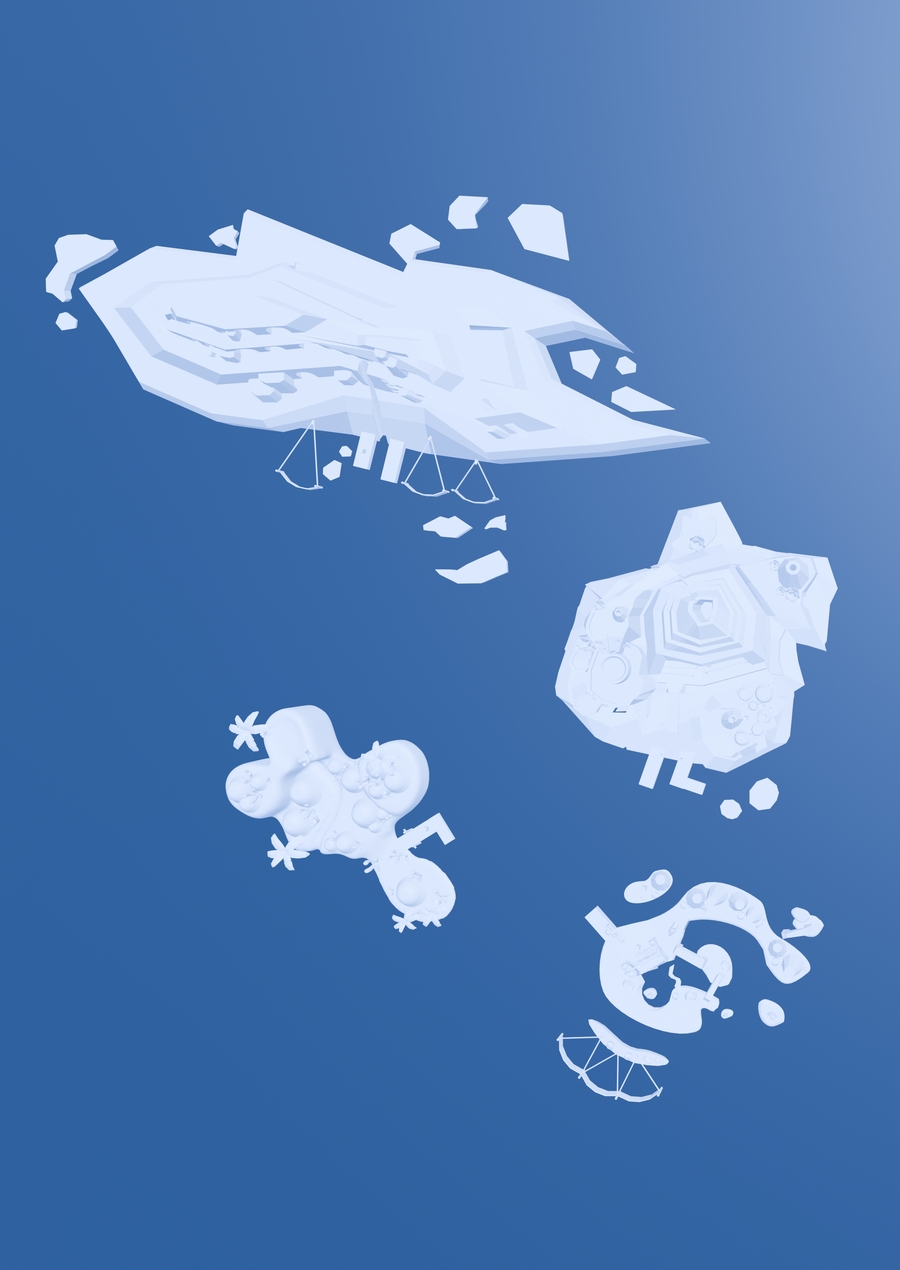
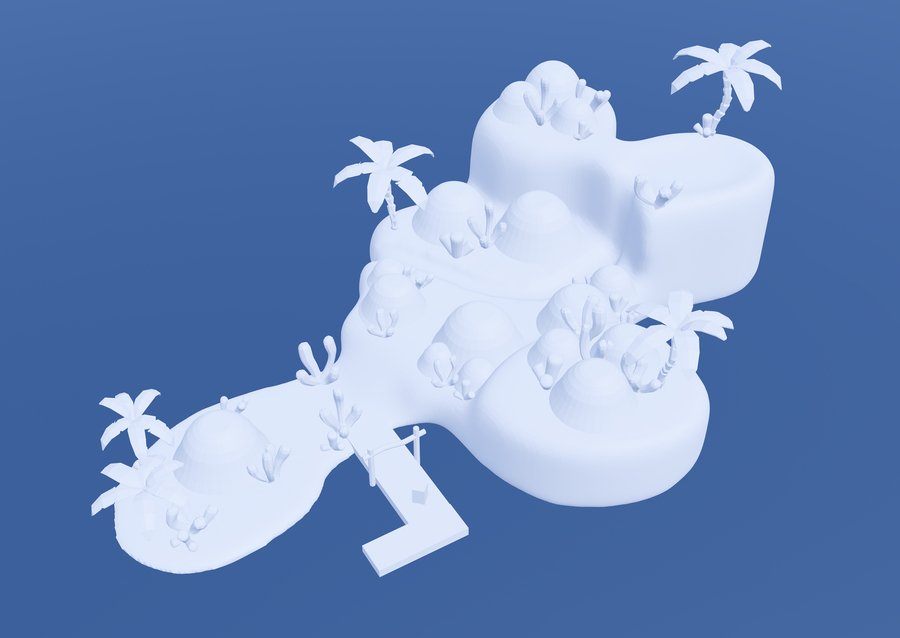
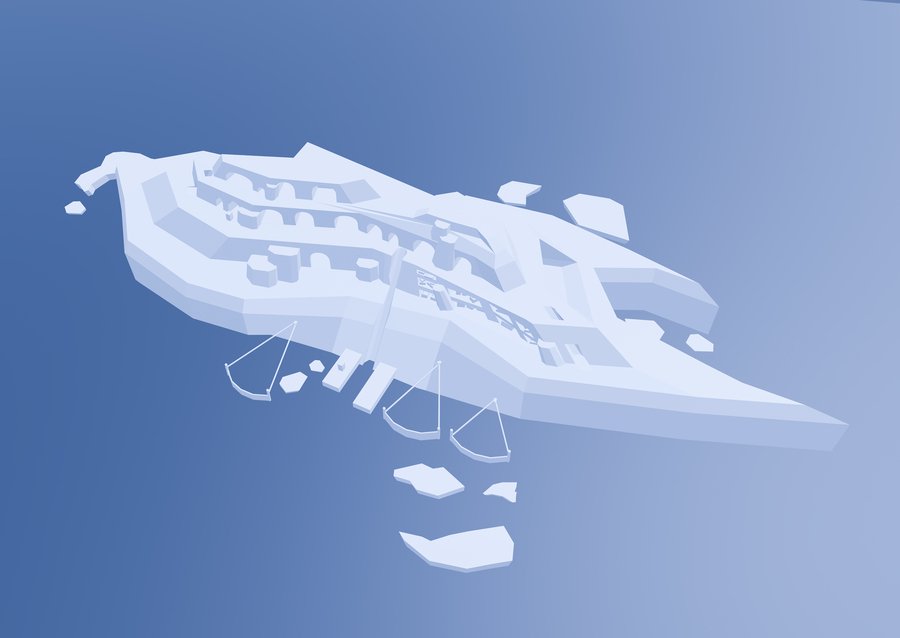
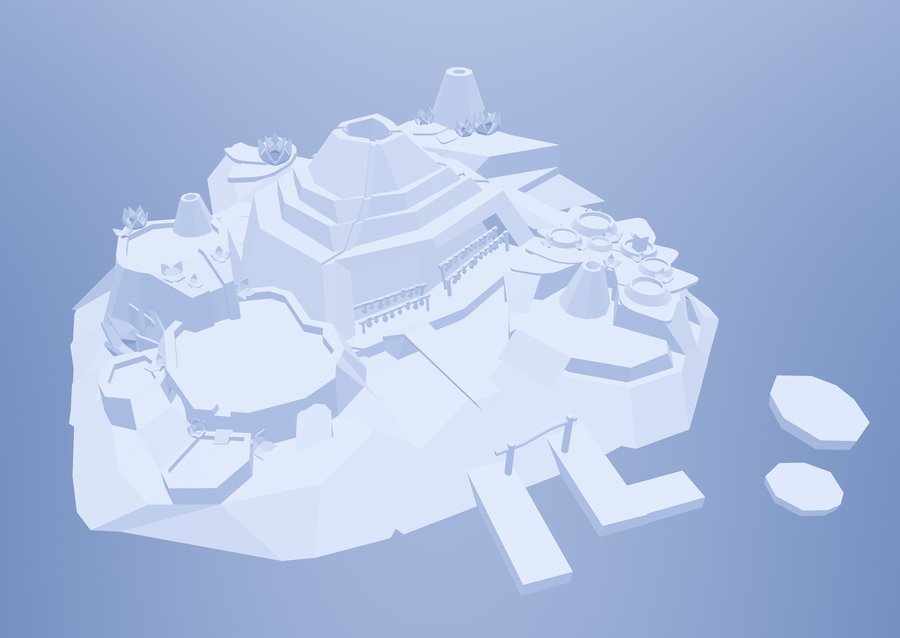
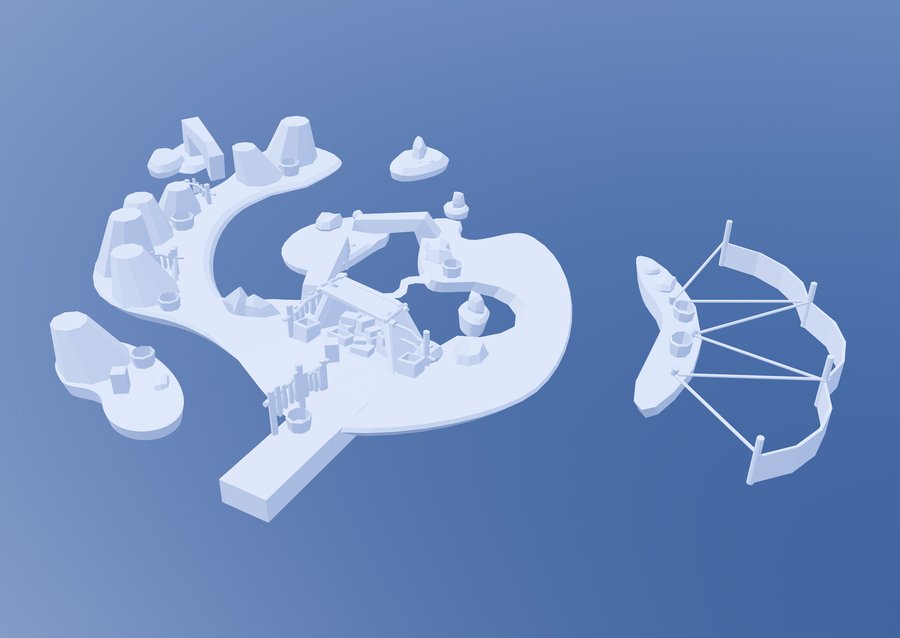
Block-out of 4 islands
Project Concept
«Penguin Mail» is a project about communication within a small, isolated community.
The four islands possess different natural conditions and resources, meaning they cannot exist entirely autonomously. They are connected by a postal service: penguins exchange food, materials, personal items, and signs.
The main character is a messenger penguin who travels between the islands.
The world’s defining feature is the absence of human civilization in the conventional sense. The penguins lack speech, writing, and complex technology—their culture is shaped through gestures, objects, habits, and collective behavior.
Project Values
The project investigates the question: how might culture look if it arises not from technology, but from the capacity to imbue objects with meaning and to exchange them?
For penguins, a stone, a seashell, or a cluster of algae can simultaneously be a resource, a gift, a request, or a message.
Therefore, mail becomes not just a game mechanic, but a central principle of the world—physical objects act as carriers of intangible connections.
World
The archipelago consists of four interdependent ecosystems:
— Ice Island — the primary habitat. Penguins live within natural layers of the ice floe, excavating the ice and catching fish. The island features living cavities, communal grottos, and natural cold storage areas.
— Volcanic Island — the heat source. Hot springs, nesting sites, drying zones, and natural deposits of warmed stones for fish preparation are located along the volcano’s slopes.
— Tropical Island — the source of pliable materials. Penguins inhabit domes and shelters formed by dense undergrowth. Here, algae, fibers, and materials for weaving, storage, and repair are collected.
— Sand Island — the shallow-water fishing island. Shells, corals, and food are harvested here in tidal lagoons and flats.
Visual Language
The project merges stylized 3D graphics with the feeling of a tangible, handcrafted world.
Visual Principles: — large, legible forms and simple silhouettes; — a minimal number of artificial structures; — infrastructure evolves from the landscape’s inherent features; — traces of handcrafting and a sense of lightness in materiality; — differences between islands are expressed through form, color, texture, and environmental behavior; — each penguin type is visually adapted to its specific biome.
The Ryazan clay figure becomes an additional source of inspiration—an interest in the conventional nature of form, distilling an image into a recognizable sign, and conveying character with minimal plastic elements.
Who is this project for?
The core audience is teens and young adults interested in: — atmospheric exploration games; — stylized 3D; — ecological worldbuilding; — small narratives about community and relationships; — collecting, exploration, and visual storytelling.
The project could potentially develop into a small, auteur-driven adventure/exploration game, an art project, or a visual Intellectual Property (IP) with subsequent use of characters and world in other formats.
Anticipated Graduation Project Outcome
At the diploma stage, the goal is not to produce a complete game, but to create a compelling visual and systemic foundation for the project.
Planned deliverables:
An art book featuring concepts and 3D development of four islands, a system for their zoning and resources, design concepts for local penguin species, the main character, and transportation.
Additionally—several materials demonstrating how the project could function as a playable product: shots with the game interface and a loading screen.
Implementation
The project is constructed in stages: research → worldbuilding → blockout → visual development → 3D production → presentation.
Initially, the ecosystem logic, resource connections, and zoning are developed. Next, island blockouts are created, and the legibility of routes and spaces is tested. Following that, forms, materials, characters, and key scenes are refined.
3D visualization software is used for production.
The primary criterion is that the world must remain convincing even without explanatory text—the function of the space and objects must be understood through form and character behavior.
Development Potential and Merch
The project is initially conceived with the potential to extend beyond the final thesis presentation. In addition to game development, the world can be effectively translated into physical collectible objects directly related to the postal theme. Planned merchandise series: — Postcards — Collectible stamps — Keychains/pendants—penguins, shells, stones, postal tokens, and other items from the world; — Character keychains Thus, the merchandise becomes not merely external souvenir production, but an extension of the project’s internal postal system.
What is needed for the next stage
For the project’s further development, the following are needed: Time for production, and expansion of 3D assets and animations; A technical specialist/game developer to create the game prototype; Sound design and music to establish the environment and nonverbal communication; And upon transitioning to a full product—producer and financial support.
Island Block-out Map
«Penguin Post» is a world without writing, yet it has mail; it lacks a complex civilization, but culture already exists.