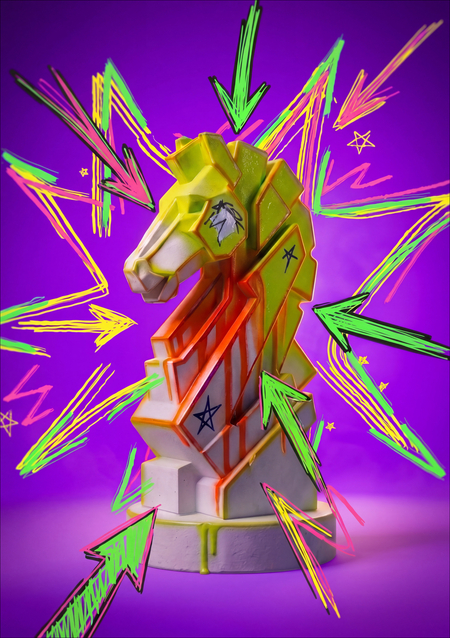
«MOVE» is a series of six chess pieces, each form of which is based on its own movement: the trajectory of motion is frozen in volume and becomes geometry. A unified language of rectangular prisms and stepped shifts holds the series together, while the white plaster, onto which street art is applied, presents the figure in two states—the pristine model and the object that has already been rewritten.
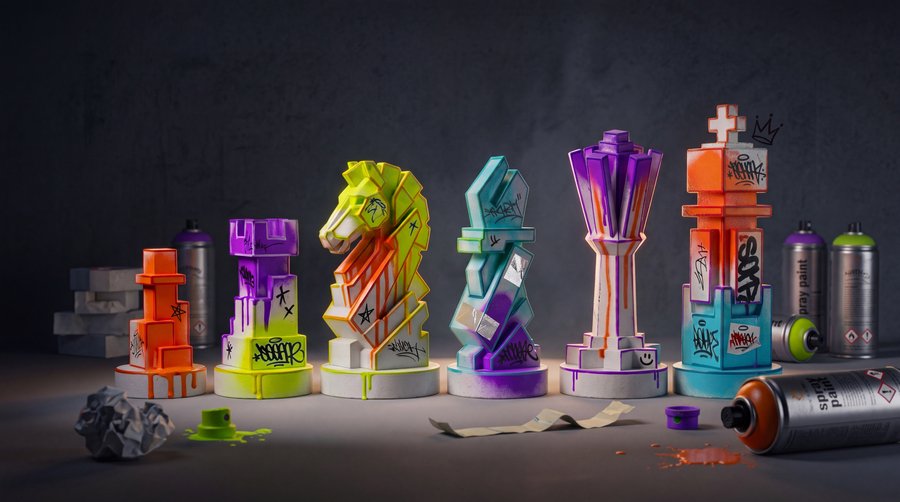
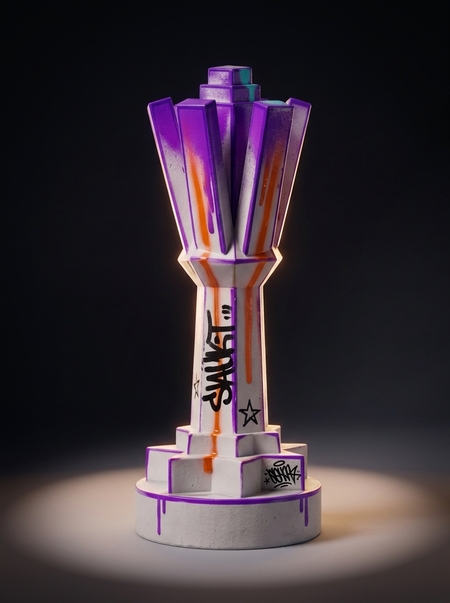
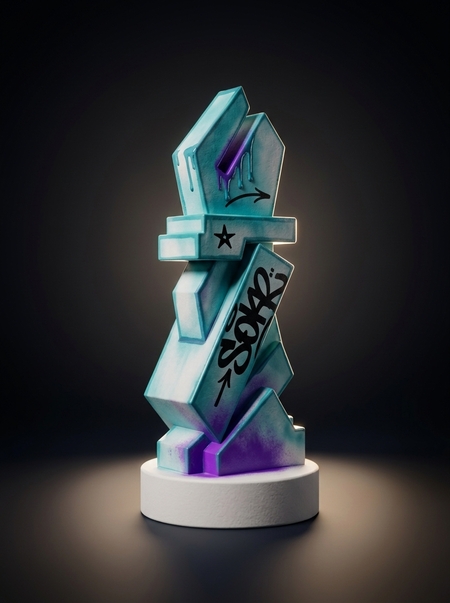
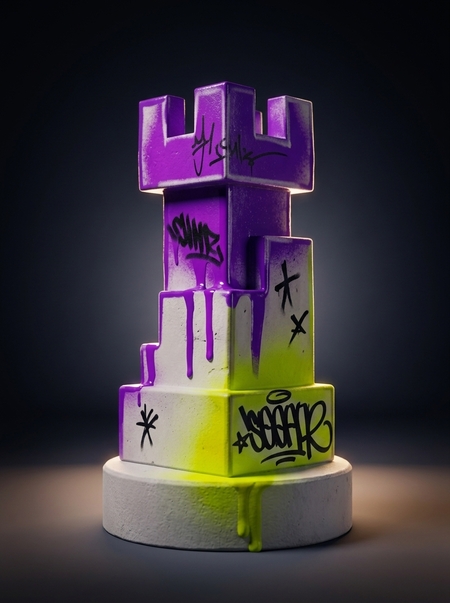
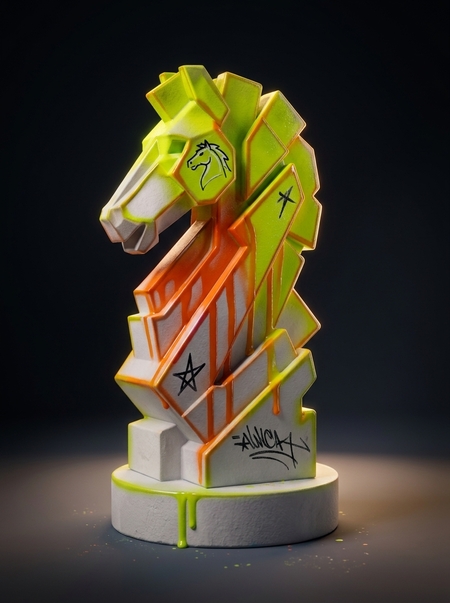
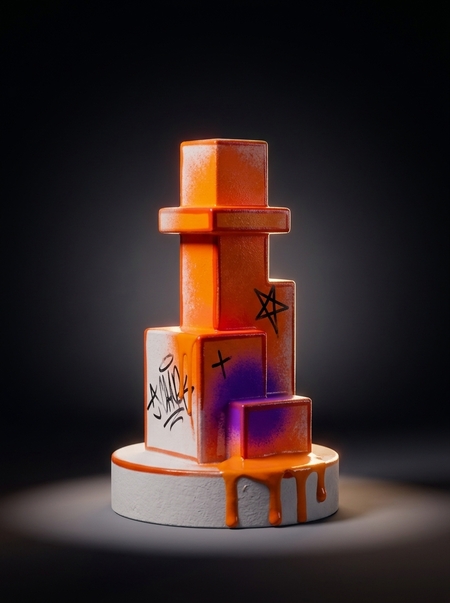
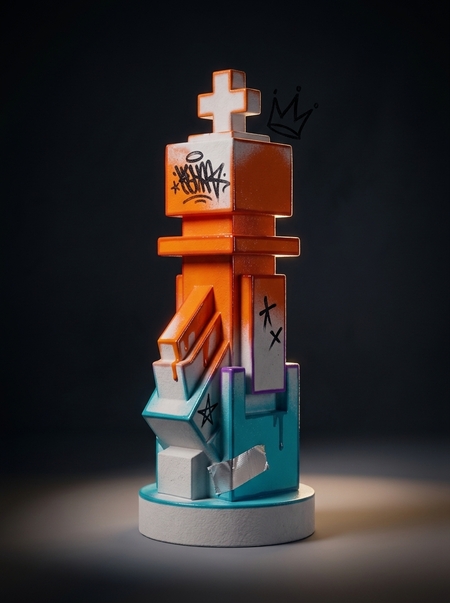
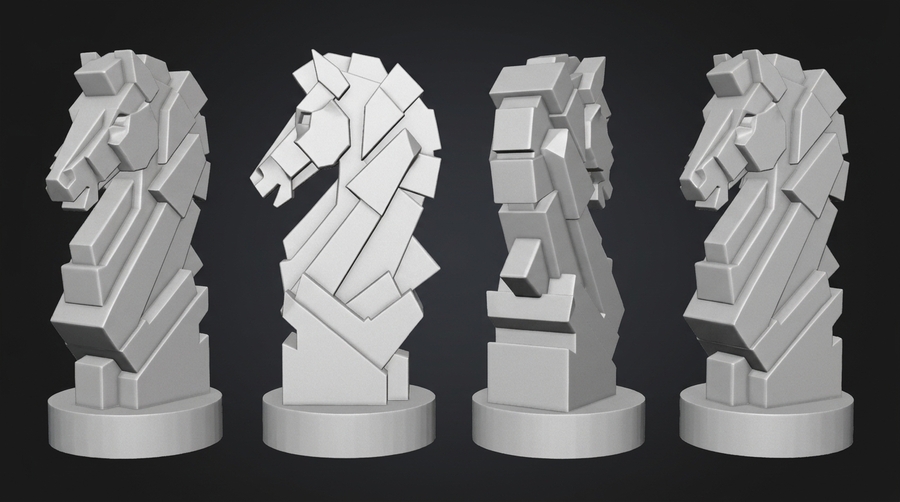
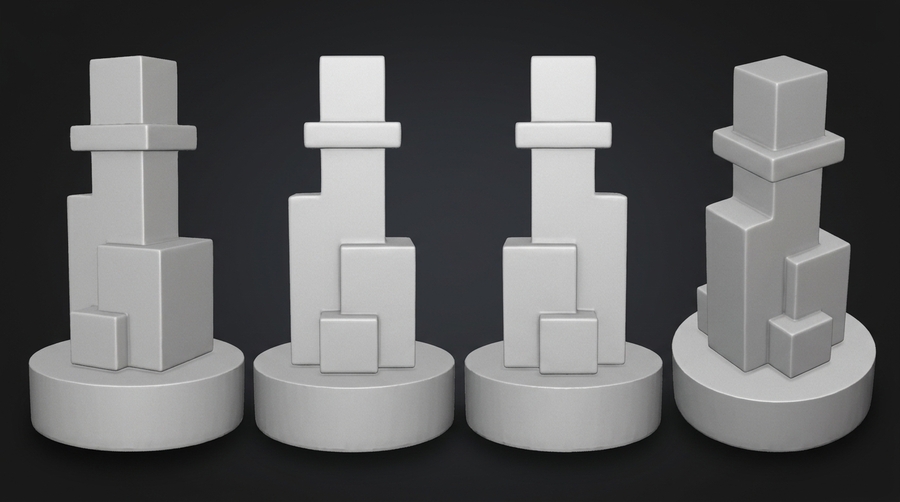
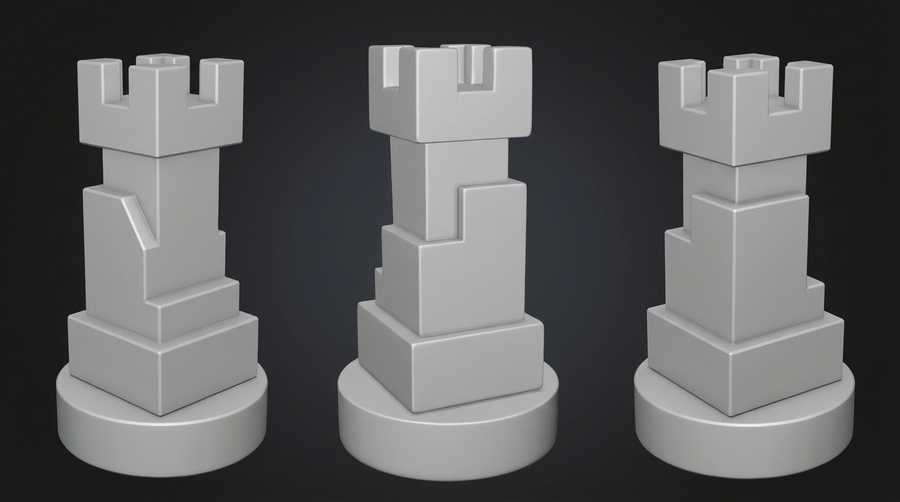
Dimensions
- The body is hollow, with a wall thickness of 2 mm.
- No element is thinner than 2 mm.
- The base features a technical opening of $\text{\O}$ 10–20 mm through which resin is drained and a weight is placed.
- Tolerance: $\pm 0.2$ mm.
- The shapes are designed for a grid board with 55 mm cells.
Printing Technology
- Photopolymer printing (SLA / MSLA), 0.05 mm layer height
- The figure must be placed base-down on the platform at a 30° angle; supports are needed only on the bottom
- FDM is unsuitable: angled surfaces and steps result in visible layer lines, and the series design relies on sharp edges and planes
- Post-processing: washing in isopropyl alcohol $\rightarrow$ support removal $\rightarrow$ UV curing $\rightarrow$ sanding $\rightarrow$ priming $\rightarrow$ finishing $\rightarrow$ lacquering
- Files: STL format in millimeters, 6 files, one per figure
Materials
- Body: ABS-like photopolymer resin. It is stronger than standard, so the teeth, cross, and prisms will not chip.
- Primer: matte white acrylic, provides a plaster texture.
- White Edition: matte acrylic varnish on top.
- Street Edition: acrylic aerosols (orange, purple, acid lime, turquoise), black acrylic markers, silver tape, stickers. Varnish on top: matte over white areas, glossy over paint.
- Weight: steel shot in epoxy resin, so the figure does not fall when the board is tilted to 30° (FIDE requirement).
- Base: self-adhesive felt.
Process
The work followed the pipeline: «text → image → 3D model → promotion» using three tools: Claude, Nano Banana 2, and Meshy.ai. In Claude, the concept was developed and the series rule was formulated, followed by prompt writing. Since the general description of the material, lighting, and height hierarchy was repeated in every request, all six figures shared a unified aesthetic language. In Nano Banana 2, the form was explored: initially, a series of six white figures with a gypsum texture, using a horse from the previous assignment as a reference, was created; subsequently, individual frames of each figure were generated from multiple angles, which later served as the source material for 3D modeling. Any figures that deviated from the series were reworked. In Meshy.ai, 3D models were generated from these images, and there, each one was verified for printability (body integrity, element thickness, geometric correctness) and then exported as an STL file. Next, screenshots of the finished model from three angles were taken from the Meshy viewer, and in Nano Banana 2, these were combined into a single image featuring a unified floor line and backdrop. Promotional materials, a poster, and a cover were also created there. The project concluded with finalizing the technical specifications for production and the layout of the presentation.