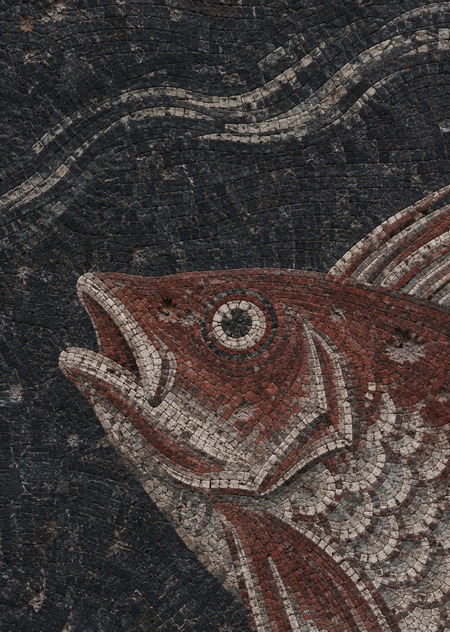
Concept
«Sea Without Horizon”—a visual study of Late Antique Levantine floor mosaics. I compare the marine panel from Lod, biblical scenes from Khoukak, Nile landscapes from Cypro and Tabhi, and two mosaics from Madaba. In one, the water becomes part of the map; in the other, the sea acquires a human face. I am interested in how the composition changes depending on the mosaic’s purpose: to depict a marine scene, tell a story, or designate a place.
Sea motif as ornamentation.
Море на полу римского дома.
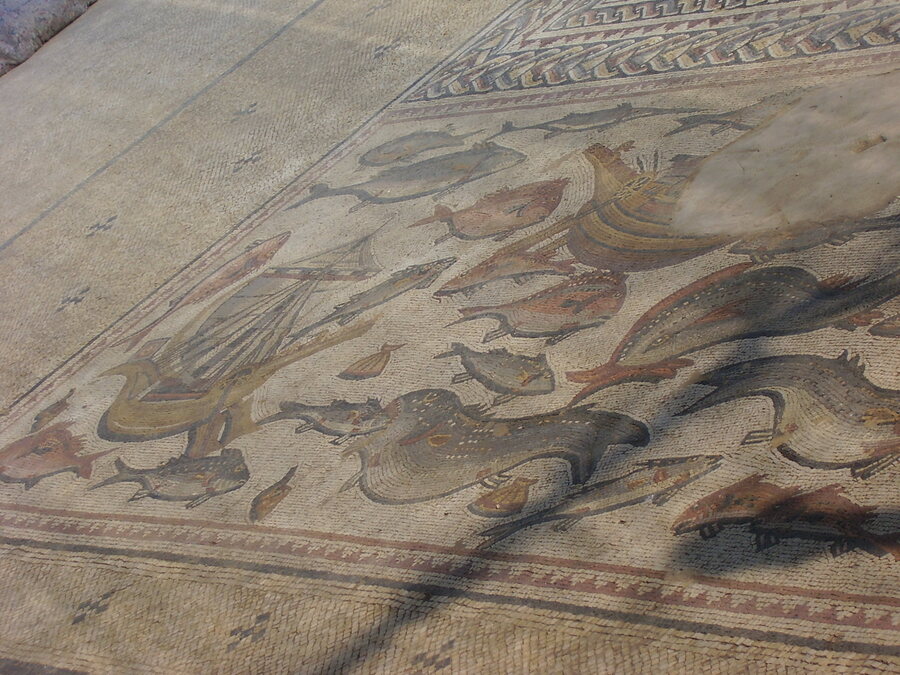
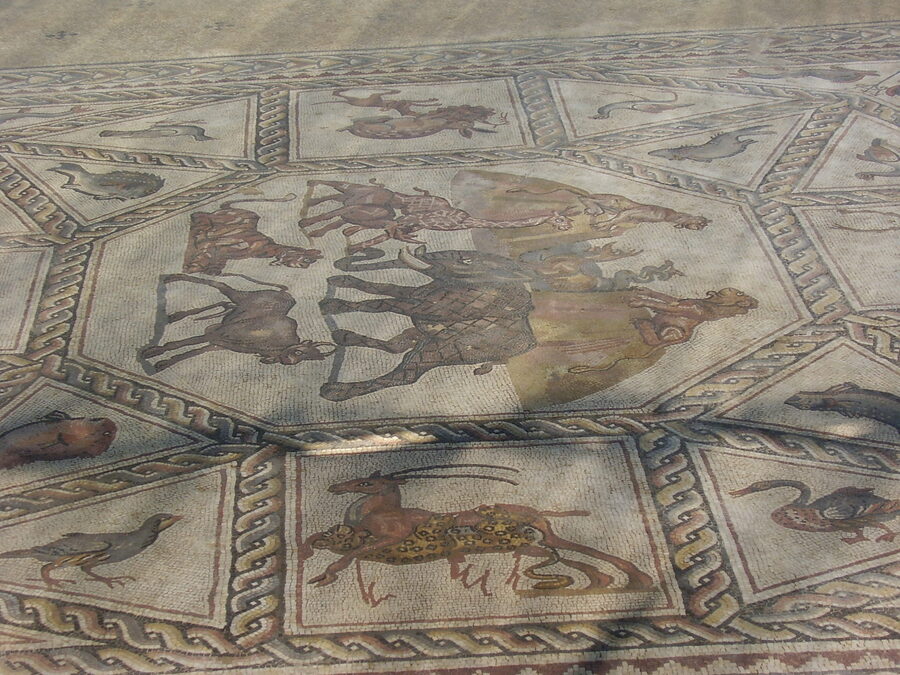
Around 300 CE, in a Roman house in Lodi, half of a grand room was decorated with mosaic. At its center was a panel featuring wild animals, and adjoining it on one side was a maritime scene. Ships, fish, and shells formed a separate rectangular panel within the overall floor design. I begin with it to understand how the marine scene altered the rhythm of the entire floor decoration.
In the central area of the floor, a woven ornament divides the image into individual cells. The sea panel has a unified frame, but inside it, ships, fish, and shells are freely distributed across a light field. After the strict geometry of the central section, the gaze begins to move differently: from the large silhouette of a ship to the small figures and back again. The sea changes the pattern of the entire floor because a different order is at play within its frame.