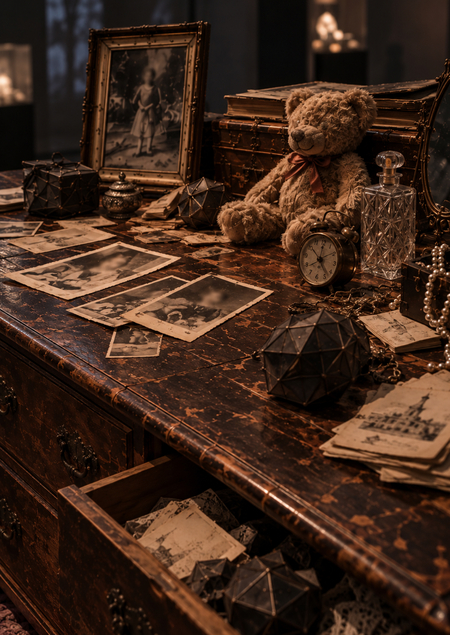
An interactive phygital installation exploring human memory, digital reconstruction, and the impossibility of fully preserving the past.
Media: physical objects, generative AI, 3D printing, projection mapping, game interfaces.
KEY THESIS
A digital system can reconstruct the form of an object, but it cannot restore the personal experience that gives it meaning.
PROJECT IDEA
What happens to human memory when we translate it into digital data?
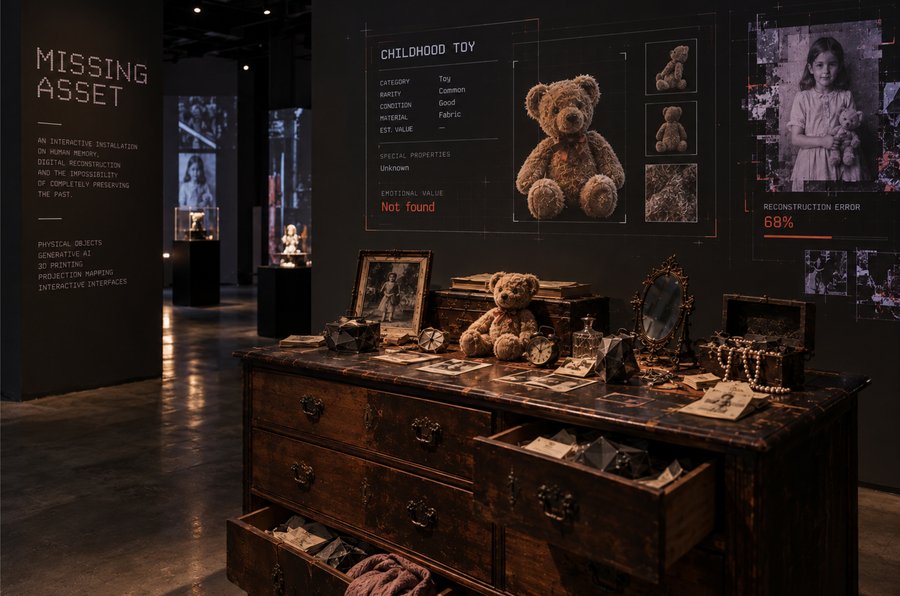
Artificial intelligence attempts to create an archive of human life by analyzing everyday objects and reconstructing their histories.Errors in digital reconstruction materialize into physical objects: polygonal surfaces and deformations emerge.
Digital simulation ceases to merely copy reality and begins to alter it.
RELEVANCE AND PROBLEM STATEMENT
We preserve photographs, correspondence, voices, and personal stories to create digital archives of our own lives.
Generative AI is capable of restoring lost details and creating plausible versions of the past.
However, retaining information does not equate to preserving lived experience.
Does the digital archive evoke a memory or create a new interpretation of it?
PHILOSOPHY
Human memories do not exist as a static archive. Over time, individual details fade, events are reinterpreted, and the emotional weight of an experience can shift.
Artificial intelligence also reconstructs missing information based on recognizable patterns and probabilistic assumptions.
The simulation creates its own reality, which cannot be reduced to the physical original. In this project, the digital model defines a new material form for the object.
Simulation is the product of models of reality without origin or reality—a hyperreal.
The archive doesn’t just preserve the past—it participates in its construction. The algorithm creates a new interpretation of the subject’s history.
Archiving creates an event to the same extent that it records one.
QUESTIONS
Can a digital copy become a full continuation of a physical object?Where does the boundary lie between preserving memory and reinterpreting it?Is it possible to reconstruct the history of an object without knowing the personal experience of its owner?
What Do We Lose When We Turn Human Experience into Data?
GAMES
In video games, items exist as assets—digital objects with specific geometry, textures, and characteristics. In role-playing games, they are further assigned rarity levels, durability, monetary value, and unique properties.
MISSING ASSET applies this system to real-world objects, transforming them into elements of in-game inventory.