Culture is everything around us.
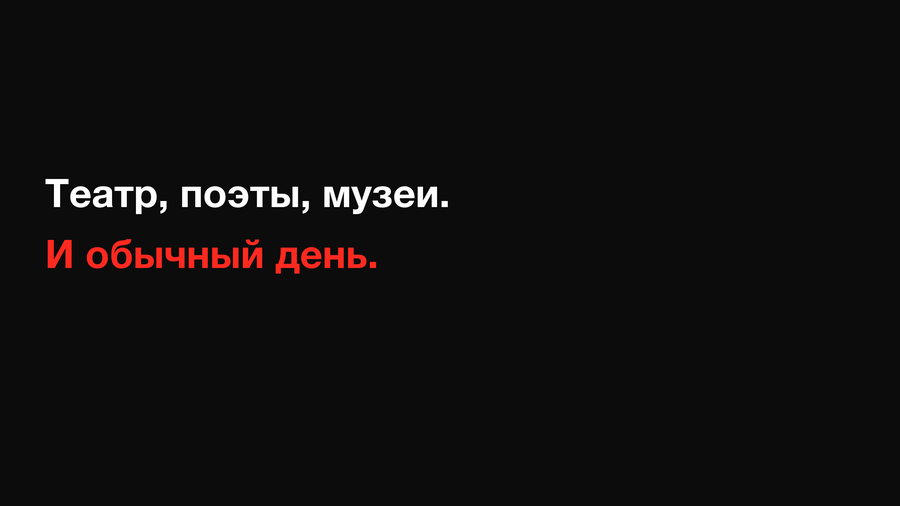
What does culture bring to mind for you? If you think of theater, poets, and museums, you are right. And like many, you’ve fallen into a stereotype. Culture is everything around us.
Project
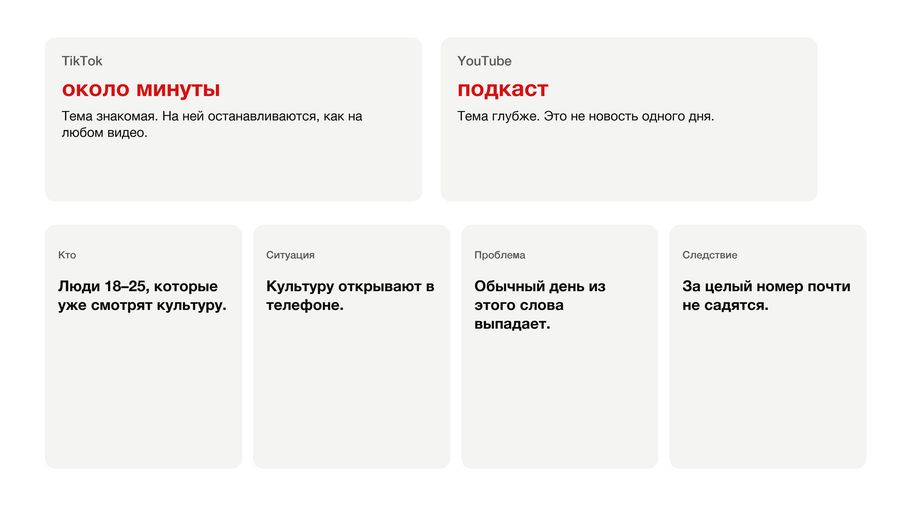
«The Culture of Everything» is a media outlet about everyday culture. Culture here isn’t a separate shelf reserved for poetry and theater. It’s what’s already around us: film, clothing, the house along the road, a short clip in your feed. A person can recognize themselves in it and take away a new fact about the world. A short video is released on TikTok and lasts about a minute. The subject matter is familiar; people stop to watch it just like any other video. The podcast is released on YouTube. The dive into the topic there is much deeper. The themes of the episodes aren’t fleeting daily news: an episode is perfectly relevant today, a month from now, or a year from now.
Classroom
What problem are we investigating, and for whom?
These are individuals aged 18–25—students and young professionals who are already engaged with culture. It’s more convenient for them to access it on their phones than to sit down for a dedicated evening with a magazine; few people read a whole issue. In the conventional understanding, culture encompasses theater, museums, literature, and fine arts, but much of daily life falls outside that definition. The market side is singular: the viewer. I assert the 18–25 age range, though I do not claim it is fully proven.
What did the first survey show?
I conducted the first survey myself. The sample is convenient but not representative; it doesn’t describe the entire student body. Among those who responded are individuals younger than 18 and older than 35, so this is a starting segment. The majority are aged 18–21. Mostly, they are currently studying or balancing studies with work. Regarding culture, there is one conclusion. Many still associate it with the «high culture"—theater, museums, literature. However, they also associate it with everyday things, naming the city, movies, food, and generally everything around us, but that is not yet proof of what media they will consume. They regularly access cultural materials, more often on YouTube and Telegram than in print magazines. TikTok was rarely named as a place specifically for culture, but it is important to me that my audience is already active there. From this form, I selected nine people for in-depth interviews. For what I am currently doing, these aspects are important. Podcasts are often listened to in the background—they listen when the topic is at least slightly related to what they want to understand, and they don’t need to watch the visual content. Many said they prefer content that isn’t a breaking news item or something only relevant today. They are interested in learning about a topic that can be revisited and understood a year later. The headline grabs attention at the entry point. It’s through the headline that they decide whether to stop or scroll past. I have not yet shown them my specific episode. I will post the link to the form and the interview analysis separately.
Market
I am not naming a specific share of the project because I don’t yet have my own audience or listenership figures. For the screen, I am only presenting external benchmarks and explicitly stating what question each one answers. For the podcast, there is a ceiling in terms of the potential audience. AdIndex, as of May 21, 2025, estimates the number of active podcast listeners to be between 16 and 18 million per month. This reflects a general habit of listening, not the consumption specifically of «All Culture.» This figure does not include a segment for «culture only» or a segment for «18–25 years old only.» Another measurement is provided alongside it, and I am not combining the two: Sostav, dated May 30, 2025, referencing Mediascope, states that podcasts regularly reach 34% of city dwellers. For a short video, there isn’t a comparable figure for the audience size. Mediascope and Cross Web, October 2025, show a different picture. For people aged 18–24, the time spent on social media is allocated as follows: TikTok 30%, Telegram 27%, YouTube 19%. This represents the share of time spent in the feed, not the number of people who came in seeking culture. The scope of the 18–24 report and my target of 18–25 years old are not the same. I am not putting the entire internet into the project’s audience scope either. According to a summary of the same October Mediascope report, 105 million people over the age of 12 use the internet in Russia per month, which accounts for 86% of that group. On average, a person spends 4 hours and 21 minutes there daily, and 51% of that time is spent on social media. For the podcast’s TAM, I am setting the ceiling at 16–18 million and not labeling it as my audience. For the video’s TAM, I am leaving the audience undefined. I am not calculating SAM because there is no segment for «18–25 years old who are already engaging with culture» for either the video or the podcast. I am not calculating SOM because there is nothing to divide by. I am not taking a percentage of 105 million or 16–18 million. Calculations incorporating these omissions are detailed in the «market» file.
Monetization. Who pays and for what?
There is no mandatory price for the viewer, and they do not pay for a short video. The platform also does not pay the Russian creator for views: YouTube stopped showing ads to users in Russia on March 3, 2022, and Russia is not listed in the TikTok Creator Rewards program. The model that does have a set price is different. The brand pays the creator for integration within the video or episode. This is the cost of external placement, not the revenue of «All Culture»; I do not carry over my own advertisers, my own views, or the brand agreement, so I won’t transfer rubles to the viewer’s canvas. I based the price on DIDENOK TEAM’s measurement for July 2025 — July 2026: 650 authors on TikTok and 700 on YouTube. The recap was published in Sostav on August 26, 2026. I am not including the December 2025 measurement in this. On TikTok, viewership without celebrities costs between 1.57 and 2.61 rubles. The «culture» category is not in the table, and there is no separate line item for «entertainment content» on TikTok in this recap. On YouTube, the average view for entertainment content costs 1.53 rubles. This is an average for the category, not the price of the podcast. There is no separate line item for «podcasts and interviews» on YouTube here. The figure of 1.24 rubles in the same article refers to podcasts on VK, and I am not transferring that to my episode. More expensive in the same measurement on YouTube are beauty, at 3.70 rubles, and business, at 3.64 rubles. I am not compiling lines and I do not multiply by my own views. Anya leaves the channel when the topic gets buried in advertising, so I do not record integrations as already accepted income. More evidence is needed to prove that this will work in my project. I am keeping donations as a separate option, and for now, only for the podcast. This is a voluntary payment from a person who listened to the entire episode, not a payment from the platform or a brand integration. I do not have my own rate, and no one promised donations in the nine discussions, so I am not recording it as accepted income. The YouTube button itself does not work here: Russian creators do not have access to Super Chat, Super Stickers, or sponsorships.
How are people satisfying their need for culture now?
The niche is not open. Some media outlets are already covering adjacent topics; details and a comparison with the project are in the «Competitors» file. FRONT ROW is a Telegram channel by Masha Dremina and Yana Kozlova about fashion and its industry: t.me/frontroww. The channel’s goal is to keep followers updated on campaigns, rankings, and industry trends through short posts. The channel has 45,748 subscribers. The Blueprint has been aggregating fashion, culture, and lifestyle in its publication since 2014: a website, a newspaper, and long-form video content. As of June 16, 2026, the publication reported over 2.5 million monthly website users. BURO has been writing about fashion, beauty, culture, and society since 2011 as an editorial platform with its own perspective.
In-depth Interviews
In conversations, people often prefer shorter pieces that can be revisited regularly, rather than one large feature once a month. Hardly anyone is willing to sit down and finish an entire issue, and a beautiful magazine doesn’t become something people read just for show. They usually stop at the headline—that’s what determines whether they open the piece or scroll past it. Long-form content is often consumed by readers who already know the author, and it’s frequently left running in the background when the topic is inherently interesting and the visuals aren’t essential. What people truly want is something that doesn’t pressure them with immediacy and isn’t necessarily important only for today. This doesn’t mean that long-form content is unnecessary for everyone. Some people do finish lengthy articles, and not everyone spends their evenings on their phones. But if that’s the case, there must be something compelling—either a captivating topic or a familiar guest. I haven’t shown my own issue in these discussions, so we can’t conclude that people will listen to it specifically.