Concept
The ladder in a board game allows a player to advance toward a goal, while the snake pushes them backward. However, the direction of movement does not yet explain what success means. The endpoint can be placed outside the numbered grid, represented as public recognition, or reduced to a specific cell number. Therefore, «Snakes and Ladders» allow for the exploration of the relationship between movement rules and conceptions of a desired outcome. This paper examines how the board’s design frames the advancement of a piece as a symbol of spiritual attainment, virtue, or a completed journey. This perspective is also useful for analyzing game design: a similar structure of transitions allows for different ways to explain to the player why they are moving.
Research Question: How do the visual elements of historical «Ladders and Snakes» fields explain victory, and is the finish line imagery sufficient to understand the game’s values? The working hypothesis is that the image of victory is constructed through the interplay of three elements: the placement of the goal, the cell names, and the connections between the start and end points of transitions. Altering one element does not necessarily change the others. This can be tested by comparing the entire field with individual routes and by comparing instances with similar structures. The «image of victory» here refers to the represented meaning of success on the field; the «transition mechanic» refers to the rule connecting landing on one position with moving to another. These concepts do not imply that the player genuinely assimilated the values depicted.
The visual collection comprises nine museum objects: a Sufi field from the Ashmolean, a Jain field from the National Gallery of Victoria, one undated specimen from the Wellcome Collection, five English game publications from the Victoria and Albert Museum, and the Australian game National from Museums Victoria. The dated objects cover the period from approximately 1815 to the mid-20th century; for National, the period of use is known rather than the precise year of publication. The undated Wellcome specimen is included for analyzing the transition between signed states and does not serve as a chronological link. The selection is based on the availability of a complete image, verifiable museum attribution, and variations in design intent. This is a targeted comparative selection, not a statistically representative history of all publications.
Each subject is examined on two levels. The overall view illustrates the relationship between the grid, the external framing, and the final area. When reading individual transitions, the source cell, direction of movement, and arrival point are correlated. Three analytical diagrams help compare routes and dates; the foundation of the study is composed of full museum images. The diagrams are not historical illustrations or reconstructed rules. A distinction is made between the inscription visible in the photograph, the museum interpretation, and the analytical conclusion. Approximate dates and speculative attributions are retained. The corpus is not used to establish the game’s inventor or its exact moment of appearance.
The textual basis integrates museum catalogs, Jacob Schmidt-Madsen’s research on Indian knowledge games, and Roger Caillau’s concepts from the book Games and People, which is included in the course curriculum. The catalogs provide information on specific artifacts. Schmidt-Madsen’s work helps differentiate between the visual, textual, and game levels [3, pp. 18–20]. Caillau’s concepts allow one to distinguish between competitive play and the dependence of the outcome on chance [1, pp. 14–18]. The primary method involves correlating observable features with verifiable descriptions. The argument progresses from the method of reading the field to religious and moralistic variants, then to numerical finishes, and finally to testing the hypothesized change with a later example.
- How to read the game board: position, name, and consequence.
- Victory off the grid: the structure of a sacred goal.
- Virtue receives a reward: the moral and social significance of transitions.
- When reaching the end is enough: the numerical field and the congratulatory game.
- Morality does not disappear: comparing Kismet and National.
- What exactly changes: results of comparison and boundaries of evidence.
How to Read the Game Board
In Roger Caillau’s classification, agôn denotes a competition where one participant’s superiority is revealed under equal conditions, while alea refers to the dependence of the outcome on a decision outside the player’s control [1, pp. 14–18]. This distinction is relevant to «Snakes and Ladders»: the presence of a winner does not necessarily mean that the victory measures mastery. When the move is determined by a die roll, the piece may land on a transgression square purely by chance. The player is not obligated to perform the depicted action to experience the consequence assigned to them. This reading is an application of Caillau’s concepts to selected fields, not a retelling of his analysis of the game.
The number answers the question, «where is the piece»; the caption answers, «what does this location signify»; and the connection answers, «where does landing here lead.» For instance, on the National field, repentance yields a positive gameplay consequence: moving from square 8 to square 26 [12]. These three layers can be modified independently. If the name is removed, the route remains, but its specific moral explanation disappears. The separation of visual, textual, and gameplay layers was proposed by Schmidt-Madsen; here, it is transformed into a method for sequentially reading each element [3, p. 18].
Victory Beyond the Grid
Starting the history of this game with the legendary inventor would be unreliable. Schmidt-Madsens dates the earliest confidently dated field in his examined corpus to 1780–1782; this testifies to the existence of the game, not its established date of birth [2, pp. 36–38]. The actual comparison begins with an available museum piece from around 1815. This immediately questions the habit of equating the highest number with victory.
Unknown artist. Sufi field, «Snakes and Ladders.» India, circa 1815. © Ashmolean Museum, University of Oxford.
A square grid occupies the lower portion of the page, above which an independent architectural space rises. According to the museum interpretation, the goal—the Throne of God—is located precisely there, outside the ordinary cells. A staircase labeled 84 leads to it, signifying a mystical disappearance into God, fana fi Allah [4]. The composition allows for the reading of success as an emergence from a sequence of states: the journey concludes not merely further along the sequence, but within a space of a different order.
Routes of the Sufi Field from the Ashmolean. Analytical Diagram, 2026.
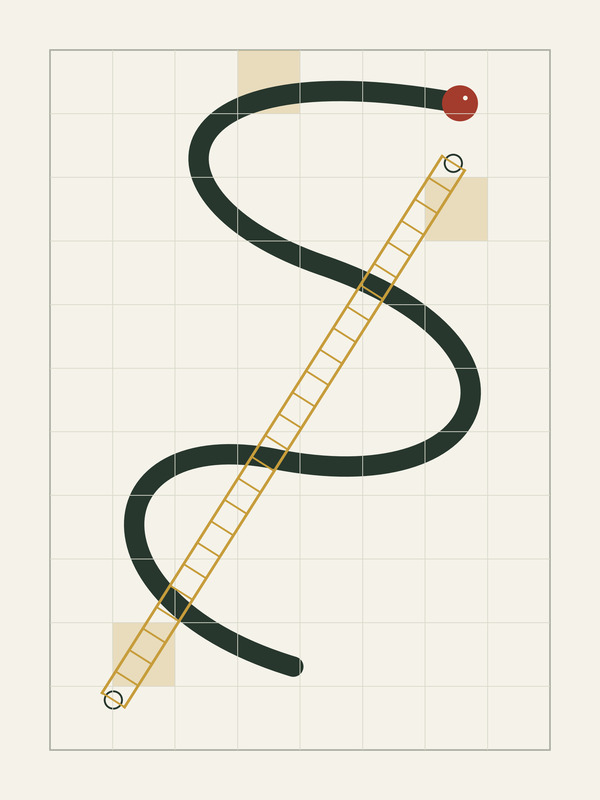
The number 100 in this field is associated with Satan and leads downward to 10, which signifies passion; pride in 91 leads to anger or violence in 18 [4]. Therefore, height and numerical seniority alone do not guarantee success. The diagram maps out two different ways to interrupt the sequential movement: the fall returns to within the grid, while a special staircase leads to an external goal. Without reading the connections, the highest number would be mistakenly interpreted as a victory.
Unknown artist. Gyanbazi. Rajasthan, circa 1900. National Gallery of Victoria, Melbourne. Photo: NGV.
In the Jain manuscript from the NGV, the game grid is incorporated into the image of the architecture and the cosmic figure of Loka Purusha. The museum describes an 84-cell field with rural scenes at the bottom, and the sun and moon at the top [5]. Unlike the previous piece, the grid here is perceived as part of a vast inhabited world. The viewer’s gaze moves from the small figures at the base up to the upper part of the composition—the movement of the piece is given a spatial context that cannot be conveyed by a single cell number.
In the article about Jain games, Schmidt-Madsens’ knowledge connects the ultimate goal with liberation and demonstrates how the numbered field is complemented by specific areas [3, p. 19]. Sufi and Jain subjects can be compared based on spatial organization, while retaining the difference in their religious meanings. The similarity lies in the relationship between the grid and the broader order. This does not imply that the depicted states and goals are identical.
Unknown artist. «Game of Heaven and Hell.» Date unknown. Wellcome Collection, CC BY 4.0.
In this piece, textual titles occupy a significant portion of the cells. Black, winding lines coexist with colored, angular junctions. The transition shape is discernible before the reader deciphers all the inscriptions, but the precise meaning of the route requires their translation. Since the open catalog does not specify the date of creation, the object is used as an example of field organization, rather than as an intermediary stage between two dated games [6].
Pair 17–69 demonstrates why analyzing the staircase drawing alone is insufficient. The connection doesn’t merely shorten the distance; it links moral quality with a designated spiritual state. Numbers allow one to check the route on the photograph, but they cannot replace its content. This connection does not provide grounds to declare 69 a universal finish line or to project such an interpretation onto any other domain.
Virtue receives an award
Publisher Globe; artist unknown. Kismet. c. 1895. © Victoria and Albert Museum, London.
At Kismet, qualities are linked to short scenes, and the upper designations of the stairs are labeled as steps of virtue. The ascent from 80, «Asceticism, ” culminates at 100—the „Seventh Virtue.“ Faith at 62 leads to the sixth virtue at 96; truthfulness at 66 leads to the third at 87 [7]. Here, a moral hierarchy develops within the grid itself. Unlike the Sufi field, the final cell is not set against the entire numbered area; a person’s worth is expressed through the position they occupy within it.
Unknown maker. «Snakes and Ladders.» c. 1900. © Victoria and Albert Museum, London.
In another rendition, the completion of the route is framed as the «Scroll of Glory»: the museum connects it with the names of individuals who have achieved renown through diligence and virtue [8]. This finish can be read as a promise of public recognition. The player reaches a place among exemplary figures. This is a different vision of success than transcendence from the earthly realm—the reward becomes visible through reputation and the memory of the person.
In a field around 1900, punctuality leads to prosperity, while robbery leads to corporal punishment [8]. A visible trajectory has been traced between the initial action and the outcome. It transforms a complex social bond into a short, unambiguous sequence. Therefore, the image should not be read as a neutral description of life; rather, it proposes a norm where a specific behavior must have a defined consequence. The roll of the die, however, may remain random.
Publisher presumably Chad Valley; artist unknown. «Snakes and Ladders.» 1900–1910. © Victoria and Albert Museum, London.
On this image field, the starting and ending points of connections are positioned. They invite the viewer to read the route like a small narrative: an initial scene receives a response in another part of the grid. To grasp this logic, it is not enough to simply view the cells sequentially by number. One must trace a ladder to its end, and then move to the next. The field organizes two simultaneous readings—the overall numbering sequence and the individual narrative connections. [9]