INDEX
- Concept;
- Historical and Everyday Life Line and Russian Style;
- The Three-Dimensional World of Chekhov, Stanislavsky, and Simov;
- The Specifics of the Moscow Art Theatre’s Repertoire as the Basis of the Realist Approach;
- Viktor Simov Between Avant-Garde and Tradition;
- Conclusion
CONCEPT
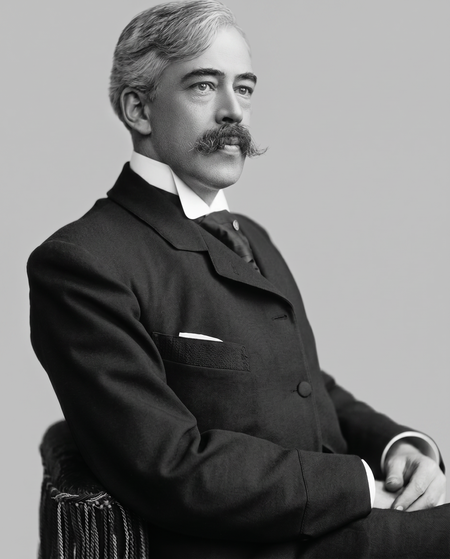
In the history of world theater, Konstantin Sergeyevich Stanislavsky’s name is inextricably linked to the concept of realism. However, in contemporary art criticism and theatrical practice, this term is often oversimplified, reduced to everyday naturalism, passive copying of reality, or the «museum-like» recreation of historical eras. The true relevance of researching the topic «Realism Forever» lies in the desire to overcome this misconception and reveal Stanislavsky’s realism as a dynamic, ever-evolving method for organizing stage space and action.
In the age of digital technologies and performative practices, looking back at the origins of the Moscow Art Theatre’s reform reveals that the stage world created by K. S. Stanislavsky and his constant collaborator V. A. Simov was initially built on the principles of active interaction between the human and the environment. Understanding and representing how the foundations of this «living» space were laid helps to recognize the vitality and enduring value of the realistic method—a method that has proven capable of transforming and responding to the challenges of any historical era.
For this research, iconographic and archival material was selected to document the evolution of the Moscow Art Theatre’s spatial solutions from 1898 through the 1920s. The material must be relevant to the key stages of stage reform:
- Sketches, drawings, and model photographs by V. Simov for historical dramas («Tsar Fyodor Ioannovich, ” „The Death of Ivan the Terrible“) that demonstrate the shift from flat scenery to three-dimensional volume.
- Scenographic plans and archival images of mise-en-scènes from Chekhov plays („The Seagull, ” „Uncle Vanya, ” „Three Sisters, ” „The Cherry Orchard“), illustrating the emergence of „atmospheric“ realism.
- Visual documents from Soviet-era productions (primarily „The Armored Express 14-69“), capturing the dialogue between the realistic tradition and Constructivist avant-garde.
The structure of the visual research is built on a chronological principle, allowing for the sequential exploration of the stated theme through five key aspects. Initially, there is an analysis of how the detailed recreation of past material culture served as the first step toward moving beyond conventional operatic tropes—the transition from scenery as a painting to scenery as an environment. This is followed by a justification of the specific repertoire of the Moscow Art Theatre (MXT). Next, the research analyzes how the dramatic material required the production creators to seek typical circumstances and contend with excessive naturalism. The concluding part of the study is an analysis of the viability of V. A. Simov’s realistic method during the era of constructivism’s dominance and its adaptation to the demands of new Soviet drama.
THE PROBLEM At the beginning of the 20th century, realistic theater faced a dual threat: on one hand, it was accused of conservative, «museum-like» realism and naturalism; on the other, it was challenged by a radical avant-garde that proposed completely abandoning verisimilitude in favor of abstracted structures. This created a problem regarding the survival of the realistic method amid a shifting artistic language.
CORE QUESTION
How did the spatial and visual reforms of K. S. Stanislavski and V. A. Simov allow realism to transcend the boundaries of mere imitation of daily life and transform into a universal, plastically flexible, and perennial methodology of theatrical art, one capable of evolving independently of changing historical epochs and artistic styles?
HYPOTHESIS It is posited that Stanislavsky’s realism became «timeless» because he initially declared the priority not of external domestic verisimilitude (such as copying furniture), but of the organic connection between the actor and the three-dimensional, dynamically changing stage environment. By creating the concept of «given circumstances» as a volumetric physical space, the MKhT reformers established a universal code of scenography—one that could seamlessly absorb the discoveries of cinema and Constructivism, thereby proving its viability in any era.
1. Historical-Everyday Line and Russian Style
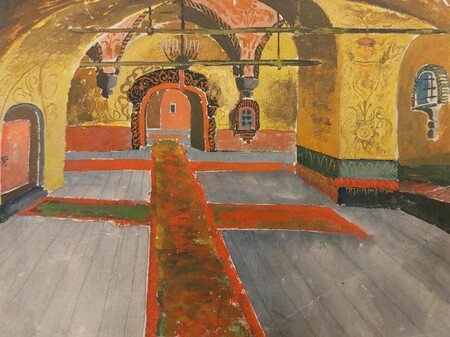
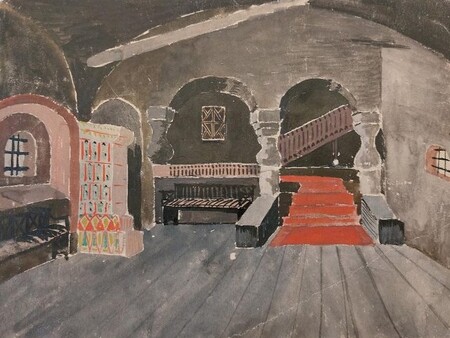
V. A. Simonov / Sketches of the Kremlin Tower «Tsar Fyodor Ioannovich» / 1898
The set design reform at the Moscow Art Theatre began with a reevaluation of the historical repertoire.
By staging historical plays («Tsar Fyodor, ” „The Death of Ivan the Terrible, ” etc.), the designer imbued the „historical style”—which was abstractly understood in theaters of the time—with vibrant everyday life
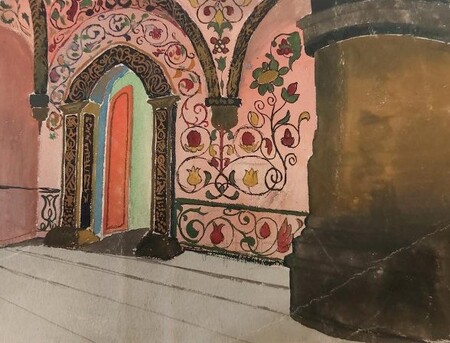
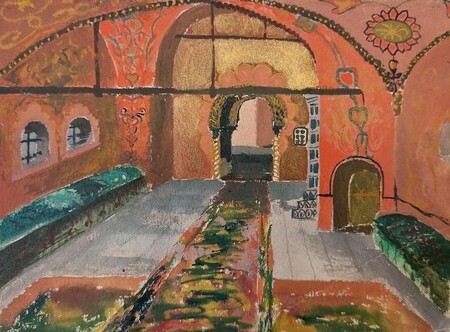
V. A. Simonov / Sketches of the Kremlin Palace «Tsar Fyodor Ioannovich» / 1898
Instead of the conventional, elaborate set designs typical of imperial stages, K. S. Stanislavski and V. A. Simov proposed a detailed recreation of the era’s material culture. In historical productions, such as «Tsar Fyodor Ioannovich» and «The Death of Ivan the Terrible, ” the co-creators moved away from a template representation of grandeur.
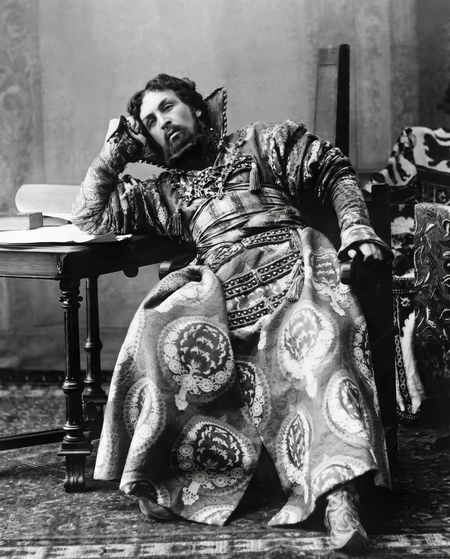
Alexander Vishnevsky / Plays Boris Godunov / 1898
Stanislavsky insisted that every detail of the costume and everyday life should contribute to creating a living character, rather than appearing as a false masquerade» [2].
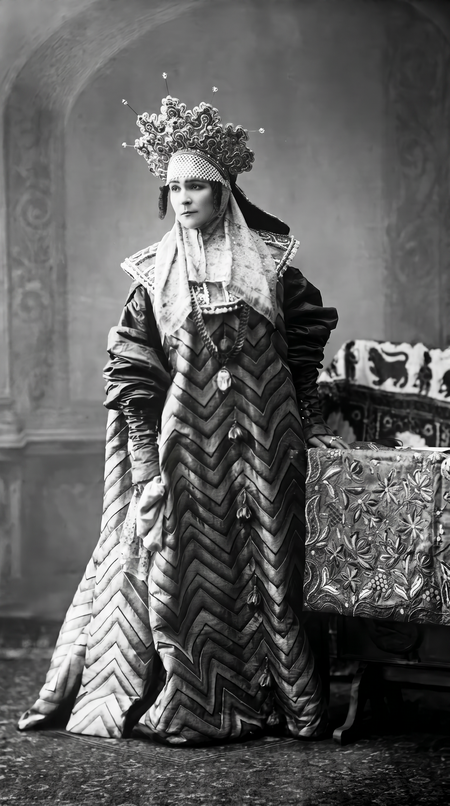
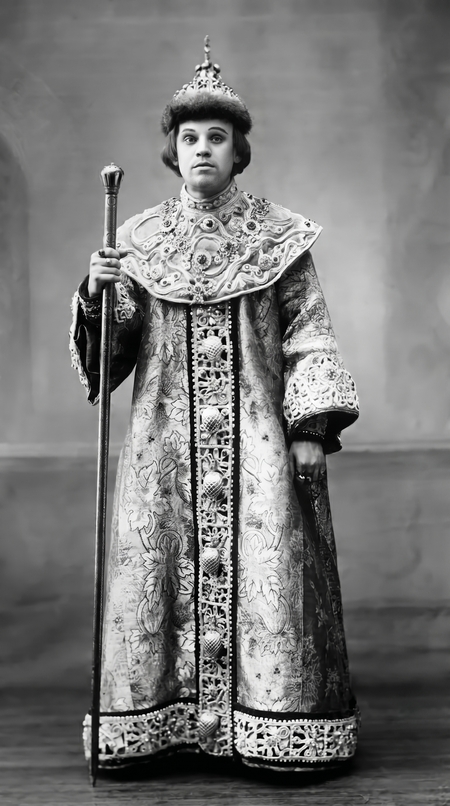
Olga Knipper / Plays Irina / 1898 Ivan Moskvin / Plays Tsar Fyodor / 1898.
The stage space ceased to be merely a backdrop; thanks to Stanislavsky’s directorial objectives, it transformed into a tool for organizing popular scenes. Simov’s historical and everyday set designs provided direction with new possibilities and a solid foundation for immersing actors in the theatrical action.
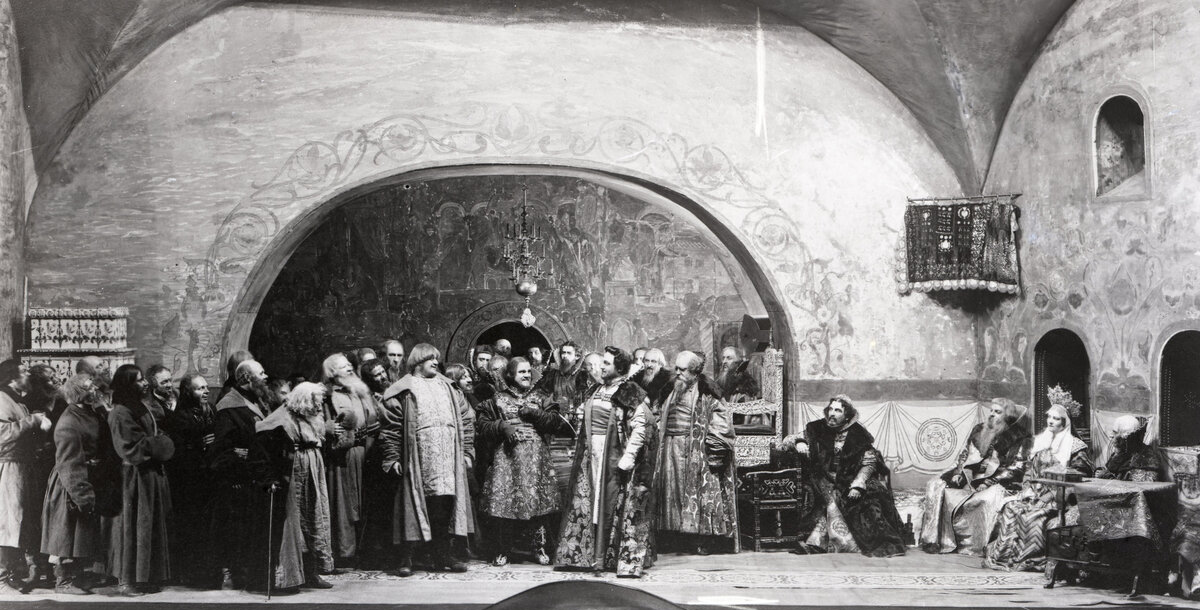
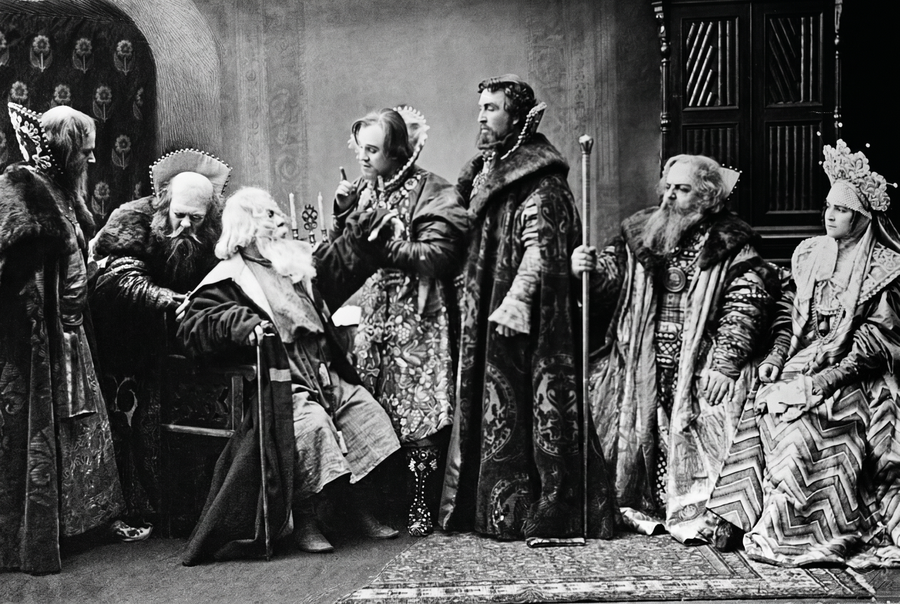
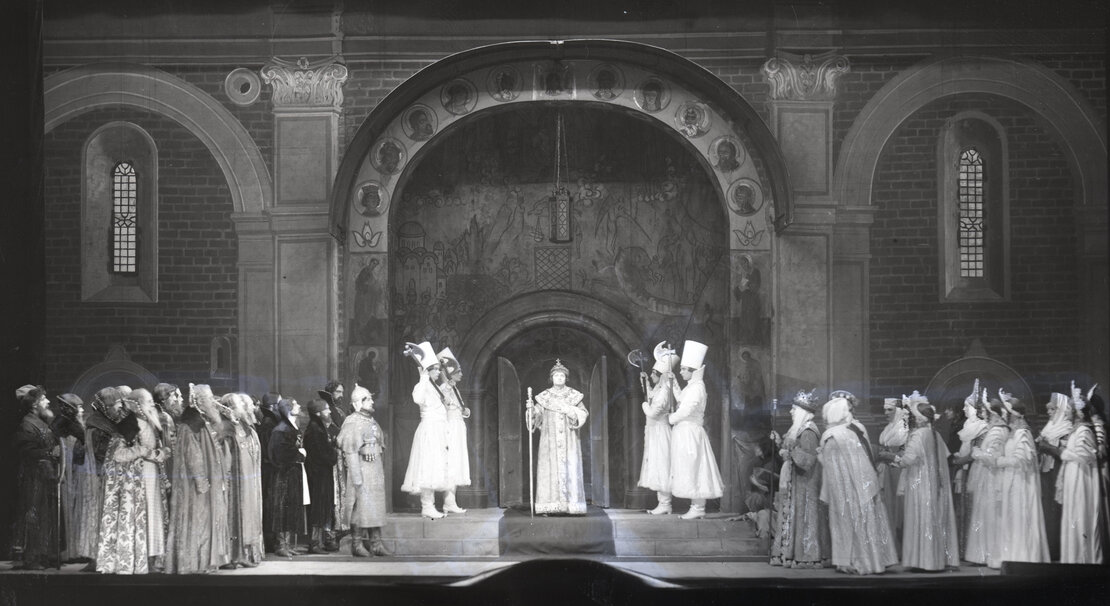
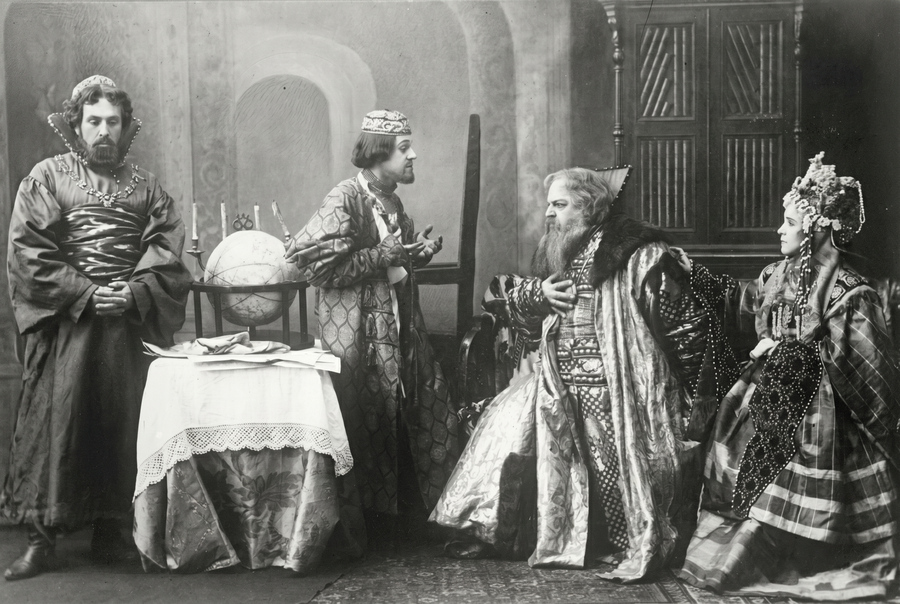
MKhT / Scenes from the play «Tsar Fyodor Ioannovich» / 1898
This approach was clearly manifested in the work on A. N. Ostrovsky’s «Snegurochka.» Unlike the lyrical, fairy-tale sketches by Viktor Vasnetsov, Simonov and Stanislavsky proposed a different, more grounded and detailed interpretation. To achieve this, the artist traveled to the Russian North so that the sets and costumes depicting a fictional country where the snow maiden lived would feel close to reality, despite the fantastical nature of the story.
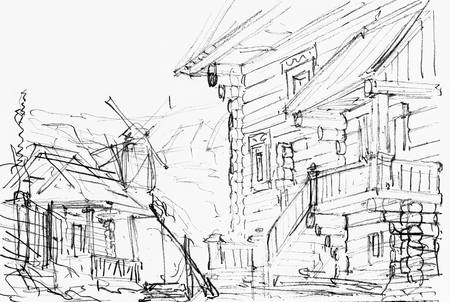
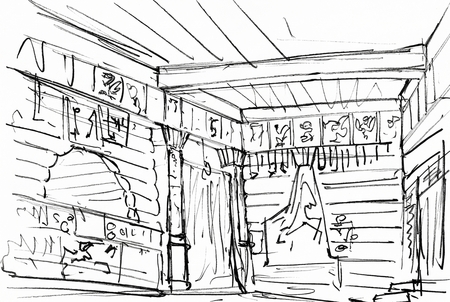
V.A. Simova / Sketches of «Snegurochka.» Moscow Art Theatre / 1900–1901
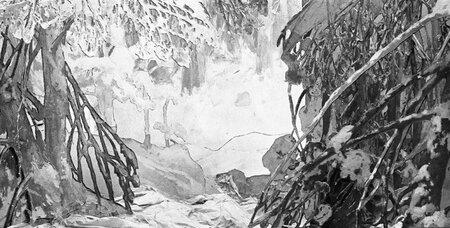
The paintings created on stage held up against masterpieces of Russian realist painting in terms of their power and psychological depth: «These paintings, in their penetration of the people’s psyche, in the strength and originality of their expression, were closer to the works of Repin and Surikov» [3] — concludes theatre historian N. N. Chushkin.
V.A. Simonov / Prologue Mock-up for «Snegurochka» / 1900
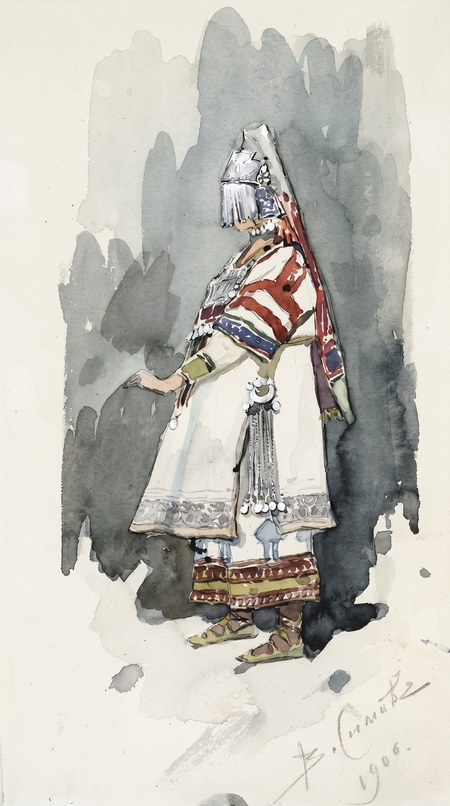
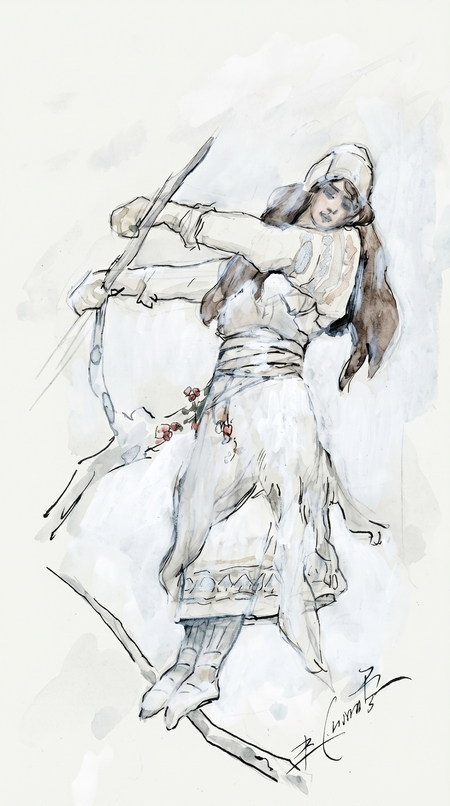
V.A. Simov / Costume Sketch for a Girl in the Play «Snegurochka» / 1900 V.A. Simov / Costume Sketch for Snegurochka in the Play «Snegurochka» / 1900
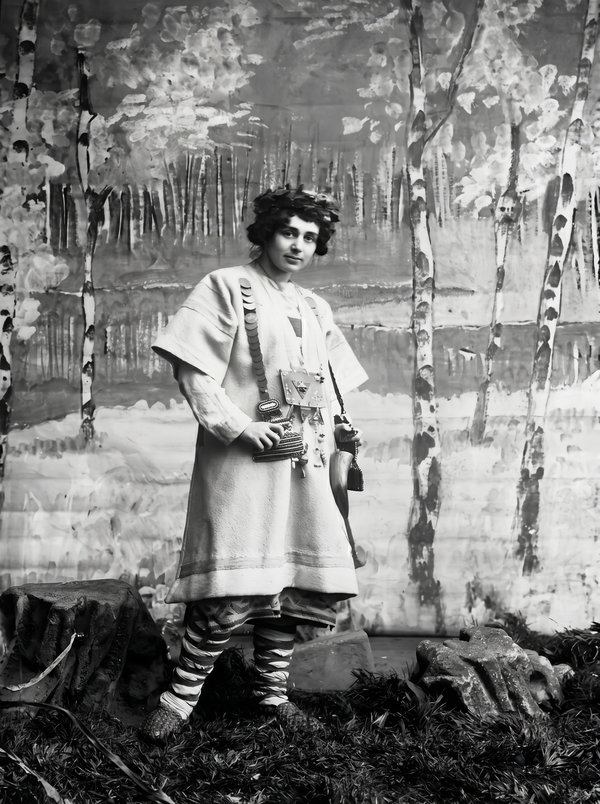
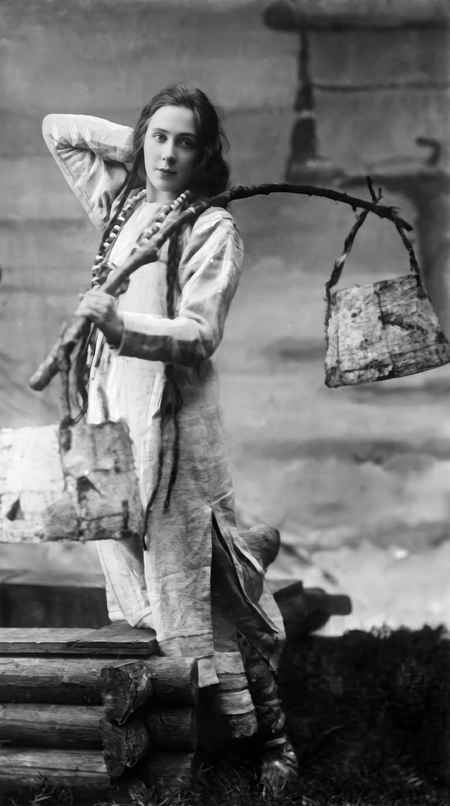
Maria Andreeva / Lel / 1900 Maria Lilina / Snow Maiden / 1900
Thus, everyday authenticity and the «Russian style» became the foundation for shaping a new theatrical truth.
2. The Three-Dimensional World of Chekhov, Stanislavsky, and Simov
The collaboration between K.S. Stanislavsky, A.P. Chekhov, and V.A. Simonov led to the creation of a fundamentally new dramatic spatial theory. Simonov rejected the traditional proscenium arch system in favor of a three-dimensional environment that actively interacts with the actor. As researcher Yuri Nekhoroshev notes:
«Simov grasped the essence of a new artistic principle. He immediately began developing an environmental volume model, creating 'proposed circumstances' through the means of fine art, architecture, and light» [4].
In the Stanislavsky system, these circumstances were interpreted as broadly as possible: «To live on stage, the actor must establish an organic connection both with partners and with the scenic environment» [5].
One of the fundamental principles of the Stanislavsky system is the actor’s progression from external form to deep internal content. Stanislavsky believed that scenery, costumes, makeup, and props should not merely decorate the stage, but rather aid the actor in discovering internal truth.
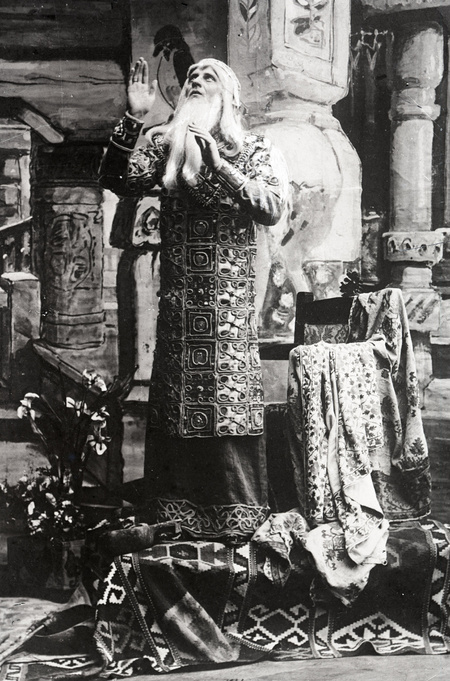
Vasily Kachalov / Playing the Tsar of Berendey in «Snegurochka» / 1900
The process of creating the performance began with a joint text analysis, during which Simov acted as co-director, sketching out the room layouts right during the readings: «He listens attentively while simultaneously sketching circles and squares thoughtfully» [5].