Project Concept
This project explores how a generative neural network can reproduce the artistic style based on the works of Vasily Vasilyevich Vereshchagin. His work is characterized by a diversity of subjects, attention to light and space, and distinctive desert and open landscapes. The goal of the project is to train the model to reproduce the visual imagery, guided by the artist’s color palette, compositional features, and atmosphere, in order to generate new scenes that maintain stylistic proximity to the original oeuvre.
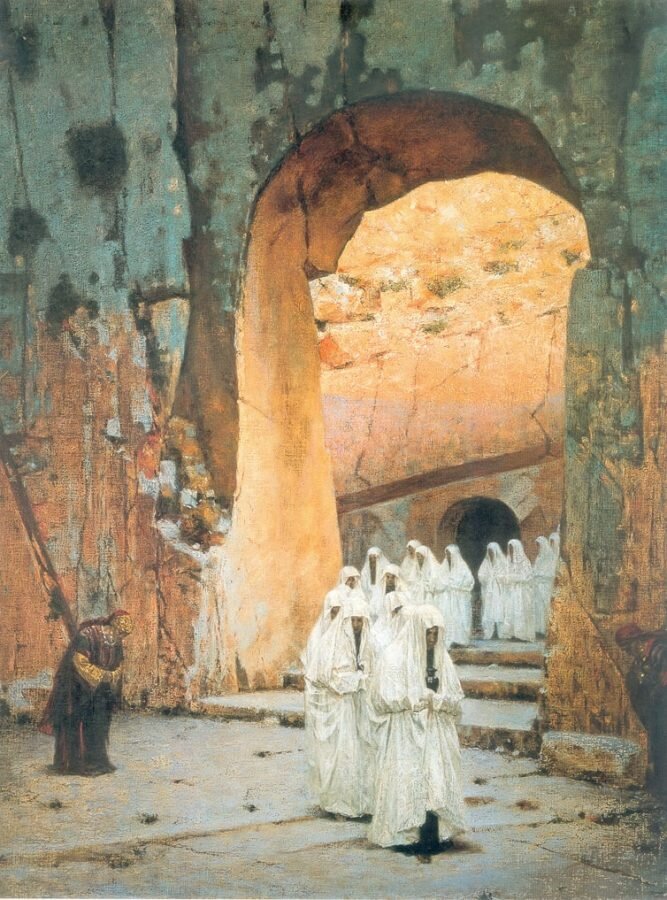
Source images — paintings by Vasily Vereshchagin
Source images (dataset)
A dataset of public domain works by Vasily Vereshchagin (in square format, 1:1) was collected to train the model. The images were sourced from open repositories and selected based on various parameters: — historical episodes — landscapes — architectural views — diverse cultural contexts — figurative scenes with people
Source images — paintings by Vasily Vereshchagin
Source Images — Paintings by Vasily Vereshchagin
Source images — paintings by Vasily Vereshchagin
Source Images — Paintings by Vasily Vereshchagin
Source images — paintings by Vasily Vereshchagin
The Learning Process
The generative model was trained using Stable Diffusion and LoRA.
Key stages of the work: — Dataset preparation (image formatting, careful image selection) — Training setup (parameter specification) — Model training (considering the stylistic features of the image selection) — Image generation
Final Series Analysis
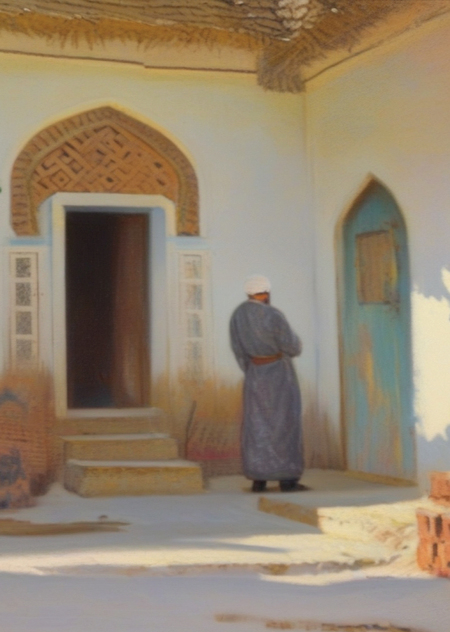
The final series demonstrates the precision with which the neural network can interpret a designated style and generate new images. It successfully captured the characteristic color palette, expressive narratives, and compositional integrity.
Resulting Images
The resulting images reflect the diversity of Vasily Vereshchagin’s works, conveying a collection of images unified by a single atmosphere.
Resulting Images
Resulting Images
Resulting Images
Resulting Images
During the project, an interesting characteristic of the generation was identified—the model sometimes enhances the visual image, imparts symmetry and uniformity, and saturates the scene with numerous objects.
Resulting Images
Resulting Images
Laptop Description
The notebook contains the complete model training process: — dataset loading and preparation — creating a directory for images — configuring training parameters — launching model training — image generation