Investigation into the modulation, distortion, and delay of a single signal in Pure Data
Concept. Principle of Constraint.
— The entire soundscape is generated from a pure sine wave. The patch contains no samples, white noise generators, or external synthesizers.— The process unfolds from chaos toward the gradual revelation of a pure tone.The goal of this piece is to demonstrate how a rich, broadband noise can be derived from a single sine wave using only internal signal modulation, distortion, and delay.
How Sound Changes Under Environmental Influence
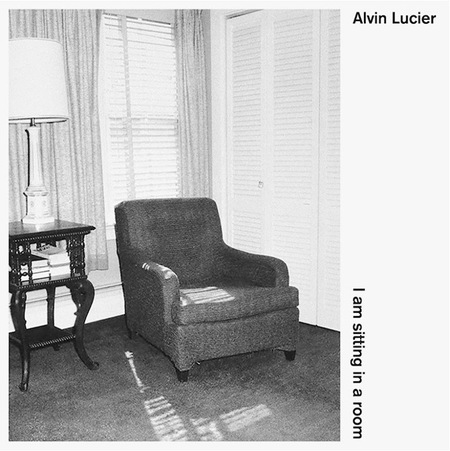
The idea is inspired by Alvine Luce’s work, «I am sitting in a room.»
Luce repeatedly reproduces a recording of his voice within a room. Gradually, the speech loses intelligibility, and the room’s resonances become more prominent. The original sound changes under the influence of processing and gradually loses its recognizable form.
This patch takes that same concept but transplants it from a physical space into a digital environment.
Patch Architecture
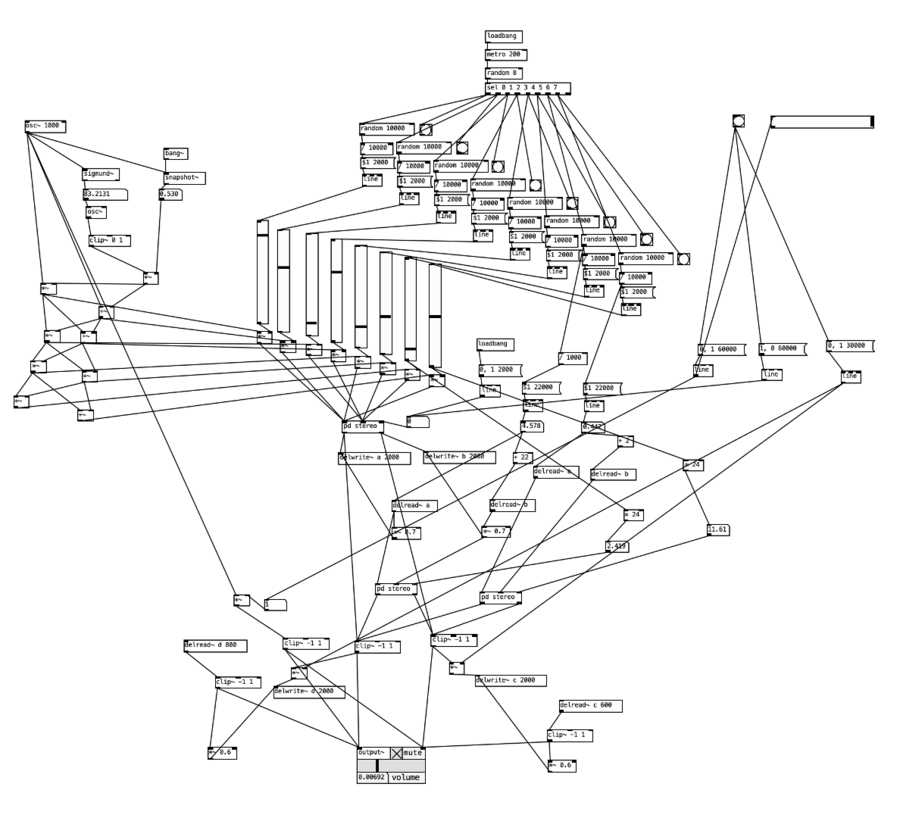
Stage I. Primary Signal and Auxiliary Oscillator.
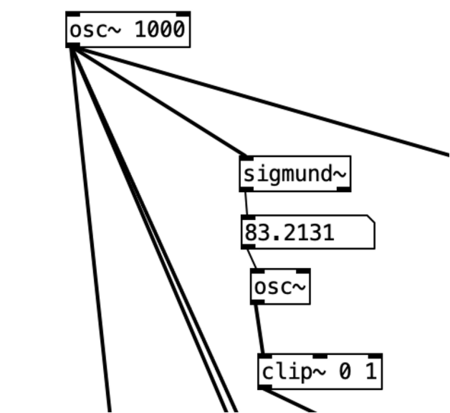
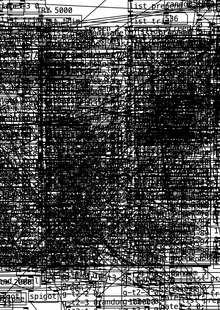
Source sine wave at 1000 Hz. The signal enters sigmund, which determines its pitch and outputs the result as a MIDI note number—approximately 83.This number is connected to the second oscillator. Here, it is used as a frequency in Hertz. Consequently, the second oscillator generates a sine wave of approximately 83 Hz.This low-frequency signal passes through a clipper and is subsequently used in sound processing.
Stage 2. Signal multiplication and summation cascade.
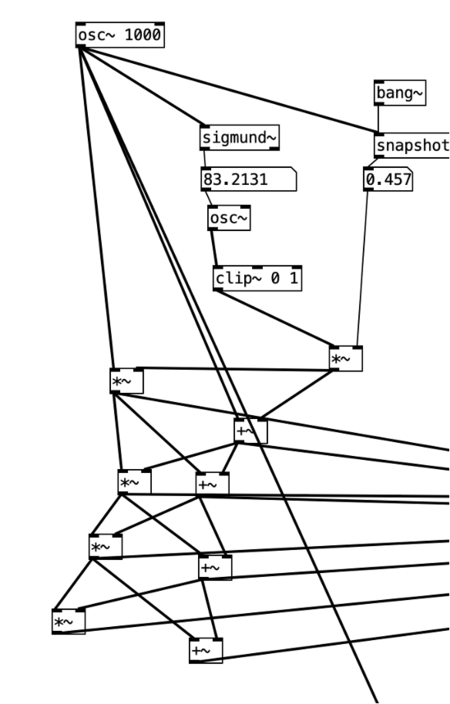
Signal A: a pure 200 Hz sine wave (carrier tone).
Signal B: a distorted 83 Hz sine wave (modulator, generated via the sigmund and clip functions).Step 1: Signal A is multiplied by Signal B and simultaneously added to it.
Step 2: The signals generated in the first step are then multiplied and added together.
Steps 3 and 4: The process repeats down the chain—each new result is multiplied by its previous versions.
Phase 3. Octagonal Dynamic Control.
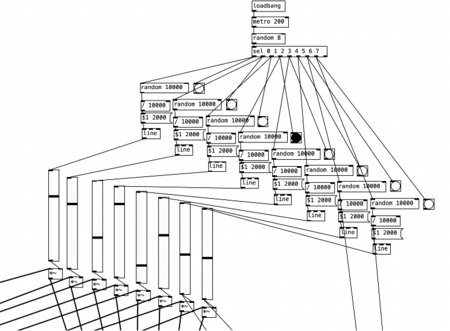
The metronome randomly selects one of 8 channels every 200 milliseconds.
The selected channel generates a random number between 0 and 1, which smoothly changes the position of the slider over 2000 milliseconds (via the line object).
These sliders control the volume of 8 parallel distorted signal layers before they are sent to the pd stereo subpatch. This creates an organic movement because the noise is constantly evolving.
Phase 4. Space and Feedback.

The shaped mononoise is distributed across two stereo sub-patches, pd stereo, and enters the cross-delay line system.The delay times in lines $a$ and $b$ are dynamically modulated by signals from the slider block, creating a spatial blurring effect.The secondary lines $c$ and $d$ pick up the signal, generating a deep spatial echo.
Stage 5. Main Macro-envelope.
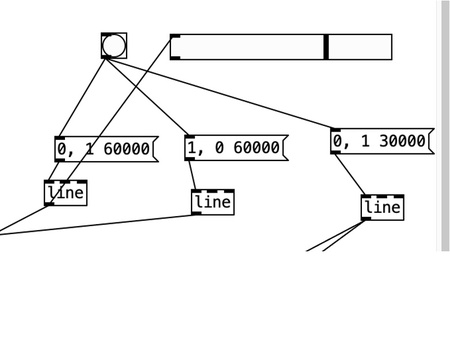
Message 1, 0 60000 initiates a smooth fade over exactly one minute (60,000 ms).As the slider moves, the delay signal drops to zero, and the direct clean signal branch from osc~ 200 gradually comes to the forefront.Because of this, the viewer hears the start with full noise, and then observes the signal clearing to a sterile sinusoid over 30 seconds.