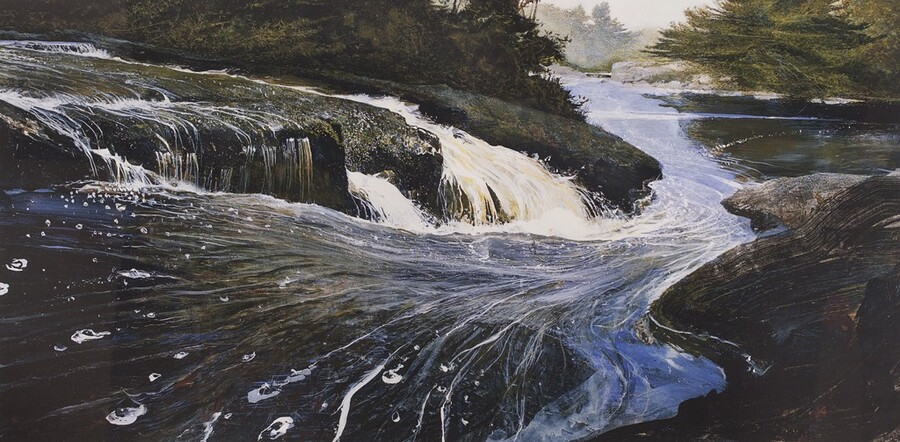
Andrew Wyeth The Carry (2003)
The standard text’s driving impulse can be visualized as a rhombus. One vertex is the entry point, determined by the method and the problem’s framing. Gradually, the plane of the work expands, becoming filled with interconnections between concepts and building semantic density. Two vectors define the boundaries of the internal volume. Initially, ideas and hypotheses gradually become the concrete content of the text, transforming in the process of establishing relationships that reveal new facets of what was initially proposed. In the final stages, having shed impurities and left behind the phase of discursive transformation, the composition arrives at conclusions that summarize the journey. The text circles back onto itself, producing a result.
Now, imagine that the initial angle, originating from a point and two rays, does not reach two vertices that refract the direction of the sides. Two straight lines curve backward, turning around to return to the point of origin. «Aesthetics of Decay» moves through three parts, concluding not in a pure fourth part, but in an epilogue that wrenches the narrative away from the preceding sections. Interludes repeatedly edit the canvas upon which all moments of reading are hung, breaking the linear accumulation of arguments.
The climax, intuitively tied to «The Future Penetrated by the Present”—the last of the major blocks—is fractured in the transitional fragment „A Step Under the Sky, ” which transforms reading into an event at the limit. This episode shifts to another text within the composition—"The Beginning of Philosophy on the Edge of Fausin: The Poetic as a Condition of Human Being.» Thus, the reader is placed at the threshold of a new ascent toward a summit from which to survey the journey completed thus far. The scene is readjusted still within the confines of the book; the shift in perspective provides the reading experience, prompting a correlation between reflections on language and poetry and the themes that previously engaged with notions of the city, civilization, culture, and the human spirit circulating within them, via language and poetry.
The motifs that weave the fabric of the text—time, ruins, and light—play the role of leitmotifs. They ensure the constant return of themes from different perspectives, allowing the composition to expand like rolling waves that reimagine the familiar.
Issues of memory, speed, deceleration, clarity, comprehension, and ultimately, the human effort to establish itself in the world and survive against the clock’s relentless ticking are frequently addressed. This is easily traced through the mention of ruins—which are used both literally and metaphorically to signify the logic of time: a time that diminishes but never fully exhausts itself, resisting obliteration. Ruins embed themselves within an environment that is often hostile to them, revealing their essence as an echo of what was done—a personal skeleton of humanity—and are installed within the Umwelt, interlinking with the flow of images and memory.
The city, through the lens of assemblage theory, provides an anchor point. They are conveniently viewed as a compilation of heterogeneous elements that exceeds the sum of its parts, allowing one to conceive of the city as a unified ensemble of technology where people, devices, and data condition one another and generate new meanings. Rather than focusing on the ontology of nodes and connections—that is, joints—assemblage demonstrates the technical aspect as a geo-autonomous entity governed by its own laws. It is driven not only by external connections, but primarily by the initial power that sets the properties of the data in motion.
Gradually, the technical world assumes responsibility for the production and maintenance of meaning, which gives rise to the «spirit of the machine”—a mode of operation for the technogenic image that extrapolates the portion of the human enduring within it, obscuring vital life. It is initiated by humans, but it autonomously develops a project of rationalization responsible for the self-knowledge of culture, during which it translates even irrational impulses into operational forms of reason. The spirit of the machine maps and encrypts existence. The geo-autonomous entity and assemblages act on the surface of Nothingness—an abstract, mirror boundary between the old and new Nature. This space is one of pure potential, where the world splits into two infinite orders and where differentiation occurs. In essence, this is a transcendental non-being—a frontier of meanings, a boundary that reflects and transforms human understanding, rather than merely representing absence.
The spirit of the machine operates where language falters in the face of nothingness, leaving the recipient on the frontier between two natures. Its code is the oscillation between presence and meaning, a process through which the individual escapes the self. Technology, having inherited a part of humanity, promises speculation.
In reality, it begins to define modes of visibility and action, thereby revealing the logic of its geautonomy. Due to this influence, subjectivity is redistributed between humans and the techno-environment. An immanent system forms where assemblages function as infrastructural ground for spontaneous connections, holding the environment in a relevant «now, ” actualizing minimalist forms by exiting into the virtual dimension. Importantly, this enables connections to launch unstable, evolving configurations of meaning that begin to differentiate from, yet continue, the human. The foundation of these differences lies in the relationship to time, the effect of distortion, and the projection of a future that diverges more strongly from what we imagine. The city, considering what has been previously discussed, embodies not a neutral accident of the human, but a temporary sign that has attained form. „The Aesthetics of Decay“ describes it as a substantializing mechanism of memory and power. It is an active deed and a habitat that proclaims the laws of reality for its inhabiting agents. Striving to embody the image of a metropolis belonging to the topos of global modernity, the city trends toward a megacity model—a closed world where its own rules of space and time reign, engulfing almost everything. It shifts the center toward the corporate stronghold of the economy, adopts the color palette of a ziggurat, and the conditional tower, stretching both upward and outward, is drawn inward, concealing rather than revealing. It no longer arises from the will of specific people but emerges from the mass of accumulated human endeavor—to which it turns to extend growth—the architecture of servers and memory. Its substantive depth becomes a reversed height, conceived within the logic of progress as a way to build the future and look ahead. Because of this, humanity is presented as diminished in relation to the detached world.
Fausin manifests in the cessation of the pulsation of the urban Umwelt or environment. It introduces topology, the scene of action, and is defined as a temporal rather than a spatial category. There, form becomes overloaded and drifts toward Nothingness; meaning flashes forth only as a differentiation event on the surface. In it, the past and the future condense into a saturated simultaneity of the «now.»
The sequence of linear history collapses and transforms into a node of waiting. Nothingness rises on the horizon—a trace of loss, destabilizing time and the flow of meaning, and with them, language. Nothingness, as a mirror, turns time backward, and into the narrative enter the categories of the sublime and the grotesque, connected to moments of rupture and formal overload, the collapse of everyday life that conceals the phausis behind the changing backdrops of the illusory course of history. This type of sublime stubbornly evades urban codification and intensifies the experience of the distance between the old and the new Natures.
The desert offers a horizontal opposition to the watery metaphor of the phausis. Furthermore, the desert motif is linked to post-apocalyptic absence and the genre myth of global catastrophe. It testifies to a state of depletion of vitality reserves, those directly derived from human presence. The verticality of the overgrown tower pierces the desert landscape; the atlas of the surviving structure’s internal organization, articulated, leads toward the architecture of memory—the authentic verticality within the construct. The image also finds the prohibition of rooting, emphasizing the nature of ruins—decay, rather than organic integration into the soil. The virtual double of Nature reveals vulnerability and shifts the gaze from the sky to the foundation—to the tragedy of the challenge and to the inversion of perspective inward to civilization.
The book features a distinct light leitmotif. Light functions as a boundary of visibility, encompassing values from ancient notions of brilliance/clarity to references to light in the technique of chiaroscuro. The conditions of cyberspace and the future city project in general create an environment where light ceases to be daylight radiance; it transforms into an instrument of power and illusion. To capture light is to fix the edge where differentiation is still possible—that is, to find a way to counter speed through stasis to reveal the boundaries of meaning. Fixation allows one to see the edges of the hyperobject with a different temporality—that of the city and the phausis standing behind it. The perception of art is also examined as a slowing practice, as it separates internal time from the rhythms of the city and makes the threshold of the phausis visible.
Both acts are tied to the surface of Nothingness and to the poetics of event. In the section on the fate of art, the «second path» is described—a movement toward Nothingness as an event of obsolescence. There, Nothingness mirrors the perceiver and returns them to itself. In other words, a literal light stage in a temporal sense is discussed, where instead of illuminating an object, its own position at the limit is illuminated. The logic of light here lies in the reflection on the surface of the boundary, where meaning trembles and the linear time of urban daily life fractures. The moment of return rhymes with the essence of ruins. Their significance is not limited to the status of picturesque remnants of the past. They also exist as breaches in the fabric of the city, symbols of decay, where time manifests itself and refers to Nothingness. Together with the city and any environment surrounding it, they move invariably in the opposite direction—toward disappearance.