Essay: «Wooden Receipts of the Genetic Lake»
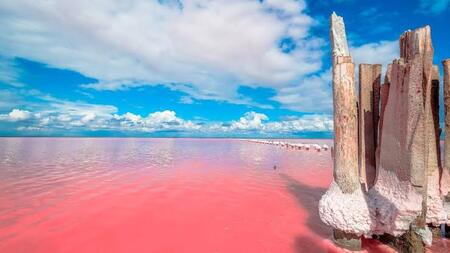
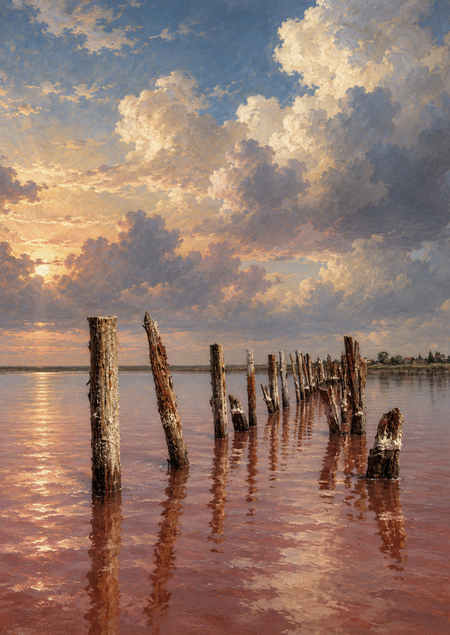
In the middle of the Genichesk Lake stand long rows of wooden pilings. Some are almost submerged underwater, while others are coated with white salt crystals. From a distance, they resemble the remnants of an old bridge or a flooded pier. It seems that a road once crossed here, connecting two shores. But this road never led anywhere. The pilings were part of a complex system that enabled people to manage the salt-making process.
These structures are called wooden cheks. More accurately, cheks were individual salt pond sections, the boundaries of which were marked by wooden barriers and dams. They were located on Genichesk Lake, near the village of Priozernoye on the Arabatskaya Spit.
In 1840, General Meshkov established a large salt mining operation here. Its design was considered advanced for its time. In certain years, the enterprise produced up to 50 thousand tons of salt, which was shipped far beyond the Priazovye region.
The most unusual aspect was that production depended almost entirely on nature. Water was distributed into special pools. In some, it settled; in others, it slowly evaporated under the sun, turning into a concentrated salt solution—rapu. The rapu was then directed further until crystals began to form on the bottom. The wooden cheks allowed this process to be managed and made salt harvesting easier.
Unlike a typical factory, the work here could not simply be accelerated by machinery. The salt operation followed its own schedule, dictated by the sun, wind, and weather. Sometimes, achieving the desired results required waiting for weeks.
In the 20th century, a salt mining plant continued operating at the site. However, production ceased by the early 2000s. Over time, the equipment disappeared, the buildings began to decay, and the wooden structures remained standing in the middle of the lake.
It is these structures today that tell a greater story about this place than the ruins of the former factory. Crystals accumulate on the old wood, and the straight lines of the pilings are gradually losing their original outlines. What was created purely for practical purposes has transformed into an unusual monument to human labor.
On photographs of Genichesk Lake, people most often focus on the pink water. But it is much more interesting to look closely at the wooden pilings. Behind each row lies a carefully designed system that once employed people and turned saltwater into a valuable commodity.
When safe travel to the Arabat Spit is possible again, you should come here specifically for these structures. Stop on the shore and watch the lines of dark piles recede into the distance, gradually dissolving into the reflections on the water. Try to mentally reconstruct the vanished partitions, imagine the movement of the crab between the pools, and visualize the work of the people who managed this unusual production.
Because what remains here is not just a few old wooden posts. Here, you can see traces of a technology where time itself was the main mechanism.
«Forty-Foot Pile»
«Thirty-eight, thirty-nine…» Varya looked up from her notebook and gazed at her reflection in the water. «Wait a minute… why is it forty here?»
At the Arabatskaya junction, near the village of Priozernoye, amid the salt lake, rows of old wooden piles still stand. Once, they held the partitions of salt ponds; now, they are slowly deteriorating, covered in white crystals.
From a distance, it appears as if these are the remnants of a bridge that once crossed the water. However, local legend tells a completely different story about this bridge.
They say that in the old days, workers never counted the piles after sunset because sometimes their reflections in the water would appear to be one more.
In the late 19th century, a large salt industry operated on the shores of Lake Genes. Water was distributed into shallow basins called checks. The sun and wind gradually evaporated it, leaving white crystals of salt on the bottom.
People worked here from dawn till dusk. Some gathered salt, others repaired the wooden partitions, and a third group loaded heavy sacks onto carts.
Seventeen-year-old Varya worked in the industry’s office. She transcribed ledgers, tallied the amount of salt collected, and checked how many workers had shown up for the shift.
Varya loved numbers. Unlike people, they never lied. If one column showed thirty-eight sacks and another showed thirty-seven, it meant one sack was lost somewhere. Everything could be found, recounted, and corrected.
Her father had taught her to keep accounts since childhood. He also worked at the saltworks but passed away several years ago. Now, Varya helped her mother and dreamed of saving enough money to go to college in a big city.
One autumn, the industry manager, Efim Ilyich, tasked her with checking the condition of the wooden checks before the cold weather set in.
«The carpenters will be replacing the partitions tomorrow. Recount the piles at the north basin and note which ones need to be replaced.»
Varya took out her notebook and headed toward the water.
The sun was already setting when she reached the old jetty. Wooden pilings stood in two uneven rows, stretching far out into the lake. Some were covered in white salt, while others were almost black with age.
Varya began counting: thirty-seven, thirty-eight, thirty-nine…
The last piling was set slightly apart from the others, almost at the shore. She wrote down the number in her notebook and was about to leave, but she accidentally glanced at the reflections in the water and stopped.
There were forty posts.
Varya recounted them. Then she looked back at the actual pilings.
Thirty-nine.
But forty in the water.
She walked closer. Where the extra reflection was, the lake surface remained perfectly empty. But in the water, a thin, dark pillar was clearly visible, as if an invisible piling truly existed.
Varya scooped water with her palm.
The reflection broke into small ripples. When the surface calmed again, the fortieth piling disappeared.
The girl smiled.
«So much for an exact count.»
She decided she was tired and went home, but she returned the following evening.
There were forty reflections in the water again.
On the third day, Varya told the old carpenter, Nazar, who had been repairing partitions for many years, about something strange.
He listened to her and unexpectedly stopped working.
«Where did you see it?» «At the northern dike.» «After sunset?» «Yes.»
Nazar remained silent for a while.
«Then it is better not to go there anymore.» «Why?» «Because the water doesn’t always show what is above it.»
Varya laughed.
«And what else can it show?»
The old man set down his hammer.
«What is missing.»
He said nothing more.
That same day, Varya learned that the manager planned to reconstruct the northern dike. Between two rows of piles, there was an old passage that allowed the discharge of lamprey during a significant rise in water level. Yefim Ilyich decided to block it off with a new partition to better retain the brine solution.
Nazar objected.
«There has always been an outlet for the water. When the wind is strong, the level rises. If everything is sealed up, where will it go?»
The manager waved his hand irritably.
«We have been extracting salt for years. We don’t need an extra passage. The lamprey escapes through it.» «But it wasn’t left there for no reason.» «Nobody pays money for empty space.»
Varya stood nearby, noting down the necessary materials.
She completely understood Yefim Ilyich. If more brine could be retained, more salt could be obtained. This meant the enterprise would make more money.
But for some reason, she remembered the missing fortieth column.
In the evening, she went again to the northern dock. This time, the reflection was different from before. Where there had been a forty-foot piling, there was a human figure.
At first, Varya thought it was one of the workers. But there was no one on the shore. She looked closer and discerned the silhouette of a small boy. He stood amidst the reflected pilings, his head bowed.
«Hey!» Varya called out.
The figure raised a hand.
Varya took a step forward, and the boy in the water turned to face her.
She recognized him.
It was Mitya, the twelve-year-old son of one of the salt-mining workers. He often brought drinking water to the people, helped carry tools, and collected stray wooden splinters.
Varya had seen him near the office in the morning, but what was he doing here?
She spun around abruptly and ran back.
The following morning, Varya found Mitya near the warehouse.
The boy was sitting on an overturned bucket, mending a torn handle of a wooden crate.
«Were you at the North Check yesterday?» «No.» «Are you sure?» «I’m sure. I was home all evening.»
Varya studied his face carefully.
«Why are you here every day? Don’t you need to go to school?»
Mitya shrugged.
«My mom works. I help out.» «Are you paid?» «Sometimes they give us bread. But I’m not an employee.»
He said this completely calmly.
Varya recalled the daily ledgers she kept. They recorded salt workers, loaders, carpenters, and guards. Even people who came for just one day received an entry.
But Mitya wasn’t on them.
She suddenly realized she had never thought about it.
That evening, the girl took out old workbooks. She flipped through the pages, trying to find any mention of the boy. But his name wasn’t on any list.
Instead, Varya found her father’s entry on the last page of an old notebook.
She recognized his handwriting immediately.
«North Check. Keep the passage clear. When the wind is strong, the water must have an exit.»
Below it, written in different ink, was an addendum:
«Barriers are counted by pilings. Labor is counted by people. Do not confuse the two.»
Varya stared at these words for a long time.
It seemed to her that she knew her father very well. He was a stern, quiet man who rarely discussed work at home. She remembered him teaching her how to add numbers, check calculations, and not leave errors in the ledgers.
But she had never asked why he monitored the workers' lists so closely.
Varya closed the notebook. That morning, she decided to speak with the manager.
However, she didn’t have time to—a strong wind rose during the night.
The water in Genichesk Lake usually appeared calm. But a strong wind could quickly change its level. By morning, waves were battering the wooden barriers, and the water was rising higher and higher.
The workers hurried to reinforce the new structures.
Yefim Ilyich ordered the last passage near the northern dike to be closed. The carpenters hammered boards, trying to ignore the wind.
Varya watched the work from the shore. The new barrier was almost completely blocking the old exit.
She recalled her father’s entry again.
«Yefim Ilyich, perhaps we shouldn’t close it?» Varya asked.
The foreman didn’t even turn around.
«Varya, you are a good accountant. So, stick to accounting, ” he replied.
After a while, he noticed Mitya standing near the warehouse.
„Boy! Take this to Nazar on the far section; the new reinforcements are ready. Have him return.“
Mitya ran along the narrow earthen embankment that divided the basins. Varya watched the small figure gradually move away from the shore. Then the wind intensified.
One of the old partitions could not withstand the pressure. Water rushed through the damaged section and began to erode the narrow embankment.The workers shouted, and Mitya found himself at its far end.He could not go back now. A wide torrent had formed between him and the shore.«Stop! Don’t move!» Nazar yelled.The boy pressed himself against a wooden post.Efim Ilyich ran toward the people, trying to find a rope. Varya stood motionless.She watched Mitya, the rapidly rising water, and the new partition that the workers had just finished reinforcing.And suddenly she saw a forty-foot piling.Where there had actually been nothing, a dark reflection appeared again in the middle of the water. It stretched along the wooden posts and then transformed into the familiar silhouette of a boy.Only now, the figure was not looking at Varya—it was pointing its hand toward the closed passage.
The young woman understood.
If the new partition is removed, some of the water will have an outlet into the adjacent plot. The water level at the eroding dike will stop rising so quickly.
But along with the water, the prepared salt will also be lost.
Varya ran to the supervisor.
«We need to open the passage!» «Do you realize how much salt we’ll lose?!» «Mitya is there!» «We’re looking for a way to get him out!»
Yefim Ilyich fell silent. For a moment, doubt flickered across his face.
Varya didn’t wait for an answer.
She grabbed a steel crowbar near the warehouse and ran toward the northern gate.
«Nazar! Help me!»
The old man saw what she was about to do and rushed to follow her.
The two of them pried one of the boards apart. The wood was stubborn. Varya braced her foot against the earthen embankment, and Nazar leaned his full weight onto the crowbar.
Finally, the fastening gave way.The water struck the resulting gap. Another plank cracked. Then the third.The flow rushed through the opened passage, carrying the saline solution into the adjacent pool.Efim Ilyich shouted from the bank:— What have you done?!But at that moment, Nazar was already handing the end of the long rope to the people on the surviving part of the dike. The workers formed a chain and managed to reach Mitya.The boy was pulled onto the bank.He shivered from the cold and could not say a word.Varya knelt beside him. For the first time in a long time, she wasn’t thinking about numbers, or money, or how much salt had been lost.She just watched Mitya breathe.
By evening, the wind had died down. The water gradually receded, leaving behind wet planks, pieces of driftwood, and lines of salt along the shore. Some of the harvest had been lost. Several pools would need to be rebuilt, and the new dividers had to be constructed from scratch. Yefim Ilyich walked along the shore for a long time, making notes in his pad. Finally, he approached Varya. «Do you understand what you have done?» «Yes.» «Then why did you open the pass?» Varya looked at him. «Because Mitya wasn’t in your calculations.» The manager wanted to respond, but changed his mind. The next morning, Varya opened the work ledger again. She recorded the amount of salt collected, the losses after the storm, and the number of damaged dividers. Then she turned the page and wrote down a name that hadn’t been there before. Mitya. Next to it, she left a blank line. Nazar, who peered into the office, noticed it. «And who is this for?» «I don’t know yet.» «Then why leave it there?» Varya thought for a moment. «What if there is someone else we didn’t count?» The old man smiled. In the evening, the girl went to the northern dock one last time. The water was calm. A light fog hung over the lake, and the red light of the sunset slowly faded at the horizon. Varya took out her notebook. She began counting the pilings: thirty-seven, thirty-eight, thirty-nine. Then she looked at the water. There were now thirty-nine reflections, too. The fortieth piling was missing. Varya stood on the shore for a long time, pondering what she had seen over these days. She never found out what exactly was appearing in the water. The reflection of a person facing danger? A warning? Or was the water itself somehow showing her something she didn’t want to notice? There was no answer. She closed the notebook and made one final entry on the last page. «The fortieth—for those who were forgotten.»