Rubricator
- Concept
- Fauvist Period: Color as an Independent Element of Painting
- Mature Period: Color as the Creator of a Harmonious Emotional Environment
- Late Period: Color as an Autonomous Expressive System
- Conclusion
Concept
«I choose colors not based on some scientific theory, but on feeling, observation, and experience, ” Henri Matisse acknowledged when defining the essence of his creative method. These words become the key to understanding the central transformation explored in this work: how color in Matisse’s still lifes evolves from a descriptive element of the material world into an autonomous and potent tool for shaping emotion and atmosphere. Matisse revolutionized the perception of color in modernist painting by asserting it as a self-sufficient expressive force. The genre of the still life, with its confined space, proved to be an ideal laboratory for the artist, where color relationships manifest with maximum conviction. The goal of my research is to analyze the specific visual mechanisms through which color creates a cohesive emotional environment, causing the traditionally static genre to „sing“ as a vibrant, sensual space.
In Matisse’s system, the still life intentionally becomes one of the main battlegrounds for radical experimentation. This genre possesses three key characteristics that the artist consistently employed to amplify the emotional impact of color. First is the controlled space, where pure color planes can interact directly without competing with complex perspectival structures. Second is the conscious deformation and simplification of objects in favor of a cohesive color field, where the chromatic resonance of the form matters more than its recognizable shape. Third is the rejection of traditional chiaroscuro modeling; light is used not to create the illusion of volume, but as a tool for highlighting and organizing color zones. Collectively, these features transform the still life from a genre of „dead nature“ into a living, pulsating emotional field where color takes center stage.
«I want the color on my canvases to sing, without adhering to any rules or restrictions”—Henri Matisse
As part of this research, I will conduct a comparative analysis of still lifes from different periods of Matisse’s career to trace the evolution of his approach to color and the emotional perception within his paintings. Special attention will be paid to his Fauvist period works, mature still lifes, and late pieces, where color gradually gains greater autonomy and begins to play a key role in organizing the picture space. Primarily, I aim to examine how the artist utilizes color contrasts and the interplay of warm and cool tones to create a specific emotional resonance. In his early still lifes, the color combinations appear sharper and more active, whereas in later works, color becomes more cohesive and starts to form a unified atmosphere within the painting.
Another crucial element of the study will be the analysis of the decorative quality and rhythm of the composition. In Matisse’s work, ornamentation, large color planes, and recurring forms cease to be secondary elements; rather, they become part of the painting’s overall system of perception. Color begins to organize the composition, link the objects together, and establish the internal rhythm of the work. Through this analysis of the pieces, it is vital for me to trace how, over time, color in Matisse’s still lifes gradually ceases to serve the description of the material world and transforms into an independent emotional environment that defines the work’s atmosphere and the viewer’s perception.
Fauvist Period: Color as an Independent Element of Painting
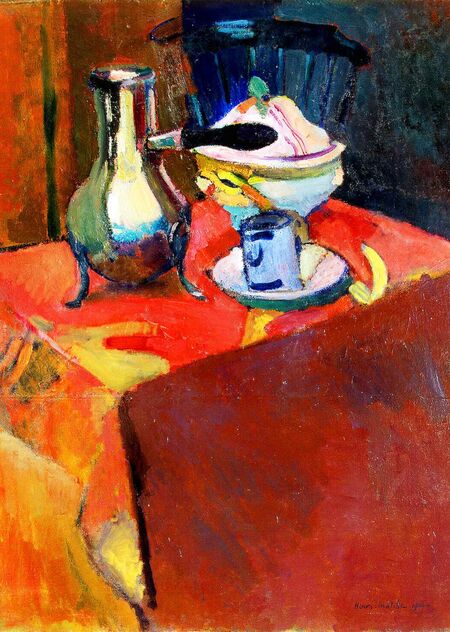
The Fauvist period in Henri Matisse’s work, approximately 1905–1908, was a time when color began to be perceived as an independent and leading force in painting. Forsaking direct imitation of nature, Matisse and his contemporaries placed emotional expression above realistic depiction. As the artist himself noted, he became «uninterested in copying the subject”—it was more important to convey „the subject’s relationship to the artist, to his personality.“
In still lifes from this period, color no longer merely conveyed the materiality of objects—vases, fruits, or textiles—but began to organize the pictorial plane and set its emotional tone. The primary technique became the collision of pure and complementary colors: crimson and green, blue and orange, without smooth transitions or traditional chiaroscuro modeling. Thus, color in Matisse’s still lifes was liberated from the role of describing reality and became an autonomous element of painting.
Henri Matisse. «Tableware on the Table.» 1900.
Henri Matisse. «Tableware and Fruits. Yellow-Lilac Still Life.» 1901.
Henri Matisse. «Still Life with Checkered Cloth.» 1903.
Henri Matisse. «Still Life with Purro (II)». 1904.
«I perceive the expressive side of color purely intuitively. When depicting an autumn landscape, I don’t recall what shades are appropriate for the season; I am only inspired by the sensations of autumn… I choose colors not based on some scientific theory, but on feeling, observation, and experience.» — Henri Matisse
Henri Matisse. «Vase, Bottle, and Fruits.» 1906.
Henri Matisse. «Pitcher in Flowers.» 1908.
Henri Matisse. «Parrot Tulips.» 1905.
Henri Matisse. «Vase with Two Handles.» 1907.
Henri Matisse. «Still Life with Blue Tablecloth.» 1909.
The pinnacle of this approach in still life painting is «Still Life with a Blue Tablecloth.» The composition is built on strong contrast: the cool, deep blue of the background and the ornamental fabric is set against the warm orange and yellow spots of the fruit. Art historian A. G. Kostenevich notes that in this work, the fabric «poses, becoming the model,» and its patterns form the rhythmic foundation of the composition. Color here serves not merely a decorative but a structural function—it organizes the picture plane and connects the objects to the space. The emotional impact arises from the collision of color masses, allowing color to finally move beyond a subservient role and become the main element of the painting.
Henri Matisse. «The Red Room”/“Harmony in Red.» 1908.
At the end of the Fauvist period, a significant transition begins in Matisse’s work: color ceases to be merely a sharp, «rebellious» device and starts functioning as a means of creating a unified atmosphere. This is particularly evident in The Red Room / Harmony in Red (1908). Although this painting is not a still life in the strict sense, it is crucial for studying it as an interior composition built around still life elements: a table, fruit, tableware, and an ornamental tablecloth.
The dominant red color unites the objects, walls, and tablecloth into a singular chromatic environment. It does not simply fill the background; instead, it begins to forge the overall feeling of the painting—warmth, tranquility, enclosure, and inner harmony. It is in this work that Matisse’s color transitions from contrast to a more complex endeavor: creating an emotional atmosphere that would become the important foundation for his more mature still lifes.
Adolescent Phase: Color as the Creator of a Harmonious Emotional Environment.
By the early 1910s, a significant shift occurs in the work of Henri Matisse. The sharp and contrasting stylistics of Fauvism gradually gives way to a calmer and more deliberate approach to color. Color no longer merely conveys a powerful emotional impression; it begins to create a cohesive, harmonious environment within the painting.
During this period, Matisse searches for balance and inner peace through color. He moves further away from traditional perspective and the illusion of depth. The space within the painting is now built not through chiaroscuro or linear perspective, but through the interaction of large color planes. The background and objects begin to exist within a unified, saturated field of color, where color becomes the primary means of organizing the composition.
Henri Matisse. «Fruits and Bronze.» 1910.
Henri Matisse. «Still Life with Geraniums.» 1910.
In the works of this period, Matisse’s color scheme becomes more complex and tranquil. In the piece «Still Life with Geraniums, ” the vibrancy of the Fauvist period is retained, but the color relationships appear more structured: the pink, green, and blue tones no longer simply contrast, but begin to create a more cohesive pictorial space. Color retains its autonomy, but it now functions not just as sharp contrast, but as a means of establishing an emotional environment.
Henri Matisse. «Goldfish.» 1911.
Henri Matisse. «Blue Vase with Flowers on a Blue Tablecloth.» 1913.
Henri Matisse. «Still Life with Oranges.» 1913.
Henri Matisse. «Still Life with Fruit.» 1915.