Concept
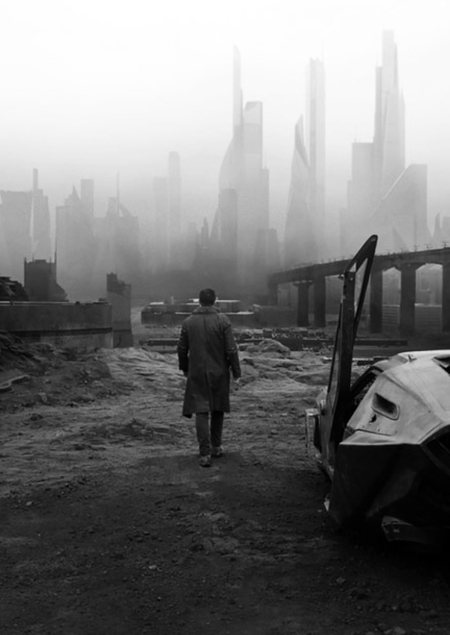
The visual research topic—analyzing the technologies used to create highly realistic digital environments in the series «Darkness» compared to the film «Blade Runner 2049"—is justified by several considerations. First, both projects share a similar artistic objective: to create dark, atmospheric spaces that the viewer perceives as real locations, even though a significant portion of them is entirely digital or augmented with computer graphics. In «Darkness,» these include underground caverns, a post-apocalyptic forest, tunnels, and expanded city streets. In «Blade Runner 2049,» these encompass the ruins of Las Vegas, colossal holographic statues, and digital urban landscapes.
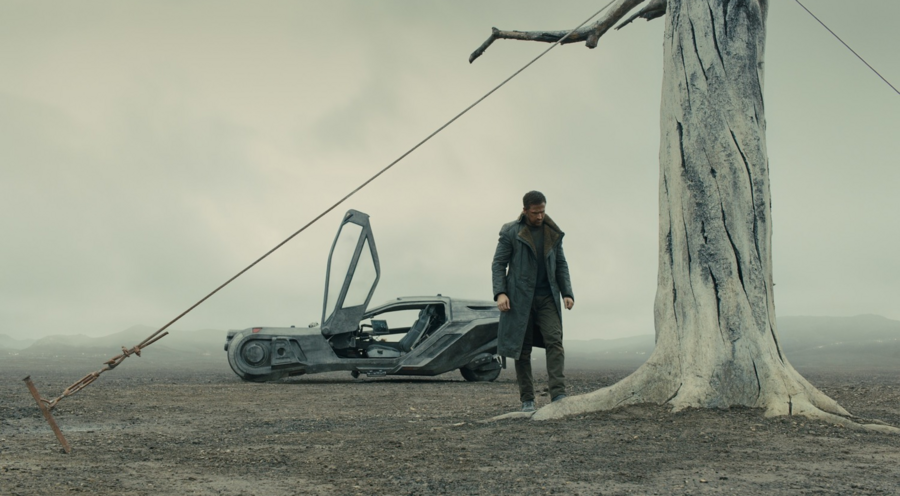
«Blade Runner 2049» (directed by Denis Villeneuve, 2017, supervised by John Nelson)
Second, the projects radically differ in budget and production capacity, which makes the comparison particularly interesting. «Dark» is a series with limited resources that still looks visually flawless. «Blade Runner 2049» is a Hollywood blockbuster with a massive team and access to any technology. Comparing how the same task is addressed at opposite poles of the industry offers the chance to understand what is truly important in creating digital environments and what is merely a consequence of a large budget. Furthermore, both projects were released almost simultaneously, which rules out the factor of technological evolution over time and allows us to speak about different approaches rather than progress.
The material for analysis consists of specific scenes from a series and a film that represent the typical methods of creating digital environments for each project.
From «Dark City,» scenes from caves, scenes in the post-apocalyptic forest, as well as scenes of the bunker expansion and the streets of Vindene are selected. The key criterion for selection is the availability of information detailing exactly how the effect was created. From «Blade Runner 2049,» scenes from the ruins of Las Vegas, scenes with holographic statues, and digital expansions of urban panoramas are selected. Atmospheric effects—fog, dust, smoke—are also subject to comparison, since in both projects they were created digitally. Thus, every selected segment has a counterpart in the other project, allowing for a meaningful comparison.
The hypothesis is as follows: when solving similar problems, technological strategies can differ dramatically depending on budget, production timelines, and available tools; however, the end result—the convincingness of the digital environment for the viewer—can be comparable.
The research is structured thematically and divided into three categories. The first is «Extending Existing Sets.» This section analyzes scenes where the digital environment completely replaces live-action photography or where a physically built set is enhanced with digital elements. The second category is «Technological Special Effects.» This includes scenes featuring high-tech objects or backgrounds, such as holograms or time machines. The third category is «Atmospheric Effects and Their Role in Compositing.» Here, we examine fog, smoke, dust, precipitation—everything that helps integrate a digital object into a natural frame—which was created digitally in both projects, albeit with varying degrees of complexity. This structure allows the focus to remain on a specific type of technological challenge and prevents the mixing of incomparable elements.
The source base is analyzed using a unified principle: specific technological descriptions are extracted from them—what software programs were used, what tracking and rendering methods were applied, and how the 3D models and textures were constructed.
I. Expanding Existing Set Designs
In the first season of «Darkness, ” the visual effects team faced an unusual challenge: creating a fully realized digital nuclear power plant. Unlike caves or forests, this subject required not merely a backdrop, but functional animation and precise engineering plausibility.
Taken from the video DARK — Season 1 | VFX Breakdown by Rise FX (2017)
Supervisor Sven Pannik’s personal achievement in the first season was the Nuclear Power Plant (NPP): «Everyone looks for typical VFX shots, like time-jump effects, but no one expects to see a fully CG power plant in the background.» The main entrance to the NPP was actually filmed at the back entrance of the Berlin Olympic Stadium—and even local residents didn’t notice. The choice of location was simply due to: «Filming near a real nuclear power plant is always a nightmare because of strict safety regulations.» [4]
Taken from the video DARK — Season 1 | VFX Breakdown by Rise FX (2017)
An unexpected problem arose with the trees. Initially, the stadium’s placement seemed perfect: the trees created a natural line separating the foreground and the CG background. However, due to shifts in the shooting schedule, the main filming was moved to winter. «There were no leaves left, and unfortunately, I lost my natural line. So, we had to replace them with CG trees.» Thus, a routine scheduling adjustment resulted in even the foreground trees becoming digital. [4]
The article describes the studio’s technological foundation: «We were one of the first companies in Europe to use Nuke for compositing. Several years later, we began using Houdini as our primary tool for animation, shading, lighting, and rendering.» [4]
Taken from the video DARK — Season 1 | VFX Breakdown by Rise FX (2017)
«Dark» (Directed by Baran bo Odar, 2017–2020, supervised by Sven Pannike)
In the second and third seasons of «Dark,» the creators faced a challenge that traditional methods could not solve: visualizing a future world where all nature had perished.
Almost all the street scenes in the fictional city of Windend were shot in real German cities (primarily in Berlin and its suburbs). However, real streets never look the way the creators of the dark time-travel thriller needed them to.
«Dark» (Directed by Baran bo Odar, 2017–2020, Supervisor Sven Pannike)
The real streets were too bright, clean, and «lively,» so the Rise Visual Effects team engaged in what is called set extension: the real streets were cleared of extraneous elements and then built up with digital backdrops—darker buildings, hazy distances, and a somber sky.
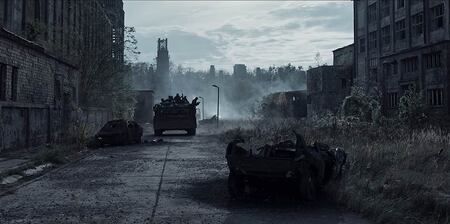
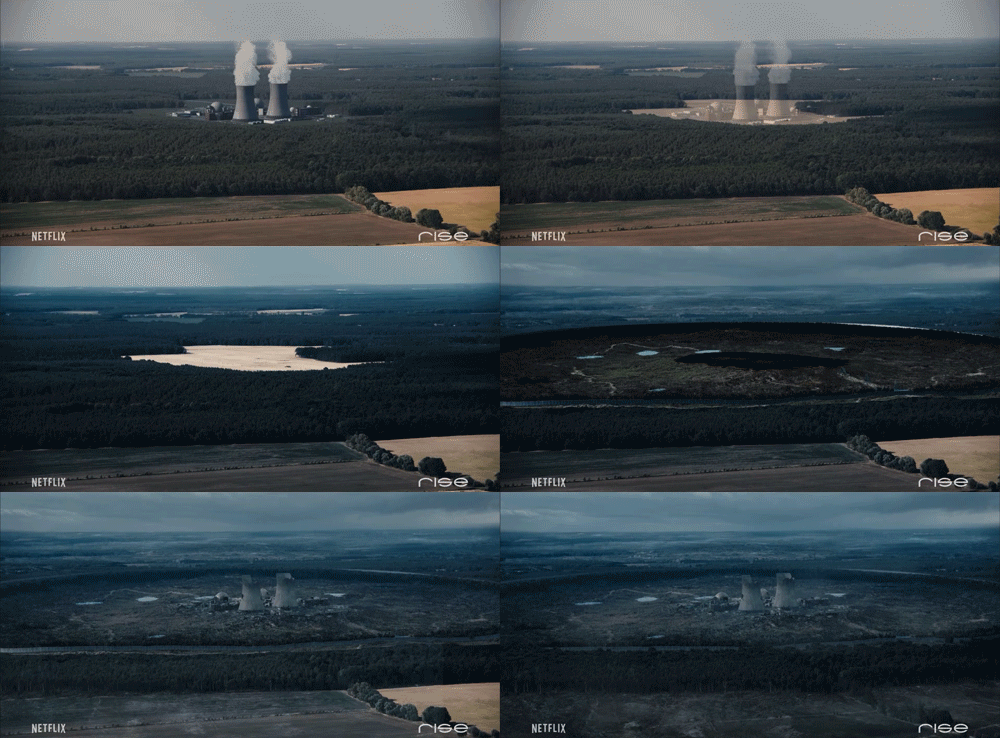
«Dark» (directed by Baran bo Odar, 2017–2020, supervised by Sven Pannicke) / Taken from the video DARK — Season 2 | VFX Breakdown by RISE (2020)
The creators of the film «Blade Runner 2049» (2017) paid special attention to building a believable image of a future metropolis. The city in the film is a bleak, neon-drenched space with oppressive architecture. The central challenge was recreating a detailed and grand-scale urban environment that serves as the backdrop for the entire action.
Creation of Los Angeles, miniature (Supervisor Gerd Neifter)
The New Zealand studio Weta Workshop organized the production of miniatures specifically for this purpose. The process unfolded as follows: first, 3D models were developed, and then real components were fabricated using laser cutting to assemble the models.
«Blade Runner 2049» (Directed by Denis Villeneuve, 2017, supervised by John Nelson)
«Blade Runner 2049» (Directed by Denis Villeneuve, 2017, Supervisor John Nelson)
In shots where the LAPD precinct was centered in the composition, physical models were utilized. CG refinement helped them achieve photorealism.
LAPD, miniature (Supervisor Gerd Neffzer)
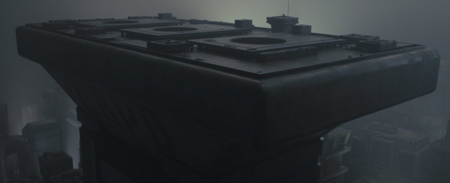
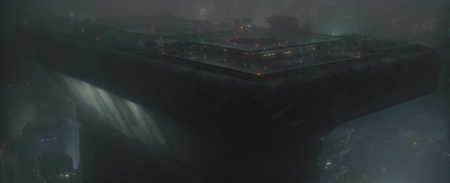
LAPD, Miniature (Supervisor Gerd Nefter)
Computer graphics also contributed to the creation of the city. All buildings were divided into three categories based on the level of detail: the foreground was occupied by gigantic structures, followed by objects with medium refinement, and in the background were placed small, barely discernible silhouettes.